Saudi Press

Saudi Arabia and the world
Wednesday, Feb 11, 2026

Ukraine war could worsen crises in Yemen and Afghanistan

Ukraine war could worsen crises in Yemen and Afghanistan

"Don't make us take food from children that are hungry to give to children that are starving," pleads the United Nations World Food Programme (WFP).

Soaring food and fuel costs, together with budget cuts in some traditional donor countries, have forced the WFP to halve the amount of food it is giving to millions of people in Yemen, Chad and Niger.

In December 2021, the UN made a record appeal for $41bn (£31bn) to help 273 million people this year.

As aid workers stress, these are not people who will be made a bit more comfortable by help from the UN. They are people, particularly children, who will probably die without it.

But that appeal was made before Russia invaded Ukraine. Both countries used to sell grain to the WFP.

Back then, Ukraine was a supplier, not a country in need of humanitarian assistance, as the WFP's Geneva director Annalisa Conte points out.

Food shortages


In the first month of the war, the WFP reached a million people inside Ukraine. But its supply of Ukrainian grain, destined to feed some of the hungriest on the planet, has dried up.

Meanwhile, many African countries, while not dependent on UN aid, import grain from Ukraine.

Somalia gets more than 60% of its grain from Ukraine and Russia, while Eritrea gets nearly 97% of its wheat from Ukraine.

They now have to bid against Europeans and North Americans on the international market in search of food.

Jan Egeland, former head of UN emergency relief and now with the Norwegian Refugee Council, describes this as a "catastrophe" for the poorest parts of the world. "They will starve," he says.

Selective aid?


This March, in the hope of reminding donors of the continued needs in Yemen and Afghanistan, the UN launched emergency "flash" appeals.
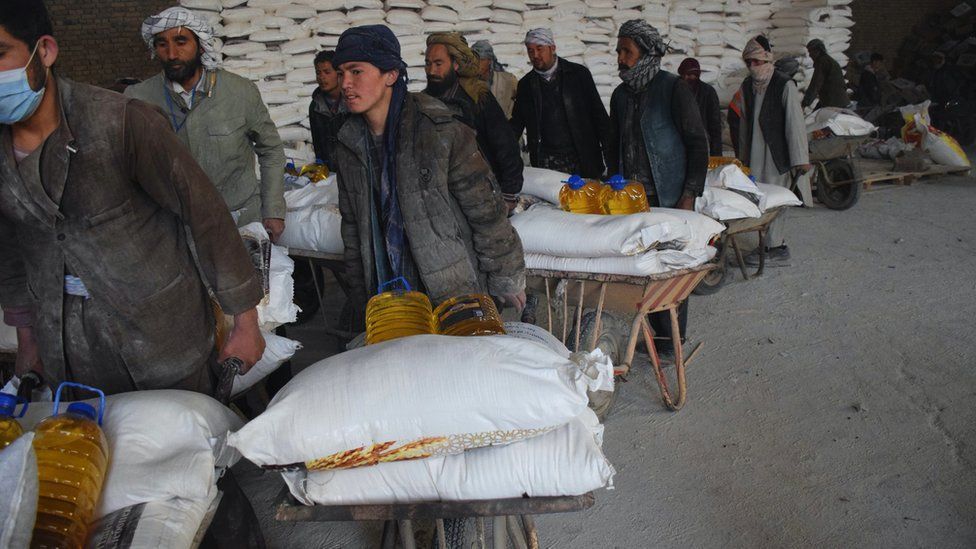
Malnutrition is on the rise in Afghanistan


UN Secretary General Antonio Guterres warned that Afghans were "selling their children, and their body parts, in order to feed their families". But the flash appeal for Afghanistan achieved about half of what the UN asked for.

A similar appeal for Yemen, which the UN says is the world's worst humanitarian crisis, got less than a third.

Although aid workers don't like to say it publicly, there is an uneasy feeling that traditional donor countries in Europe, who in recent weeks have raised record sums for Ukraine and offered tens of thousands of places in their homes for Ukrainian refugees, are being somewhat selective about who they help.

There is no question that vulnerable civilians in Ukraine "deserve all our compassion, and the outpouring of generosity that we have seen", says Robert Mardini, director general of the International Committee of the Red Cross.

But, he adds, there is a long list of unresolved conflicts elsewhere that continue to unfold day in, day out.

The crises in Afghanistan, Yemen and Syria among others have only got worse since the Ukraine war. Jan Egeland admits aid agencies feel "overstretched, underfunded, overwhelmed like never before".

Compassion for all


The generosity towards Ukrainians who have fled their homes has been welcomed by the UN Refugee Agency. But aid workers also know that until quite recently, many European countries, among them Hungary and Poland, were pushing Syrian refugees back across their borders.

More than four million people have fled Ukraine to neighbouring countries because of the Russian invasion


The refugee agency's Shabia Mantoo thinks the Ukraine war could be an opportunity for the world to come to a better understanding of what it is to be a refugee, or to be a neighbouring country, like Lebanon, Uganda or Turkey, hosting hundreds of thousands of people.

She hopes the countries now throwing their doors open to Ukrainian refugees will "extend that solidarity, that compassion to all others in a similar situation".

Tough year ahead


But even if this crisis does cause a surge in global solidarity, aid agencies know this will be a very difficult year.

The fact that Russia, a permanent, veto-wielding member of the UN Security Council, is the aggressor in this latest war will probably make the delivery of aid more complicated.

The UN needs co-operation between Russia and the West, for example, for cross-border deliveries to Syria. But this relationship is now "in the deep freeze", as Jan Egeland puts it.

Meanwhile, food and fuel prices are set to rise still further, while wealthy countries are looking to balance their books after spending tens of billions on their Covid recovery programmes.

It's a perfect storm, aid workers say, which shows once again that humanitarian aid is never a solution and usually only an inadequate sticking plaster on the gaping wound of war.

Peace is the precondition to everything else, says Annalisa Conte.

Newsletter

Related Articles

Saudi Press
0:00
0:00
Close
Prince William in Saudi Arabia on Official Three-Day Visit to Strengthen UK-Saudi Relations
Prince William Highlights Women’s Sport During High-Profile Visit to Saudi Arabia
Prince William Begins High-Profile Diplomatic Mission to Saudi Arabia
Syria and Saudi Arabia Seal Multibillion-Dollar Investment Agreements to Drive Post-War Economic Reconstruction
Apple iPhone Lockdown Mode blocks FBI data access in journalist device seizure
Foreign Governments and Corporations Spend Millions with Trump-Linked Lobbying Firm in Washington
KPMG Urges Auditor to Relay AI Cost Savings
Saudi Arabia Quietly Allows Wealthy Foreign Residents to Buy Alcohol, Signalling Policy Shift
US and Iran to Begin Nuclear Talks in Oman
China unveils plans for a 'Death Star' capable of launching missile strikes from space
Investigation Launched at Winter Olympics Over Ski Jumpers Injecting Hyaluronic Acid
U.S. State Department Issues Urgent Travel Warning for Citizens to Leave Iran Immediately
Wall Street Erases All Gains of 2026; Bitcoin Plummets 14% to $63,000
Eighty-one-year-old man in the United States fatally shoots Uber driver after scam threat
German Chancellor Friedrich Merz Begins Strategic Gulf Tour with Saudi Arabia Visit
Dubai Awards Tunnel Contract for Dubai Loop as Boring Company Plans Pilot Network
Five Key Takeaways From President Erdoğan’s Strategic Visit to Saudi Arabia
AI Invented “Hot Springs” — Tourists Arrived and Were Shocked
Erdoğan’s Saudi Arabia Visit Focuses on Trade, Investment and Strategic Cooperation
Germany and Saudi Arabia Move to Deepen Energy Cooperation Amid Global Transition
Saudi Aviation Records Historic Passenger Traffic in 2025 and Sets Sights on Further Growth in 2026
Tech Market Shifts and AI Investment Surge Drive Global Innovation and Layoffs
Global Shifts in War, Trade, Energy and Security Mark Major International Developments
Tesla Ends Model S and X Production and Sends $2 Billion to xAI as 2025 Revenue Declines
The AI Hiring Doom Loop — Algorithmic Recruiting Filters Out Top Talent and Rewards Average or Fake Candidates
Federal Reserve Holds Interest Rate at 3.75% as Powell Faces DOJ Criminal Investigation During 2026 Decision
Putin’s Four-Year Ukraine Invasion Cost: Russia’s Mass Casualty Attrition and the Donbas Security-Guarantee Tradeoff
Saudi Crown Prince Tells Iranian President: Kingdom Will Not Host Attacks Against Iran
U.S. Central Command Announces Regional Air Exercise as Iran Unveils Drone Carrier Footage
Trump Defends Saudi Crown Prince in Heated Exchange After Reporter Questions Khashoggi Murder and 9/11 Links
Saudi Stocks Rally as Kingdom Prepares to Fully Open Capital Market to Global Investors
Air France and KLM Suspend Multiple Middle East Routes as Regional Tensions Disrupt Aviation
Saudi Arabia scales back Neom as The Line is redesigned and Trojena downsized
Saudi Industrial Group Completes One Point Three Billion Dollar Acquisition of South Africa’s Barloworld
Saudi-Backed LIV Golf Confirms Return to Trump National Bedminster for 2026 Season
Gold Jumps More Than 8% in a Week as the Dollar Slides Amid Greenland Tariff Dispute
Boston Dynamics Atlas humanoid robot and LG CLOiD home robot: the platform lock-in fight to control Physical AI
United States under President Donald Trump completes withdrawal from the World Health Organization: health sovereignty versus global outbreak early-warning access
Trump Administration’s Iran Military Buildup and Sanctions Campaign Puts Deterrence Credibility on the Line
Tech Brief: AI Compute, Chips, and Platform Power Moves Driving Today’s Market Narrative
NATO’s Stress Test Under Trump: Alliance Credibility, Burden-Sharing, and the Fight Over Strategic Territory
Saudi Arabia’s Careful Balancing Act in Relations with Israel Amid Regional and Domestic Pressures
Greenland, Gaza, and Global Leverage: Today’s 10 Power Stories Shaping Markets and Security
America’s Venezuela Oil Grip Meets China’s Demand: Market Power, Legal Shockwaves, and the New Rules of Energy Leverage
Trump’s Board of Peace: Breakthrough Diplomacy or a Hostile Takeover of Global Order?
Prince William to Make Official Visit to Saudi Arabia in February
Saudi Arabia Advances Ambitious Artificial River Mega-Project to Transform Water Security
Saudi Crown Prince and Syrian President Discuss Stabilisation, Reconstruction and Regional Ties in Riyadh Talks
Mohammed bin Salman Confronts the ‘Iranian Moment’ as Saudi Leadership Faces Regional Test
Cybercrime, Inc.: When Crime Becomes an Economy. How the World Accidentally Built a Twenty-Trillion-Dollar Criminal Economy
×