
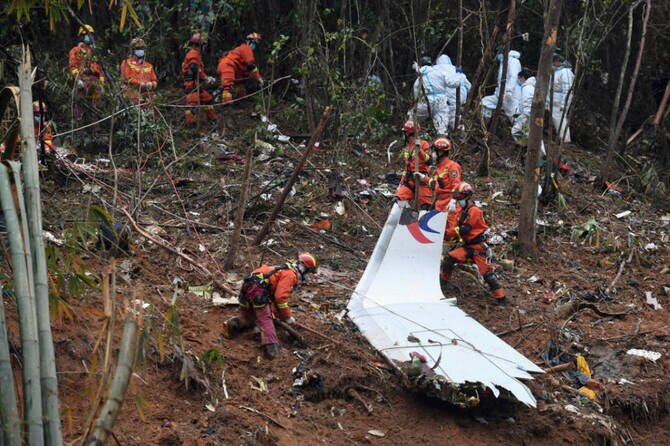
2022 China Plane Crash: Cockpit Struggle and Engine Shut-off Before Impact
Newly released data by the NTSB suggests cockpit struggle and intentional fuel cut before the crash.
In a shocking revelation, newly released data from the National Transportation Safety Board (NTSB) indicates that both engines of a China Eastern Airlines jet were shut off and there was a struggle in the cockpit before the plane crashed into a mountain in 2022.
The incident resulted in the tragic loss of all 132 people aboard.
The NTSB became involved in the investigation due to the American-made Boeing 737-800 aircraft and engines.
This involvement stems from international cooperation and the recognition of US investigators as world-leading experts in analyzing crash data.
The NTSB's report, released recently, provides insights into the events leading up to the crash.
According to the data, the fuel supply to both engines was deliberately cut off, leading to a nosedive and a 360-degree roll of the plane.
However, the exact cause remains unclear as the Civil Aviation Administration of China has yet to release its final report four years after the incident.
International standards typically require crash reports to be released within a year.
Safety experts agree that the data points towards someone deliberately moving the fuel levers into the cutoff position.
The Boeing 737's design means that shutting off the engines requires intentional action, suggesting no accidental or technical malfunction.
The NTSB report details the events leading up to the crash, including a struggle in the cockpit.
However, it does not include a transcript of the cockpit voice recorder conversations, which could shed further light on what happened.
The NTSB is awaiting Chinese authorities to release these details.
The findings have reignited concerns about pilot mental health and the reluctance of pilots to seek help due to potential career repercussions.
Several incidents have highlighted this issue, including a Germanwings crash in 2015, believed to be caused by the actions of one of the pilots.
The plane was en route from Kunming to Guangzhou when it entered a nosedive at approximately 29,000 feet and later crashed into the mountain, creating a 20-meter crater and igniting a forest fire.
The crew had reported no issues before losing contact with air traffic control, and Chinese investigators initially found no abnormalities.
This incident represents a rare failure for China's airline industry, which has significantly improved safety following deadly crashes in the 1990s.
The incident resulted in the tragic loss of all 132 people aboard.
The NTSB became involved in the investigation due to the American-made Boeing 737-800 aircraft and engines.
This involvement stems from international cooperation and the recognition of US investigators as world-leading experts in analyzing crash data.
The NTSB's report, released recently, provides insights into the events leading up to the crash.
According to the data, the fuel supply to both engines was deliberately cut off, leading to a nosedive and a 360-degree roll of the plane.
However, the exact cause remains unclear as the Civil Aviation Administration of China has yet to release its final report four years after the incident.
International standards typically require crash reports to be released within a year.
Safety experts agree that the data points towards someone deliberately moving the fuel levers into the cutoff position.
The Boeing 737's design means that shutting off the engines requires intentional action, suggesting no accidental or technical malfunction.
The NTSB report details the events leading up to the crash, including a struggle in the cockpit.
However, it does not include a transcript of the cockpit voice recorder conversations, which could shed further light on what happened.
The NTSB is awaiting Chinese authorities to release these details.
The findings have reignited concerns about pilot mental health and the reluctance of pilots to seek help due to potential career repercussions.
Several incidents have highlighted this issue, including a Germanwings crash in 2015, believed to be caused by the actions of one of the pilots.
The plane was en route from Kunming to Guangzhou when it entered a nosedive at approximately 29,000 feet and later crashed into the mountain, creating a 20-meter crater and igniting a forest fire.
The crew had reported no issues before losing contact with air traffic control, and Chinese investigators initially found no abnormalities.
This incident represents a rare failure for China's airline industry, which has significantly improved safety following deadly crashes in the 1990s.