German Chancellor Olaf Scholz's Tough Balancing Act: Strengthening Economic Ties with China Amidst Geopolitical Pressure
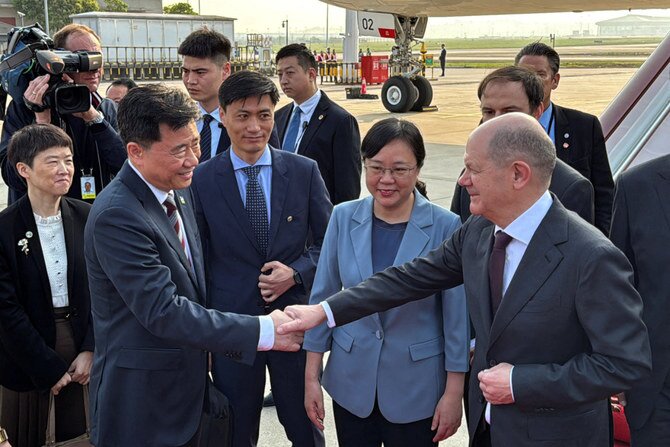
German Chancellor Olaf Scholz began a trip to China on Sunday, leading a large delegation of ministers and business executives.
Scholz aims to strengthen economic ties with China, Berlin's largest trading partner, despite pressure from Western allies to reduce dependence on the world's second-largest economy.
Scholz is expected to emphasize Germany's commitment to doing business with China and reject calls for "decoupling" from the US.
His friendly approach towards China may draw criticism from Washington and EU partners, who are concerned about Beijing's heavy subsidies for industries.
German Chancellor Olaf Scholz is currently on a three-day visit to China, emphasizing the economic importance of the partnership between the two countries.
He plans to advocate for fair business conditions for German companies in China.
Additionally, Scholz aims to persuade Chinese President Xi Jinping to use his influence to help end the war in Ukraine by pressuring Russian President Vladimir Putin.
Given China's close relationship with Russia, the German government source believes Beijing has the power to impact Russia's actions.
Scholz's visit is his second since taking office, following his first trip in November 2022, which occurred under intense scrutiny after Xi's power consolidation and marked the first post-pandemic visit by a G7 leader to China.
Germany's Chancellor Olaf Scholz visited China amidst growing tensions between Western allies and Beijing over supply chain disruptions during the health crisis, China's relationship with Russia, and ongoing investigations into Chinese subsidies for solar panels, electric cars, and wind turbines in Europe and national security risks posed by Chinese technology in cars in the US.
Additionally, tensions have escalated over Taiwan, with the US making defense pledges to Japan and the Philippines and describing China's behavior in the South China Sea as "dangerous and aggressive." German Chancellor Olaf Scholz held talks with French President Emmanuel Macron before his visit to China, aiming to defend a rebalancing of European-Chinese trade relations.
However, China is a crucial market for Germany, with many jobs dependent on Chinese demand.
Both economies are in need of a boost, as Germany's economy shrank by 0.3% last year and is expected to grow only anaemically this year, while China set a five percent GDP growth target but experienced unexpected export declines.
German politicians and analysts urged Scholz to take a firm stance against China, with the Green party's Deborah Duering cautioning against viewing China solely as an economic opportunity.
Duering warned against disregarding potential long-term risks for immediate gains in Germany's Russia policy, citing past reliance on Moscow for affordable energy supplies.
Zenglein from the Mercator Institute for China Studies urged Germany to be more assertive in light of other countries' tougher stances against China.
He emphasized Germany's strength and its significant role in counterbalancing China's influence.
Scholz is expected to emphasize Germany's commitment to doing business with China and reject calls for "decoupling" from the US.
His friendly approach towards China may draw criticism from Washington and EU partners, who are concerned about Beijing's heavy subsidies for industries.
German Chancellor Olaf Scholz is currently on a three-day visit to China, emphasizing the economic importance of the partnership between the two countries.
He plans to advocate for fair business conditions for German companies in China.
Additionally, Scholz aims to persuade Chinese President Xi Jinping to use his influence to help end the war in Ukraine by pressuring Russian President Vladimir Putin.
Given China's close relationship with Russia, the German government source believes Beijing has the power to impact Russia's actions.
Scholz's visit is his second since taking office, following his first trip in November 2022, which occurred under intense scrutiny after Xi's power consolidation and marked the first post-pandemic visit by a G7 leader to China.
Germany's Chancellor Olaf Scholz visited China amidst growing tensions between Western allies and Beijing over supply chain disruptions during the health crisis, China's relationship with Russia, and ongoing investigations into Chinese subsidies for solar panels, electric cars, and wind turbines in Europe and national security risks posed by Chinese technology in cars in the US.
Additionally, tensions have escalated over Taiwan, with the US making defense pledges to Japan and the Philippines and describing China's behavior in the South China Sea as "dangerous and aggressive." German Chancellor Olaf Scholz held talks with French President Emmanuel Macron before his visit to China, aiming to defend a rebalancing of European-Chinese trade relations.
However, China is a crucial market for Germany, with many jobs dependent on Chinese demand.
Both economies are in need of a boost, as Germany's economy shrank by 0.3% last year and is expected to grow only anaemically this year, while China set a five percent GDP growth target but experienced unexpected export declines.
German politicians and analysts urged Scholz to take a firm stance against China, with the Green party's Deborah Duering cautioning against viewing China solely as an economic opportunity.
Duering warned against disregarding potential long-term risks for immediate gains in Germany's Russia policy, citing past reliance on Moscow for affordable energy supplies.
Zenglein from the Mercator Institute for China Studies urged Germany to be more assertive in light of other countries' tougher stances against China.
He emphasized Germany's strength and its significant role in counterbalancing China's influence.
Translation:
•
Translated by AI