Turkey Signals Interest in Closer Defence Alignment With Saudi-Pakistan Security Framework
Ankara’s outreach fuels debate over a possible new Muslim-majority defence bloc, though officials stress talks remain exploratory
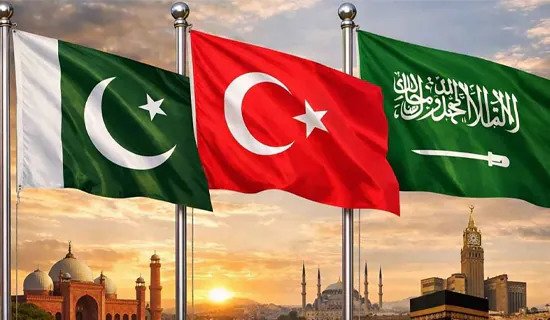
Turkey has taken preliminary steps toward closer defence coordination with a Saudi Arabia–Pakistan security framework, prompting renewed discussion among analysts about whether a broader multilateral alignment could eventually emerge.
Officials familiar with the contacts describe them as exploratory and focused on cooperation rather than formal membership, underscoring that no binding treaty or collective defence obligation has been announced.
Recent diplomatic exchanges have centred on intelligence sharing, joint exercises, defence industrial collaboration and regional security consultations.
Saudi Arabia and Pakistan, long-standing defence partners, have expanded military cooperation in recent years through training programmes and coordinated planning, creating a platform that other countries have shown interest in engaging with on a case-by-case basis.
Turkey’s outreach reflects its interest in deepening ties with key regional powers while preserving strategic autonomy.
Government sources in Ankara emphasise that the discussions are pragmatic and incremental, aimed at interoperability and crisis coordination rather than the creation of a formal alliance.
Saudi and Pakistani officials have similarly framed the dialogue as open and inclusive, focused on stability, counterterrorism and maritime security.
No timeline or accession process has been disclosed, and participants stress that any future steps would be consensus-based.
The notion of an “Islamic NATO” has circulated in commentary, but policymakers involved in the talks have avoided such labels, noting the absence of a charter, mutual defence clause or unified command.
Instead, they point to flexible cooperation mechanisms that allow partners to align on specific security priorities without compromising national decision-making.
Observers say Turkey’s engagement highlights shifting regional dynamics and a preference for modular security arrangements.
Whether the consultations mature into a standing framework will depend on political will, threat perceptions and the ability to balance cooperation with existing alliances and partnerships.
Officials familiar with the contacts describe them as exploratory and focused on cooperation rather than formal membership, underscoring that no binding treaty or collective defence obligation has been announced.
Recent diplomatic exchanges have centred on intelligence sharing, joint exercises, defence industrial collaboration and regional security consultations.
Saudi Arabia and Pakistan, long-standing defence partners, have expanded military cooperation in recent years through training programmes and coordinated planning, creating a platform that other countries have shown interest in engaging with on a case-by-case basis.
Turkey’s outreach reflects its interest in deepening ties with key regional powers while preserving strategic autonomy.
Government sources in Ankara emphasise that the discussions are pragmatic and incremental, aimed at interoperability and crisis coordination rather than the creation of a formal alliance.
Saudi and Pakistani officials have similarly framed the dialogue as open and inclusive, focused on stability, counterterrorism and maritime security.
No timeline or accession process has been disclosed, and participants stress that any future steps would be consensus-based.
The notion of an “Islamic NATO” has circulated in commentary, but policymakers involved in the talks have avoided such labels, noting the absence of a charter, mutual defence clause or unified command.
Instead, they point to flexible cooperation mechanisms that allow partners to align on specific security priorities without compromising national decision-making.
Observers say Turkey’s engagement highlights shifting regional dynamics and a preference for modular security arrangements.
Whether the consultations mature into a standing framework will depend on political will, threat perceptions and the ability to balance cooperation with existing alliances and partnerships.