

Shireen Abu Akleh and the journalists killed by Israeli forces
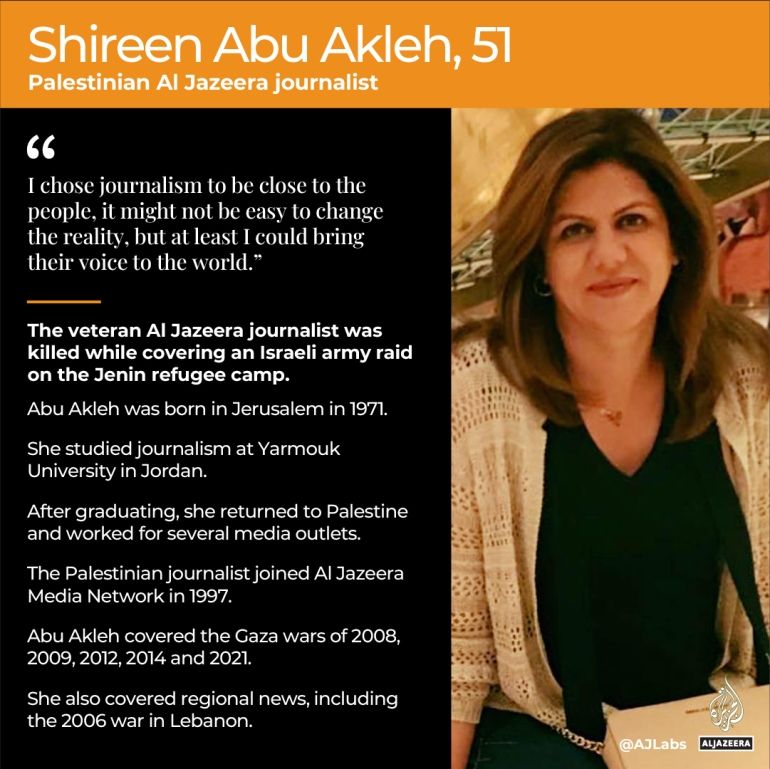
Al Jazeera journalist Shireen Abu Akleh was killed on May 11 by Israeli forces in Jenin, in the occupied West Bank.
The 51-year-old Palestinian-American TV correspondent for Al Jazeera Arabic was wearing a protective vest marked with “PRESS” and standing with other journalists when she was shot dead.
Another Palestinian journalist, Ali al-Samoudi, was shot in the back and is in a stable condition.
Abu Akleh’s death is the latest in a long line of journalists killed by the Israeli military, which has a long history of targeting reporters and other members of the media.
At least 45 journalists have been killed by Israeli forces since 2000, according to the Palestinian Ministry of Information.
The Palestinian Journalists’ Union places the death toll higher at 55 killed.
The following is a short summary of those who have been killed covering the conflict in Palestine.
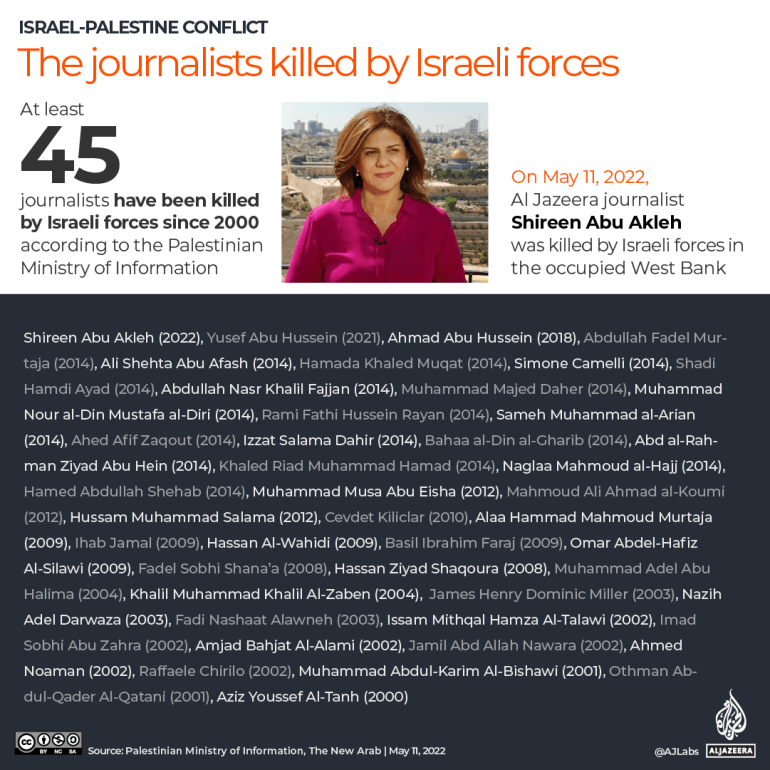
Last year, during Israel’s most recent assault on Gaza in May 2021, an Israeli air raid killed Yusef Abu Hussein, a broadcaster for the local Voice of Al-Aqsa radio station. The air raid targeted his home in the besieged Gaza Strip, family and colleagues said.
At least 260 Palestinians were killed during the 11-day bombardment that lasted from May 10 to May 21.
Midway through the sustained attack, on May 15, the building housing the offices of Al Jazeera and other media organisations was destroyed in an Israeli attack.
Al Jazeera condemned the attack on its offices and called on “all media and human rights institutions to join forces” in denouncing the bombing and to “hold the government of Israel accountable”.
Yet the killing of journalists by Israeli forces continues.
2018: Two journalists killed in one week
In April 2018, two Palestinian journalists were shot and killed by Israeli forces in one week.
Ahmad Abu Hussein was shot by Israeli forces while covering a mass demonstration along the Gaza border. The 24-year-old, who was shot in the abdomen during a protest near Jebaliya on April 13, died of his wounds. According to witnesses, Hussein, a photographer for the Gaza-based Voice of the People radio station, was also wearing a protective vest marked “PRESS” at the time he was shot.
Days earlier, Yaser Murtaja, a photographer with the Gaza-based Ain Media agency, died on April 7 as a result of gunshot wounds inflicted by Israeli forces the previous day. Murtaja, 30, was hit in the stomach despite also wearing a blue flak jacket marked with the word “PRESS” while covering a protest in Khuza’a in the south of the Gaza Strip.
2014: Deadliest year for journalists in Palestine
Israel waged its deadliest assault on Gaza from July 8 to August 26, 2014. The assault killed at least 2,100 people and injured more than 11,000 others in Gaza.
That year was also the deadliest for journalists in Palestine.
At least 17 journalists were killed in 2014, according to the Palestinian Ministry of Information.
Those killed included: Abdullah Fadel Murtaja, Ali Shehta Abu Afash, Hamada Khaled Muqat, Simone Camelli, Shadi Hamdi Ayad, Abdullah Nasr Khalil Fajjan, Muhammad Majed Daher, Muhammad Nour al-Din Mustafa al-Diri, Rami Fathi Hussein Rayan, Sameh Muhammad al-Arian, Ahed Afif Zaqout, Izzat Salama Dahir, Bahaa al-Din al-Gharib, Abd al-Rahman Ziyad Abu Hein, Khaled Riad Muhammad Hamad, Naglaa Mahmoud al-Hajj, Hamed Abdullah Shehab.
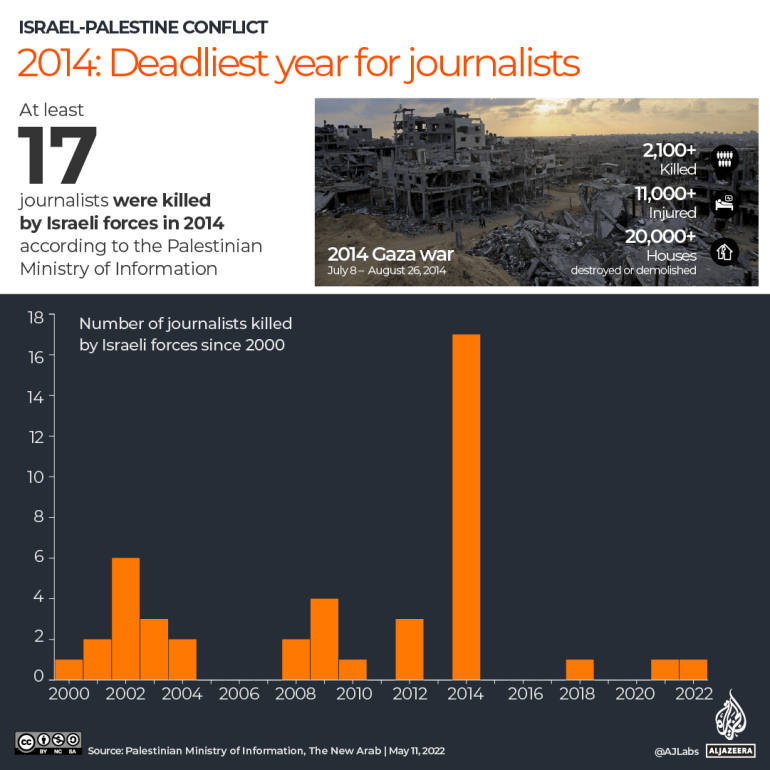
2000-2012: At least 25 journalists killed
From the start of the Second Intifada in 2000 to 2012 at least 25 other journalists were killed by Israeli forces.
Those killed included: Muhammad Musa Abu Eisha (2012), Mahmoud Ali Ahmad al-Koumi (2012), Hussam Muhammad Salama (2012), Cevdet Kiliclar (2010), Alaa Hammad Mahmoud Murtaja (2009), Ihab Jamal (2009), Hassan Al-Wahidi (2009), Basil Ibrahim Faraj (2009), Omar Abdel-Hafiz Al-Silawi (2009), Fadel Sobhi Shana’a (2008), Hassan Ziyad Shaqoura (2008), Muhammad Adel Abu Halima (2004), Khalil Muhammad Khalil Al-Zaben (2004), James Henry Dominic Miller (2003), Nazih Adel Darwaza (2003), Fadi Nashaat Alawneh (2003), Issam Mithqal Hamza Al-Talawi (2002), Imad Sobhi Abu Zahra (2002), Amjad Bahjat Al-Alami (2002), Jamil Abd Allah Nawara (2002), Ahmed Noaman (2002), Raffaele Chirilo (2002), Muhammad Abdul-Karim Al-Bishawi (2001), Othman Abdul-Qader Al-Qatani (2001), Aziz Youssef Al-Tanh (2000).
Israel’s lack of accountability
The killing of Abu Akleh again places a spotlight on the lack of accountability when it comes to deadly Israeli attacks against journalists and media workers.
Israel has offered to conduct a joint investigation into Abu Akleh’s killing with Palestinian authorities, a proposal which Palestinian authorities have rejected.
Israel’s track record in conducting such investigations has been described as “mechanisms” for whitewashing.
Speaking to Al Jazeera on Wednesday, Omar Shakir, Israel and Palestine director for Human Rights Watch, said Israel cannot be trusted to hold those responsible accountable.
“The reality is there is no accountability for those sorts of abuses when it comes to actions by the Israeli authorities,” Shakir said.
The EU, US, and UN, as well as other governments and international organisations, have now called for a full, independent, and impartial investigation into the killing of Abu Akleh – the latest journalist to be killed covering Palestine.