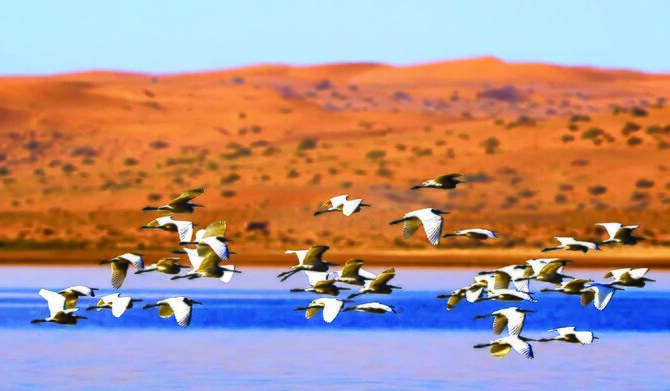
World Migratory Bird Day: Saudi Arabia Strengthens Role as Vital Refuge
Saudi Arabia plays a crucial role in the conservation of migratory bird species, ensuring critical habitats and resources that sustain long-distance journeys.
Riyadh: As millions of birds cross continents each year, navigating vast distances between breeding and wintering grounds, Saudi Arabia continues to serve as a critical point on their journey — a safe haven for migratory species.
At the center of this effort lies the Imam Turki bin Abdullah Royal Reserve, one of Saudi Arabia’s largest and most ecologically significant protected areas.
Spanning nearly 91,500 square kilometers, the reserve is home to rich biodiversity, hosting 184 recorded bird species — more than a third of Saudi Arabia’s avian diversity.
The reserve serves as a key stopover point for migratory birds, providing essential habitats and resources that sustain them during their long journeys.
The reserve also plays an active role in protecting endangered wildlife.
Among its most notable efforts are breeding programs for species including the red-necked ostrich, alongside yet-to-be-launched initiatives focused on conserving the houbara bustard.
"This unique reserve embodies Saudi Arabia’s commitment to protecting biodiversity and preserving vital ecosystems for both resident and migratory species.’’ A.M., a representative from the reserve, told Arab News.
The reserve’s conservation strategy is rooted in carefully designed ecological systems that support migratory birds along their routes.
Natural water sources located along migration paths provide essential hydration during long flights, while protected vegetation enhances food availability by supporting insects and seeds.
Strict enforcement of hunting bans also reduces direct threats and improves survival rates.
HIGHLIGHT: Saudi Arabia aims to protect 30 percent of its land and marine areas, while continuing to expand research and monitoring programs.
Inside the reserve, all bird species, both migratory and resident, are monitored and protected through a combination of field observation, modern technology and habitat management.
Conservation work also extends to restoring ecological balance through breeding and reintroduction programs.
Under Vision 2030, environmental protection has become a national priority.
The Kingdom lies along the African-Eurasian flyway, one of the world’s most critical migration routes, placing it at the center of global bird movement.
Saudi Arabia received leadership awards in 2024 and 2026 from the Convention on the Conservation of Migratory Species, highlighting its role in combating illegal hunting and wildlife trafficking.
Despite progress, migratory birds continue to face modern challenges such as electrocution from power lines.
In response, authorities are installing insulation in key areas, including major reserves and coastal habitats.
Additional protections include hunting bans along coastal zones and near wetlands, ensuring safer environments for birds during critical stages of their journeys.
The NCW also emphasizes the role of public awareness in conservation efforts.
Looking ahead, Saudi Arabia aims to protect 30 percent of its land and marine areas, while continuing to expand research and monitoring programs.
As World Migratory Bird Day shines a spotlight on the importance of protecting migratory species, Saudi Arabia’s expanding network of reserves, policies, and partnerships reflects a growing commitment to safeguarding some of nature’s most remarkable journeys.
At the center of this effort lies the Imam Turki bin Abdullah Royal Reserve, one of Saudi Arabia’s largest and most ecologically significant protected areas.
Spanning nearly 91,500 square kilometers, the reserve is home to rich biodiversity, hosting 184 recorded bird species — more than a third of Saudi Arabia’s avian diversity.
The reserve serves as a key stopover point for migratory birds, providing essential habitats and resources that sustain them during their long journeys.
The reserve also plays an active role in protecting endangered wildlife.
Among its most notable efforts are breeding programs for species including the red-necked ostrich, alongside yet-to-be-launched initiatives focused on conserving the houbara bustard.
"This unique reserve embodies Saudi Arabia’s commitment to protecting biodiversity and preserving vital ecosystems for both resident and migratory species.’’ A.M., a representative from the reserve, told Arab News.
The reserve’s conservation strategy is rooted in carefully designed ecological systems that support migratory birds along their routes.
Natural water sources located along migration paths provide essential hydration during long flights, while protected vegetation enhances food availability by supporting insects and seeds.
Strict enforcement of hunting bans also reduces direct threats and improves survival rates.
HIGHLIGHT: Saudi Arabia aims to protect 30 percent of its land and marine areas, while continuing to expand research and monitoring programs.
Inside the reserve, all bird species, both migratory and resident, are monitored and protected through a combination of field observation, modern technology and habitat management.
Conservation work also extends to restoring ecological balance through breeding and reintroduction programs.
Under Vision 2030, environmental protection has become a national priority.
The Kingdom lies along the African-Eurasian flyway, one of the world’s most critical migration routes, placing it at the center of global bird movement.
Saudi Arabia received leadership awards in 2024 and 2026 from the Convention on the Conservation of Migratory Species, highlighting its role in combating illegal hunting and wildlife trafficking.
Despite progress, migratory birds continue to face modern challenges such as electrocution from power lines.
In response, authorities are installing insulation in key areas, including major reserves and coastal habitats.
Additional protections include hunting bans along coastal zones and near wetlands, ensuring safer environments for birds during critical stages of their journeys.
The NCW also emphasizes the role of public awareness in conservation efforts.
Looking ahead, Saudi Arabia aims to protect 30 percent of its land and marine areas, while continuing to expand research and monitoring programs.
As World Migratory Bird Day shines a spotlight on the importance of protecting migratory species, Saudi Arabia’s expanding network of reserves, policies, and partnerships reflects a growing commitment to safeguarding some of nature’s most remarkable journeys.