US, Iran Clash at UN Over Nuclear Program and Non-Proliferation Role
The United States and Iran argue over Tehran's nuclear program and its selection as a vice president at the nuclear Non-Proliferation Treaty review conference.
At the United Nations on Monday, tensions escalated between the United States and Iran regarding Tehran's nuclear program and its designation as one of the dozens of vice presidents for the month-long conference reviewing the Nuclear Non-Proliferation Treaty (NPT).
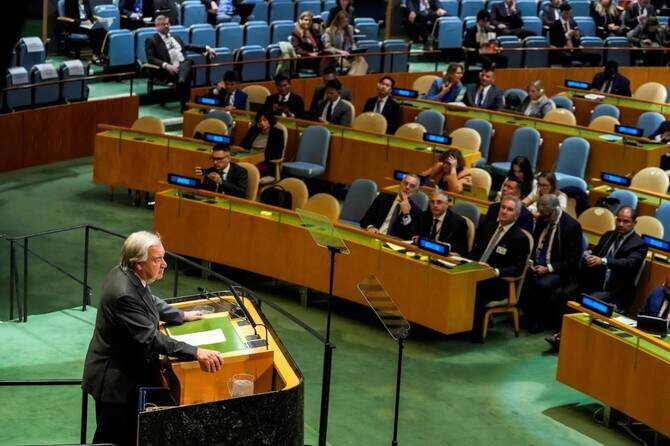
The 11th NPT review conference began on Monday at the UN headquarters in New York.
Out of 34 nominations for conference vice presidents, Iran was selected by 'the group of non-aligned and other states,' as announced by Vietnam's UN ambassador, Do Hung Viet.
Christopher Yeaw, an assistant secretary from the US Bureau of Arms Control and Nonproliferation, criticized Iran's selection, describing it as an "affront" to the NPT.
He highlighted that it is "indisputable" that Iran has consistently shown its disregard for the non-proliferation commitments outlined in the treaty.
Furthermore, Yeaw accused Iran of refusing to cooperate with the International Atomic Energy Agency (IAEA) to address questions surrounding its nuclear program, deeming this selection "beyond shameful and an embarrassment to the credibility of this conference".
Reza Najafi, Tehran's ambassador to the IAEA, dismissed the US statement as "baseless and politically motivated".
He argued that it is "indefensible" for the United States, given its history as the only nuclear power to have used nuclear weapons and its ongoing expansion and modernization of its nuclear arsenal, to position itself as an arbitrator on compliance issues.
The dispute over Iran's nuclear program has been a central issue in the ongoing conflict between Iran, the United States, and Israel.
On Sunday, US President Donald Trump reiterated that Iran could never be allowed to possess nuclear weapons.
In response, Iran has insisted on its right to enrich uranium for peaceful purposes but acknowledges concerns from Western powers about potential military applications.
Separately, Iranian sources revealed a new proposal by Tehran aimed at ending the conflict, which suggests setting aside discussions of Iran's nuclear program until after the war and disputes over shipping in the Gulf are resolved.
On Monday, Trump and his top national security advisors met to discuss the situation.
White House spokeswoman Karoline Leavitt confirmed that the president's red lines regarding Iran have been clearly communicated to both the American public and the Iranian government.
The US-Iranian clash at the UN highlights the ongoing geopolitical tensions surrounding Iran's nuclear program, with both nations presenting opposing viewpoints on the issue within the framework of the NPT review conference.
The 11th NPT review conference began on Monday at the UN headquarters in New York.
Out of 34 nominations for conference vice presidents, Iran was selected by 'the group of non-aligned and other states,' as announced by Vietnam's UN ambassador, Do Hung Viet.
Christopher Yeaw, an assistant secretary from the US Bureau of Arms Control and Nonproliferation, criticized Iran's selection, describing it as an "affront" to the NPT.
He highlighted that it is "indisputable" that Iran has consistently shown its disregard for the non-proliferation commitments outlined in the treaty.
Furthermore, Yeaw accused Iran of refusing to cooperate with the International Atomic Energy Agency (IAEA) to address questions surrounding its nuclear program, deeming this selection "beyond shameful and an embarrassment to the credibility of this conference".
Reza Najafi, Tehran's ambassador to the IAEA, dismissed the US statement as "baseless and politically motivated".
He argued that it is "indefensible" for the United States, given its history as the only nuclear power to have used nuclear weapons and its ongoing expansion and modernization of its nuclear arsenal, to position itself as an arbitrator on compliance issues.
The dispute over Iran's nuclear program has been a central issue in the ongoing conflict between Iran, the United States, and Israel.
On Sunday, US President Donald Trump reiterated that Iran could never be allowed to possess nuclear weapons.
In response, Iran has insisted on its right to enrich uranium for peaceful purposes but acknowledges concerns from Western powers about potential military applications.
Separately, Iranian sources revealed a new proposal by Tehran aimed at ending the conflict, which suggests setting aside discussions of Iran's nuclear program until after the war and disputes over shipping in the Gulf are resolved.
On Monday, Trump and his top national security advisors met to discuss the situation.
White House spokeswoman Karoline Leavitt confirmed that the president's red lines regarding Iran have been clearly communicated to both the American public and the Iranian government.
The US-Iranian clash at the UN highlights the ongoing geopolitical tensions surrounding Iran's nuclear program, with both nations presenting opposing viewpoints on the issue within the framework of the NPT review conference.