Billionaire Tax Proposal in California Qualifies for November Ballot, Backers Claim
A proposal to temporarily increase taxes on billionaires in California has reportedly secured enough signatures to qualify for the November ballot.
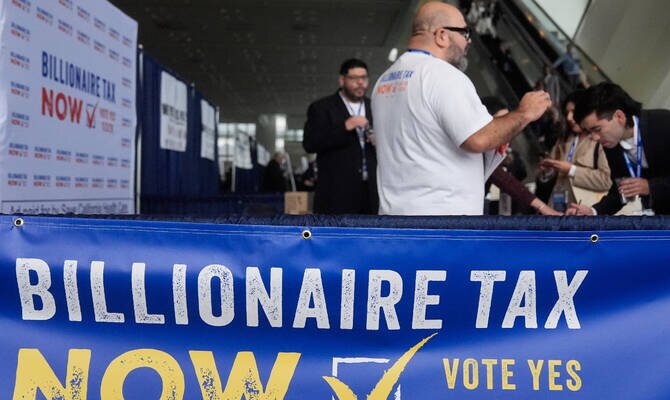
Sacramento, California: A contentious measure aiming to impose a temporary tax hike on Californian billionaires is set to appear on the November ballot, according to a labor union supporting the initiative.
The Service Employees International Union Healthcare Workers West claims to have gathered over 1.5 million signatures for the proposal, exceeding the necessary threshold of approximately 875,000 required for qualification.
The proposed tax, which would apply to individuals with a net worth surpassing $1 billion and who were residents of the state as of January 1, 2026, entails a one-time, 5 percent levy.
The primary objective is to raise an estimated $100 billion in revenue to mitigate federal funding reductions for healthcare services catering to low-income individuals.
Liz Perlman, executive director of a chapter of the American Federation of State, County and Municipal Employees, emphasized that California's health stands at risk due to hospital closures and resultant fatalities.
The statement accuses billionaires of not requiring additional tax cuts.
The verification process by the California Secretary of State is yet to finalize the measure's placement on the ballot.
Although the exact cost per signature varies, it typically hovers around $15 per signature, considering the reimbursement practice for petition circulators.
If approved by voters in November, this initiative may spark one of the most expensive electoral battles in history and serve as a benchmark of public sentiment regarding wealth taxation.
Already, significant funds have been raised to oppose the tax, leading to measures intended to invalidate it.
Meanwhile, Vermont Senator Bernie Sanders has voiced his support for the concept.
Notably, California Governor Gavin Newsom and prominent Silicon Valley tech entrepreneurs vehemently oppose the measure, warning that it could prompt the state's wealthiest individuals to relocate.
Approximately half of California’s personal income tax revenue derives from the top 1 percent of earners, some of whom have already begun acquiring properties in other states.
David Lesperance, a tax consultant advising some of his affluent clients who have left or are considering leaving California due to this proposal, said that SEIU's efforts have ignited a 'Tax the Rich' wildfire.
He noted that many billionaire targets are already relocating to other jurisdictions.
Brian Brokaw, a long-time adviser to Newsom and leader of an opposition political committee, criticized the measure's construction, suggesting it would adversely affect California’s budget over the long term.
The initiative has garnered attention from at least 25 billionaires featured on Forbes' list of the world's 500 wealthiest individuals who have ties to or reside in California.
However, determining their residency status could become contentious due to diverse property holdings across multiple states.
The federal tax cuts implemented under President Donald Trump's signature law are anticipated to reduce more than $1 trillion over a decade from Medicaid and federal food assistance programs nationwide.
The Service Employees International Union Healthcare Workers West claims to have gathered over 1.5 million signatures for the proposal, exceeding the necessary threshold of approximately 875,000 required for qualification.
The proposed tax, which would apply to individuals with a net worth surpassing $1 billion and who were residents of the state as of January 1, 2026, entails a one-time, 5 percent levy.
The primary objective is to raise an estimated $100 billion in revenue to mitigate federal funding reductions for healthcare services catering to low-income individuals.
Liz Perlman, executive director of a chapter of the American Federation of State, County and Municipal Employees, emphasized that California's health stands at risk due to hospital closures and resultant fatalities.
The statement accuses billionaires of not requiring additional tax cuts.
The verification process by the California Secretary of State is yet to finalize the measure's placement on the ballot.
Although the exact cost per signature varies, it typically hovers around $15 per signature, considering the reimbursement practice for petition circulators.
If approved by voters in November, this initiative may spark one of the most expensive electoral battles in history and serve as a benchmark of public sentiment regarding wealth taxation.
Already, significant funds have been raised to oppose the tax, leading to measures intended to invalidate it.
Meanwhile, Vermont Senator Bernie Sanders has voiced his support for the concept.
Notably, California Governor Gavin Newsom and prominent Silicon Valley tech entrepreneurs vehemently oppose the measure, warning that it could prompt the state's wealthiest individuals to relocate.
Approximately half of California’s personal income tax revenue derives from the top 1 percent of earners, some of whom have already begun acquiring properties in other states.
David Lesperance, a tax consultant advising some of his affluent clients who have left or are considering leaving California due to this proposal, said that SEIU's efforts have ignited a 'Tax the Rich' wildfire.
He noted that many billionaire targets are already relocating to other jurisdictions.
Brian Brokaw, a long-time adviser to Newsom and leader of an opposition political committee, criticized the measure's construction, suggesting it would adversely affect California’s budget over the long term.
The initiative has garnered attention from at least 25 billionaires featured on Forbes' list of the world's 500 wealthiest individuals who have ties to or reside in California.
However, determining their residency status could become contentious due to diverse property holdings across multiple states.
The federal tax cuts implemented under President Donald Trump's signature law are anticipated to reduce more than $1 trillion over a decade from Medicaid and federal food assistance programs nationwide.