Saudi Arabia's Agricultural Innovation: Engineering Food Production in Harsh Conditions
Through advanced irrigation techniques, large-scale innovation, and strategic partnerships, Saudi Arabia is transforming its arid lands into high-output farming hubs, securing its food future.
In the heart of Saudi Arabia, Wadi Al-Dawasir stands as a testament to the Kingdom's ambitious vision for agriculture under Vision 2030.
Once barren desert land, it has been transformed into expansive green potato fields, accounting for nearly half of the country's production.
This metamorphosis is anchored in advanced irrigation systems, industrial collaborations, and data-driven farming practices.
The transformation is evident at INMA farms in Wadi Al-Dawasir, where some of the largest and most sophisticated irrigation pivots operate.
Drip irrigation, a pivotal technology for water conservation, now dominates large-scale potato cultivation in this region, setting a benchmark for efficient agriculture in water-scarce environments.
The system's efficiency is measured not just by cost reduction but by long-term sustainability, aligning with Saudi Arabia’s strategic goals to ensure food security despite its limited freshwater resources.
Ahmed Al-Sheikh, president and general manager of PepsiCo MENAPAK Foods, emphasizes the significance of water efficiency in achieving sustainable growth.
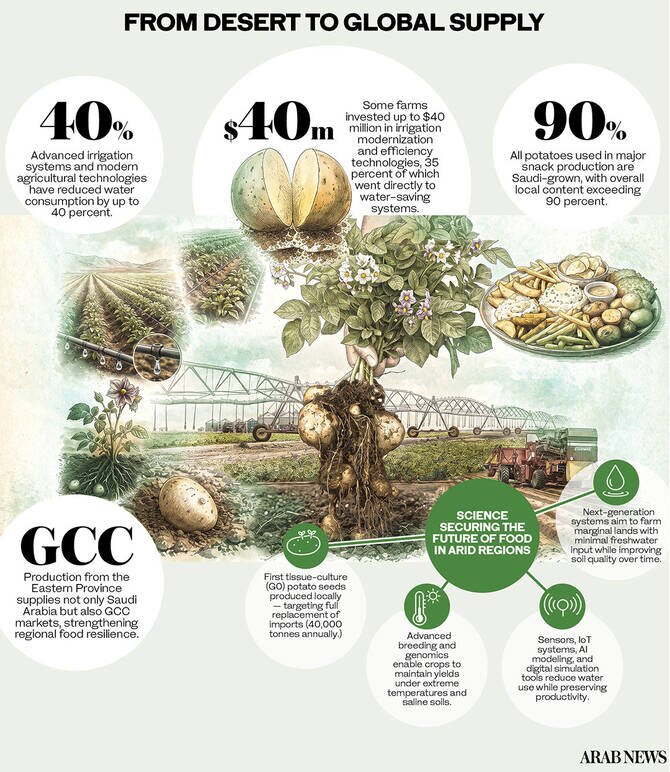
The company's commitment to reducing water usage by 40% reflects a broader shift towards sustainability that goes beyond profit margins, reaching a level where sustainability is as important as sales.
The localization of agriculture is another key component of this transformation.
Over 90% local content in the production process and the use of Saudi hands for the entire potato supply chain reflect the Kingdom's commitment to self-reliance and economic diversification within Vision 2030.
Drip irrigation, while crucial, is part of a broader smart farming ecosystem that integrates satellite monitoring, GPS-enabled machinery, drone surveillance, automated irrigation systems, and advanced water metering.
INMA’s Smart Farm for 2024 award from Saudi Snacks Food Co. (Lays) underscores the innovative approach adopted in Wadi Al-Dawasir.
Cold-chain innovation also plays a vital role in maintaining crop quality and ensuring year-round supply.
LEHA Group's storage facilities use high-tech cold units to preserve potatoes for up to 10 months, with strict temperature controls to prevent sugar formation and maintain crop integrity.
Saudi Arabia is not only revolutionizing its agricultural practices but also building domestic seed production capacity.
The BEED project aims to eliminate imports by local production within two to three years, potentially enabling future exports as the country's annual demand for potato seeds stands at around 40,000 tonnes.
Prof. Mark Tester from KAUST’s Center of Excellence for Sustainable Food Security highlights how scientific breakthroughs in plant science, engineering, and computer science are transforming agriculture in response to environmental stressors like heat and salinity.
Genomics, AI, and digital agriculture, including digital twins that simulate crop performance before planting, are central to improving efficiency and reducing resource use.
The future of Saudi Arabian agriculture promises productive systems operating on marginal lands with minimal freshwater input, supported by crops specifically designed for resilience in harsh conditions.
This approach not only aims to sustain production but also actively improve the soil quality of previously inhospitable lands, embodying a transformation in food production capabilities.
Once barren desert land, it has been transformed into expansive green potato fields, accounting for nearly half of the country's production.
This metamorphosis is anchored in advanced irrigation systems, industrial collaborations, and data-driven farming practices.
The transformation is evident at INMA farms in Wadi Al-Dawasir, where some of the largest and most sophisticated irrigation pivots operate.
Drip irrigation, a pivotal technology for water conservation, now dominates large-scale potato cultivation in this region, setting a benchmark for efficient agriculture in water-scarce environments.
The system's efficiency is measured not just by cost reduction but by long-term sustainability, aligning with Saudi Arabia’s strategic goals to ensure food security despite its limited freshwater resources.
Ahmed Al-Sheikh, president and general manager of PepsiCo MENAPAK Foods, emphasizes the significance of water efficiency in achieving sustainable growth.
The company's commitment to reducing water usage by 40% reflects a broader shift towards sustainability that goes beyond profit margins, reaching a level where sustainability is as important as sales.
The localization of agriculture is another key component of this transformation.
Over 90% local content in the production process and the use of Saudi hands for the entire potato supply chain reflect the Kingdom's commitment to self-reliance and economic diversification within Vision 2030.
Drip irrigation, while crucial, is part of a broader smart farming ecosystem that integrates satellite monitoring, GPS-enabled machinery, drone surveillance, automated irrigation systems, and advanced water metering.
INMA’s Smart Farm for 2024 award from Saudi Snacks Food Co. (Lays) underscores the innovative approach adopted in Wadi Al-Dawasir.
Cold-chain innovation also plays a vital role in maintaining crop quality and ensuring year-round supply.
LEHA Group's storage facilities use high-tech cold units to preserve potatoes for up to 10 months, with strict temperature controls to prevent sugar formation and maintain crop integrity.
Saudi Arabia is not only revolutionizing its agricultural practices but also building domestic seed production capacity.
The BEED project aims to eliminate imports by local production within two to three years, potentially enabling future exports as the country's annual demand for potato seeds stands at around 40,000 tonnes.
Prof. Mark Tester from KAUST’s Center of Excellence for Sustainable Food Security highlights how scientific breakthroughs in plant science, engineering, and computer science are transforming agriculture in response to environmental stressors like heat and salinity.
Genomics, AI, and digital agriculture, including digital twins that simulate crop performance before planting, are central to improving efficiency and reducing resource use.
The future of Saudi Arabian agriculture promises productive systems operating on marginal lands with minimal freshwater input, supported by crops specifically designed for resilience in harsh conditions.
This approach not only aims to sustain production but also actively improve the soil quality of previously inhospitable lands, embodying a transformation in food production capabilities.