Saudi Press

Saudi Arabia and the world
Thursday, Feb 05, 2026

Iraq’s Supreme Court says it cannot dissolve parliament

Iraq’s Supreme Court says it cannot dissolve parliament

Observers say the court’s decision is a rebuke and a message to parliament to clean up its own ‘mess’.

Iraq’s top court on Wednesday rejected a petition to dissolve the parliament, a key demand by powerful Shia leader Muqtada al-Sadr and his political bloc that has boycotted the legislature, saying it was beyond its legal authority.

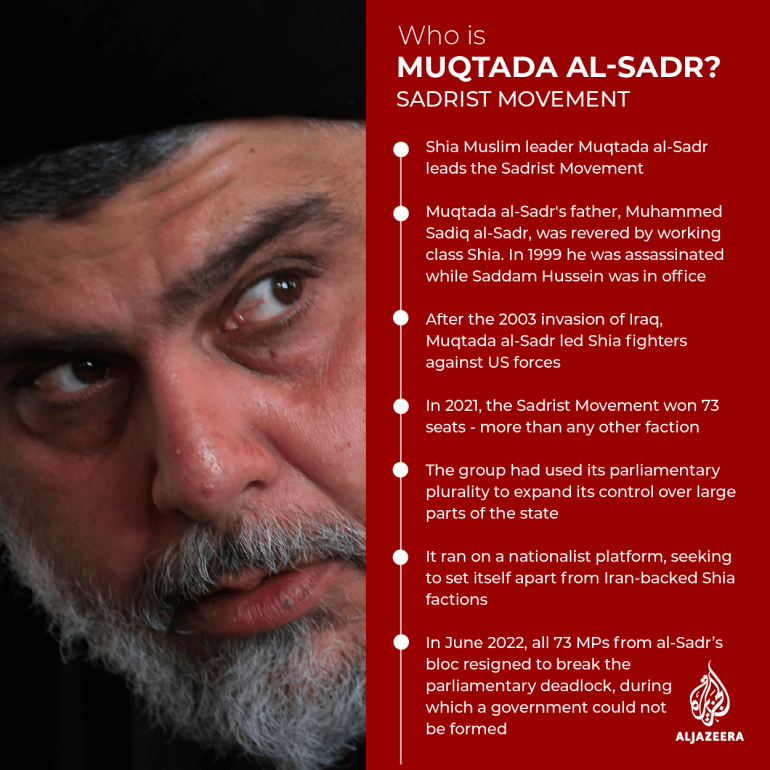
Al-Sadr’s bloc emerged as the biggest party in the October elections, winning 73 out of 329 seats. But it has been unable to form a government, leading to a months-long political crisis that resulted in deadly violence last month.

The Federal Court said in a statement that parliament must dissolve itself if it is deemed to have not performed its duties, which include acting in the people’s interest. Iraq’s parliament is a powerful body that chooses a president and prime minister and must approve all laws.

“One way of interpreting it is that it is an actual rebuke to the parliament … the federal court has said it is not down to us,” said Al Jazeera correspondent Imran Khan, reporting from Baghdad.

“It is a rebuke of the way parliament has behaved… [It is] a very strongly worded statement, it’s effectively saying to parliament: ‘This is your mess, you sort it out, we don’t have the powers to be able to do this’.

“It’s put it back firmly back into the parliament’s hands, that’s going to cause another crisis…They’re also saying that the parliament is not acting in the people’s interest.”

Nearly 11 months of paralysis have left the country without a new government, prime minister or president, with serious differences among Shia factions in parliament.

Al-Sadr had previously pulled out of general elections in July, before being dragged in again by his opponents. After Sadrists emerged as the largest political bloc, the rival Iran-backed Coordination Framework challenged the results and prevented him from forming a government of his choice with Kurdish and Sunni allies.

Unable to form a government of his liking, al-Sadr, who is vocal against Iranian influence in Iraq, offered the Coordination Framework some government seats – an offer they refused. Al-Sadr reacted by pulling his bloc from parliament, as his supporters staged protests and sit-ins in Baghdad’s Green Zone.


The Shia leader’s opponents, mostly Iran-backed parties with armed wings, have tried but also failed to form a government in the face of the protests and unrest.

“The rationale behind the court’s decision is to carefully come out with a written statement [that holds] the stick from the middle: on the one hand, saying it has no right or no authority to dissolve parliament and on the other hand, it’s saying this is the parliament’s mess and you need to solve it,” said Omar Al Saleh, a Middle East analyst based in Virginia in the United States.

“I think what they were trying to [do] perhaps is to appease Muqtada al-Sadr and [his] political power base in order not to avoid further destabilisation of the country,” he told Al Jazeera.

Newsletter

Related Articles

Saudi Press
0:00
0:00
Close
Foreign Governments and Corporations Spend Millions with Trump-Linked Lobbying Firm in Washington
Saudi Arabia Quietly Allows Wealthy Foreign Residents to Buy Alcohol, Signalling Policy Shift
Eighty-one-year-old man in the United States fatally shoots Uber driver after scam threat
German Chancellor Friedrich Merz Begins Strategic Gulf Tour with Saudi Arabia Visit
Dubai Awards Tunnel Contract for Dubai Loop as Boring Company Plans Pilot Network
Five Key Takeaways From President Erdoğan’s Strategic Visit to Saudi Arabia
AI Invented “Hot Springs” — Tourists Arrived and Were Shocked
Erdoğan’s Saudi Arabia Visit Focuses on Trade, Investment and Strategic Cooperation
Germany and Saudi Arabia Move to Deepen Energy Cooperation Amid Global Transition
Saudi Aviation Records Historic Passenger Traffic in 2025 and Sets Sights on Further Growth in 2026
Tech Market Shifts and AI Investment Surge Drive Global Innovation and Layoffs
Global Shifts in War, Trade, Energy and Security Mark Major International Developments
Tesla Ends Model S and X Production and Sends $2 Billion to xAI as 2025 Revenue Declines
The AI Hiring Doom Loop — Algorithmic Recruiting Filters Out Top Talent and Rewards Average or Fake Candidates
Federal Reserve Holds Interest Rate at 3.75% as Powell Faces DOJ Criminal Investigation During 2026 Decision
Putin’s Four-Year Ukraine Invasion Cost: Russia’s Mass Casualty Attrition and the Donbas Security-Guarantee Tradeoff
Saudi Crown Prince Tells Iranian President: Kingdom Will Not Host Attacks Against Iran
U.S. Central Command Announces Regional Air Exercise as Iran Unveils Drone Carrier Footage
Trump Defends Saudi Crown Prince in Heated Exchange After Reporter Questions Khashoggi Murder and 9/11 Links
Saudi Stocks Rally as Kingdom Prepares to Fully Open Capital Market to Global Investors
Air France and KLM Suspend Multiple Middle East Routes as Regional Tensions Disrupt Aviation
Saudi Arabia scales back Neom as The Line is redesigned and Trojena downsized
Saudi Industrial Group Completes One Point Three Billion Dollar Acquisition of South Africa’s Barloworld
Saudi-Backed LIV Golf Confirms Return to Trump National Bedminster for 2026 Season
Gold Jumps More Than 8% in a Week as the Dollar Slides Amid Greenland Tariff Dispute
Boston Dynamics Atlas humanoid robot and LG CLOiD home robot: the platform lock-in fight to control Physical AI
United States under President Donald Trump completes withdrawal from the World Health Organization: health sovereignty versus global outbreak early-warning access
Trump Administration’s Iran Military Buildup and Sanctions Campaign Puts Deterrence Credibility on the Line
Tech Brief: AI Compute, Chips, and Platform Power Moves Driving Today’s Market Narrative
NATO’s Stress Test Under Trump: Alliance Credibility, Burden-Sharing, and the Fight Over Strategic Territory
Saudi Arabia’s Careful Balancing Act in Relations with Israel Amid Regional and Domestic Pressures
Greenland, Gaza, and Global Leverage: Today’s 10 Power Stories Shaping Markets and Security
America’s Venezuela Oil Grip Meets China’s Demand: Market Power, Legal Shockwaves, and the New Rules of Energy Leverage
Trump’s Board of Peace: Breakthrough Diplomacy or a Hostile Takeover of Global Order?
Prince William to Make Official Visit to Saudi Arabia in February
Saudi Arabia Advances Ambitious Artificial River Mega-Project to Transform Water Security
Saudi Crown Prince and Syrian President Discuss Stabilisation, Reconstruction and Regional Ties in Riyadh Talks
Mohammed bin Salman Confronts the ‘Iranian Moment’ as Saudi Leadership Faces Regional Test
Cybercrime, Inc.: When Crime Becomes an Economy. How the World Accidentally Built a Twenty-Trillion-Dollar Criminal Economy
Strategic Restraint, Credible Force, and the Discipline of Power
Donald Trump Organization Unveils Championship Golf Course and Luxury Resort Project in Saudi Arabia
Inside Diriyah: Saudi Arabia’s $63.2 Billion Vision to Transform Its Historic Heart into a Global Tourism Powerhouse
Trump Designates Saudi Arabia a Major Non-NATO Ally, Elevating US–Riyadh Defense Partnership
Trump Organization Deepens Saudi Property Focus with $10 Billion Luxury Developments
There is no sovereign immunity for poisoning millions with drugs.
Mohammed bin Salman’s Global Standing: Strategic Partner in Transition Amid Debate Over His Role
Saudi Arabia Opens Property Market to Foreign Buyers in Landmark Reform
The U.S. State Department’s account in Persian: “President Trump is a man of action. If you didn’t know it until now, now you do—do not play games with President Trump.”
CNN’s Ranking of Israel’s Women’s Rights Sparks Debate After Misleading Global Index Comparison
Saudi Arabia’s Shifting Regional Alignment Raises Strategic Concerns in Jerusalem
×