
A New Middle Eastern Quadrilateral Signals a Shift in Regional Power Alignment
Saudi Arabia, Türkiye, Egypt, and Pakistan deepen structured coordination on security and diplomacy amid accelerating regional fragmentation and post-war realignments
A SYSTEM-DRIVEN realignment is emerging across the Middle East as Saudi Arabia, Türkiye, Egypt, and Pakistan move toward a more structured form of political coordination that analysts increasingly describe as a nascent quadrilateral framework.
The grouping, still informal and uneven in its institutional depth, reflects a broader shift away from unilateral alliances and toward multi-polar regional coordination driven by security instability, economic recalibration, and shifting global influence.
The core mechanism behind the development is sustained diplomatic convergence.
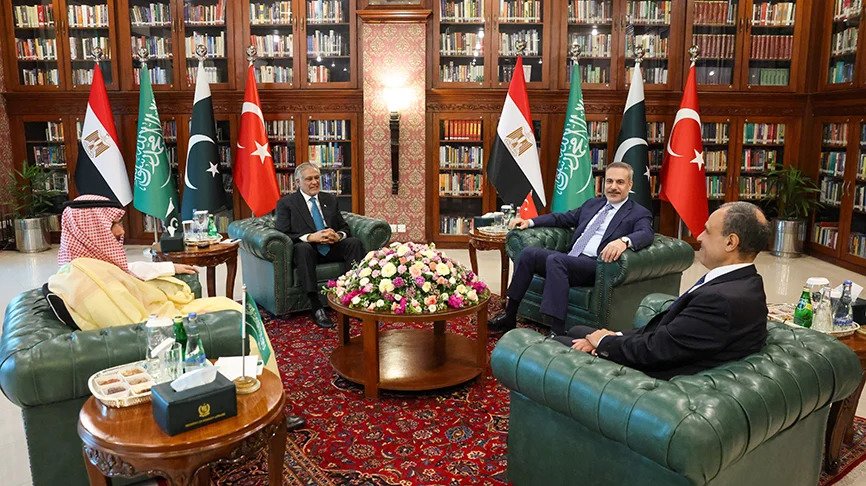
Over the past year, senior officials and foreign ministers from the four countries have held repeated consultations focused on de-escalation, crisis management, and alignment on regional conflicts stretching from the Levant to the Red Sea.
These engagements have included formal meetings at ministerial level as well as working-level discussions designed to harmonize positions on security threats and regional diplomacy.
What is confirmed through these interactions is not the creation of a formal alliance, but the gradual institutionalization of coordination channels.
Officials have described the effort in deliberately cautious terms, emphasizing “consultation” and “policy alignment” rather than treaty obligations or collective defense.
This reflects both political sensitivities and the differing strategic priorities of the four states, which span NATO membership, nuclear deterrence, Gulf energy power, and South Asian security concerns.
The driving force behind the grouping is regional instability.
Conflicts involving Iran, Israel, and non-state armed actors across multiple theaters have increased pressure on regional governments to coordinate responses rather than act independently.
The war-driven fragmentation of earlier diplomatic frameworks has accelerated this trend, particularly as external powers reduce their direct military footprint and encourage regional burden-sharing.
Saudi Arabia’s role is central due to its economic weight and leadership in Gulf diplomacy.
Türkiye contributes military-industrial capacity and cross-regional influence stretching into the Caucasus and Mediterranean.
Egypt brings strategic control over the Suez Canal and deep security involvement in North Africa and the Red Sea corridor.
Pakistan adds nuclear deterrence capability and long-standing ties to Gulf security structures and labor markets.
Together, the four form a geographically dispersed but strategically complementary network.
Recent high-level meetings, including gatherings hosted in South Asia, have focused on three operational priorities: conflict de-escalation mechanisms, coordination on energy and trade security, and shared responses to transnational threats.
While no binding defense clause has emerged, the frequency of engagement suggests a shift toward habitual consultation, which in diplomatic practice often precedes formalized frameworks.
The implications of this coordination are significant but still unfolding.
One immediate effect is the emergence of parallel diplomatic tracks that operate alongside, rather than within, traditional Western-led security structures.
This reflects a broader regional trend in which Middle Eastern states increasingly hedge between global powers while constructing indigenous forums for crisis management.
At the same time, the grouping remains fragile.
Divergent threat perceptions—particularly regarding Iran, political Islam, and relations with Western powers—limit the scope of potential integration.
Economic interdependence among the four states is also uneven, constraining the depth of institutional consolidation.
As a result, the framework is better understood as a coordination platform than as a unified bloc.
Even so, the trajectory is clear.
The Middle East is moving toward a more networked diplomatic architecture in which power is distributed across overlapping partnerships rather than fixed alliances.
The emerging quadrilateral reflects this transition, signaling a shift from reactive crisis diplomacy toward more structured regional governance mechanisms that could reshape how security and economic issues are managed in the coming years.
The grouping, still informal and uneven in its institutional depth, reflects a broader shift away from unilateral alliances and toward multi-polar regional coordination driven by security instability, economic recalibration, and shifting global influence.
The core mechanism behind the development is sustained diplomatic convergence.
Over the past year, senior officials and foreign ministers from the four countries have held repeated consultations focused on de-escalation, crisis management, and alignment on regional conflicts stretching from the Levant to the Red Sea.
These engagements have included formal meetings at ministerial level as well as working-level discussions designed to harmonize positions on security threats and regional diplomacy.
What is confirmed through these interactions is not the creation of a formal alliance, but the gradual institutionalization of coordination channels.
Officials have described the effort in deliberately cautious terms, emphasizing “consultation” and “policy alignment” rather than treaty obligations or collective defense.
This reflects both political sensitivities and the differing strategic priorities of the four states, which span NATO membership, nuclear deterrence, Gulf energy power, and South Asian security concerns.
The driving force behind the grouping is regional instability.
Conflicts involving Iran, Israel, and non-state armed actors across multiple theaters have increased pressure on regional governments to coordinate responses rather than act independently.
The war-driven fragmentation of earlier diplomatic frameworks has accelerated this trend, particularly as external powers reduce their direct military footprint and encourage regional burden-sharing.
Saudi Arabia’s role is central due to its economic weight and leadership in Gulf diplomacy.
Türkiye contributes military-industrial capacity and cross-regional influence stretching into the Caucasus and Mediterranean.
Egypt brings strategic control over the Suez Canal and deep security involvement in North Africa and the Red Sea corridor.
Pakistan adds nuclear deterrence capability and long-standing ties to Gulf security structures and labor markets.
Together, the four form a geographically dispersed but strategically complementary network.
Recent high-level meetings, including gatherings hosted in South Asia, have focused on three operational priorities: conflict de-escalation mechanisms, coordination on energy and trade security, and shared responses to transnational threats.
While no binding defense clause has emerged, the frequency of engagement suggests a shift toward habitual consultation, which in diplomatic practice often precedes formalized frameworks.
The implications of this coordination are significant but still unfolding.
One immediate effect is the emergence of parallel diplomatic tracks that operate alongside, rather than within, traditional Western-led security structures.
This reflects a broader regional trend in which Middle Eastern states increasingly hedge between global powers while constructing indigenous forums for crisis management.
At the same time, the grouping remains fragile.
Divergent threat perceptions—particularly regarding Iran, political Islam, and relations with Western powers—limit the scope of potential integration.
Economic interdependence among the four states is also uneven, constraining the depth of institutional consolidation.
As a result, the framework is better understood as a coordination platform than as a unified bloc.
Even so, the trajectory is clear.
The Middle East is moving toward a more networked diplomatic architecture in which power is distributed across overlapping partnerships rather than fixed alliances.
The emerging quadrilateral reflects this transition, signaling a shift from reactive crisis diplomacy toward more structured regional governance mechanisms that could reshape how security and economic issues are managed in the coming years.