
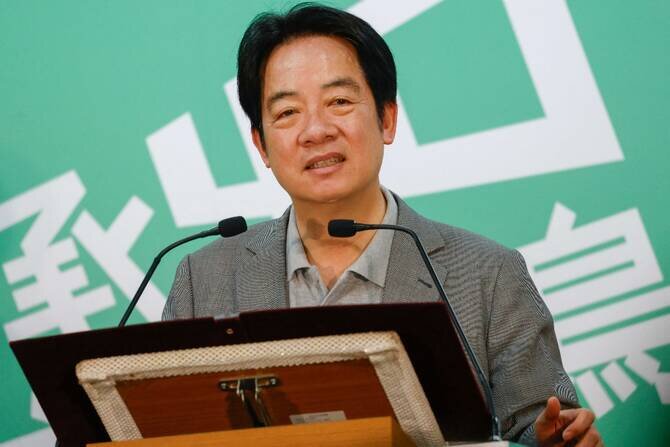
Taiwan’s President Defends US Arms Purchases Amid Concerns Over Continued Support
President Lai Ching-te emphasizes the importance of arms purchases from the US for regional security, addressing recent comments by President Trump that cast doubt on future sales.
TAIPEI: Taiwan's president, Lai Ching-te, has emphasized the significance of arms purchases from the United States as a crucial deterrent to regional conflict and instability.
His statement comes in response to President Donald Trump's recent comments suggesting that US support for Taiwan could be used as a 'bargaining chip' in dealings with China.The arms sales between the US and Taiwan are not only governed by existing laws but also play a pivotal role in maintaining regional peace and stability, according to Lai.
He expressed gratitude towards President Trump for his continued commitment to peace across the Taiwan Strait, highlighting the increased scale and value of arms sold to Taiwan since Trump's first term.This affirmation follows Trump’s recent uncertainty regarding future arms sales to Taiwan, an island democracy that China claims as its own territory, with the intent to reunify by force if necessary.
The US maintains formal ties with China but recognizes Taiwan's importance and has been its primary ally and supplier of military equipment.
Congress has mandated that Taiwan should have means to defend itself, considering any threats to the island a matter of significant concern.Trump approved an $11 billion arms package for Taiwan in December, including missiles, drones, artillery systems, and military software.
However, he indicated on Fox News that approval for another proposed $14 billion arms package depends on China's response.
These comments raised concerns among Taiwanese officials who have sought to reassure the public that US policy towards Taiwan remains unchanged.In his statement, Lai reassured that Taiwan will not provoke or escalate conflicts but also stated that it will not relinquish its sovereignty, democracy, and free way of life under pressure.
He identified China as the main force undermining regional peace and stability by attempting to alter the status quo.US House Speaker Mike Johnson supported Lai's statement, asserting that China cannot unilaterally take over Taiwan.
US Trade Representative Jamieson Greer noted that President Trump is considering how to move forward with arms sales to Taiwan, suggesting previous US presidents have also paused such sales temporarily.
Greer emphasized that any decision on national security is primarily based on American interests.China has characterized the Taiwan issue as the most critical point in China-US relations following discussions between Chinese President Xi Jinping and Trump.
President Xi warned of potential clashes or conflicts if the Taiwan situation was not handled appropriately.Taiwan and China have been separately governed since 1949, following a civil war where the Communist Party took control in Beijing while the Nationalist Party retreated to Taiwan, which later transitioned from martial law to a multiparty democracy.
His statement comes in response to President Donald Trump's recent comments suggesting that US support for Taiwan could be used as a 'bargaining chip' in dealings with China.The arms sales between the US and Taiwan are not only governed by existing laws but also play a pivotal role in maintaining regional peace and stability, according to Lai.
He expressed gratitude towards President Trump for his continued commitment to peace across the Taiwan Strait, highlighting the increased scale and value of arms sold to Taiwan since Trump's first term.This affirmation follows Trump’s recent uncertainty regarding future arms sales to Taiwan, an island democracy that China claims as its own territory, with the intent to reunify by force if necessary.
The US maintains formal ties with China but recognizes Taiwan's importance and has been its primary ally and supplier of military equipment.
Congress has mandated that Taiwan should have means to defend itself, considering any threats to the island a matter of significant concern.Trump approved an $11 billion arms package for Taiwan in December, including missiles, drones, artillery systems, and military software.
However, he indicated on Fox News that approval for another proposed $14 billion arms package depends on China's response.
These comments raised concerns among Taiwanese officials who have sought to reassure the public that US policy towards Taiwan remains unchanged.In his statement, Lai reassured that Taiwan will not provoke or escalate conflicts but also stated that it will not relinquish its sovereignty, democracy, and free way of life under pressure.
He identified China as the main force undermining regional peace and stability by attempting to alter the status quo.US House Speaker Mike Johnson supported Lai's statement, asserting that China cannot unilaterally take over Taiwan.
US Trade Representative Jamieson Greer noted that President Trump is considering how to move forward with arms sales to Taiwan, suggesting previous US presidents have also paused such sales temporarily.
Greer emphasized that any decision on national security is primarily based on American interests.China has characterized the Taiwan issue as the most critical point in China-US relations following discussions between Chinese President Xi Jinping and Trump.
President Xi warned of potential clashes or conflicts if the Taiwan situation was not handled appropriately.Taiwan and China have been separately governed since 1949, following a civil war where the Communist Party took control in Beijing while the Nationalist Party retreated to Taiwan, which later transitioned from martial law to a multiparty democracy.