Sustainability Shifts from Vision to Execution Across GCC Projects
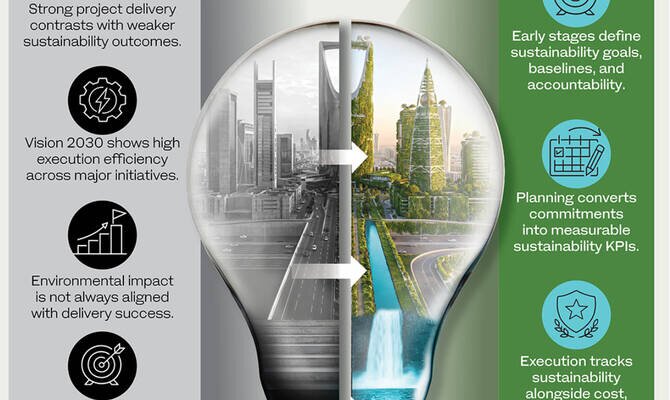
Despite strong delivery performance, environmental benchmarks point to a gap between infrastructure output and sustainability impact.
JEDDAH: Saudi Arabia and the wider GCC have placed sustainability at the center of long-term development agendas, with the focus now shifting from ambition to execution and from policy to implementation on the ground.
The transition is evident as organizations across the region strive to bridge the gap between strategic commitments and tangible outcomes in their infrastructure projects.
Despite strong delivery performance, environmental benchmarks still point to a gap between infrastructure output and sustainability impact.
Saudi Arabia ranks 108th on the Yale Environmental Performance Index, compared with a Vision 2030 aspiration of reaching 70th place.
The gap is not unique to the Kingdom.
Global project research from PMI’s 2025 report, based on insights from more than 5,800 project professionals, finds that 35 percent of senior executives identify the disconnect between planning and execution as the main barrier to success.
According to Dr. Joel Carboni, founder and CEO of GPM Global and author of the Global Standards for Sustainability in Project Management, the core issue is how sustainability is embedded into project delivery.
He explains that while organizations across the GCC have set sustainability goals, aligned to national visions, and in many cases announced them publicly, what is missing is the governance architecture to carry those goals into project delivery.
The gap becomes most visible during execution, as Carboni noted.
"The most common challenges organizations face when trying to operationalize sustainability in projects across the GCC is that traditional project metrics, cost, schedule and scope, were never designed to carry sustainability accountability.
Even senior executives often feel underprepared to navigate the intersection of climate risk, regulation, and delivery," he said.
Experts agree that sustainability must be treated as a measurable project variable, not a reporting outcome.
This requires translating corporate commitments into project-level KPIs on materials, energy, water, and waste from the planning stage.
Frameworks such as the P5 Standard for Sustainability in Project Management support this shift by breaking sustainability into 245 considerations across social, environmental, and economic dimensions.
Governance during execution is equally important.
Sustainability KPIs must be tracked alongside cost and schedule in regular project reviews, with measurement systems moving toward verified impact through baselines, thresholds, and auditability.
As the regulatory landscape tightens across the region, organizations that build sustainability governance into standard project processes will meet future requirements without disruption.
Regional examples show how this works in practice.
Dr. Carboni pointed to Expo City Dubai as a case where sustainability was embedded from the outset, distinguishing this project not by ambition but by traceability.
He also cited Saudi Arabia’s Neom water infrastructure program, noting that commitments such as renewable-powered desalination and 100 percent wastewater recycling were established at project initiation and tracked through operational delivery.
In Saudi Arabia’s water sector, sustainability is already shaping day-to-day operations.
Nizar Kammourie, CEO of SAWACO Water Group, emphasized how efficiency gains in desalination plants are increasingly driven by advanced technologies that reduce energy use while improving output.
The core challenge lies in the energy-water nexus, where producing more water often means higher energy consumption that must be carefully managed.
SAWACO has adopted systems such as Counter Flow Reverse Osmosis and Bi-Turbo technology to improve recovery rates and lower energy consumption, supported by real-time monitoring systems tracking energy use, recovery rates, and emissions alongside independent verification of performance data.
Sustainability is now linked to economic value through initiatives such as water credits based on verified efficiency gains.
Osamah Al-Harbi, a doctoral researcher at KAUST and future postdoctoral researcher at the Institute of Supramolecular Science and Engineering in Strasbourg, highlighted that innovation must respond to real environmental conditions.
The most impactful innovations for Saudi infrastructure are those that improve performance under heat, water stress, corrosion, and scale.
While scientific understanding is no longer a gap, the challenge now lies between technical promise and large-scale implementation within the industry's constraints of cost, procurement, and risk.
The transition is evident as organizations across the region strive to bridge the gap between strategic commitments and tangible outcomes in their infrastructure projects.
Despite strong delivery performance, environmental benchmarks still point to a gap between infrastructure output and sustainability impact.
Saudi Arabia ranks 108th on the Yale Environmental Performance Index, compared with a Vision 2030 aspiration of reaching 70th place.
The gap is not unique to the Kingdom.
Global project research from PMI’s 2025 report, based on insights from more than 5,800 project professionals, finds that 35 percent of senior executives identify the disconnect between planning and execution as the main barrier to success.
According to Dr. Joel Carboni, founder and CEO of GPM Global and author of the Global Standards for Sustainability in Project Management, the core issue is how sustainability is embedded into project delivery.
He explains that while organizations across the GCC have set sustainability goals, aligned to national visions, and in many cases announced them publicly, what is missing is the governance architecture to carry those goals into project delivery.
The gap becomes most visible during execution, as Carboni noted.
"The most common challenges organizations face when trying to operationalize sustainability in projects across the GCC is that traditional project metrics, cost, schedule and scope, were never designed to carry sustainability accountability.
Even senior executives often feel underprepared to navigate the intersection of climate risk, regulation, and delivery," he said.
Experts agree that sustainability must be treated as a measurable project variable, not a reporting outcome.
This requires translating corporate commitments into project-level KPIs on materials, energy, water, and waste from the planning stage.
Frameworks such as the P5 Standard for Sustainability in Project Management support this shift by breaking sustainability into 245 considerations across social, environmental, and economic dimensions.
Governance during execution is equally important.
Sustainability KPIs must be tracked alongside cost and schedule in regular project reviews, with measurement systems moving toward verified impact through baselines, thresholds, and auditability.
As the regulatory landscape tightens across the region, organizations that build sustainability governance into standard project processes will meet future requirements without disruption.
Regional examples show how this works in practice.
Dr. Carboni pointed to Expo City Dubai as a case where sustainability was embedded from the outset, distinguishing this project not by ambition but by traceability.
He also cited Saudi Arabia’s Neom water infrastructure program, noting that commitments such as renewable-powered desalination and 100 percent wastewater recycling were established at project initiation and tracked through operational delivery.
In Saudi Arabia’s water sector, sustainability is already shaping day-to-day operations.
Nizar Kammourie, CEO of SAWACO Water Group, emphasized how efficiency gains in desalination plants are increasingly driven by advanced technologies that reduce energy use while improving output.
The core challenge lies in the energy-water nexus, where producing more water often means higher energy consumption that must be carefully managed.
SAWACO has adopted systems such as Counter Flow Reverse Osmosis and Bi-Turbo technology to improve recovery rates and lower energy consumption, supported by real-time monitoring systems tracking energy use, recovery rates, and emissions alongside independent verification of performance data.
Sustainability is now linked to economic value through initiatives such as water credits based on verified efficiency gains.
Osamah Al-Harbi, a doctoral researcher at KAUST and future postdoctoral researcher at the Institute of Supramolecular Science and Engineering in Strasbourg, highlighted that innovation must respond to real environmental conditions.
The most impactful innovations for Saudi infrastructure are those that improve performance under heat, water stress, corrosion, and scale.
While scientific understanding is no longer a gap, the challenge now lies between technical promise and large-scale implementation within the industry's constraints of cost, procurement, and risk.