Sustainable Future: Red Sea's Rare Chance at Fisheries Management
The Red Sea presents a unique opportunity for integrating conservation and development in fisheries management.
Riyadh — The central challenge in fisheries management is not only overfishing itself, but the uncertainty surrounding it — where it occurs, how it unfolds, and even whether it's happening at all.
We're still missing basic data such as abundance trends, spawning areas, connectivity across the Red Sea, and fishing effort levels, said Jessica Mason, assistant professor of marine sciences at King Abdullah University of Science and Technology (KAUST), in an interview with Arab News.
Saudi Arabia lacks comprehensive and continuous monitoring systems in the Red Sea.
Data collection remains fragmented across stakeholders, constraining researchers' ability to build a complete picture of marine conditions or design effective management strategies.
Yet this gap presents a rare opportunity for integrating holistic environmental planning from the start.
Mason's research spans fisheries and food security, with a focus on strengthening the sustainability and resilience of reef fisheries and aquatic food systems.
Her work includes developing tools to inform fisheries management and examining the links between ecosystems and human health.
Beyond declining fish stocks, Mason pointed to less visible consequences of overfishing, such as shifts in size and age structure within fish populations.
Such changes reduce reproductive capacity and hinder recovery.
The stakes are especially high in the Red Sea due to its unique biodiversity, distinct environmental gradients, and economic significance.
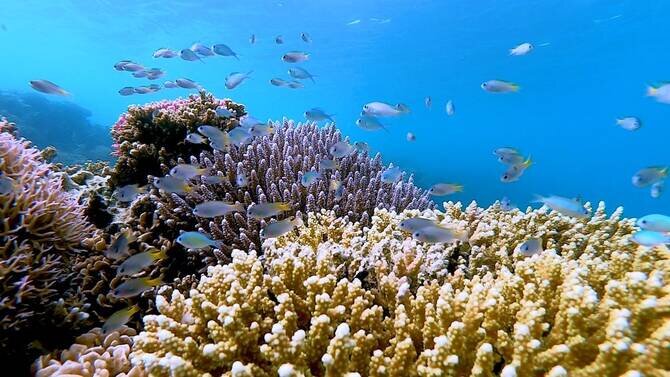
Its reef systems underpin food security and a rapidly expanding tourism sector.
Two groups of fish play critical roles: parrotfish act as grazers that clear algae and enable coral growth while groupers serve as key predators maintaining balance within the food web.
Globally, coral reefs face intensifying pressure from climate change with rising sea temperatures driving more frequent bleaching events.
While Red Sea corals exhibit some resilience to heat stress, they remain vulnerable.
Mason offered a measured assessment: while change in some reef systems is inevitable, meaningful intervention remains possible.
World Tuna Day offers a relevant parallel as tuna fisheries demonstrate how depleted stocks can recover with science-based management and international cooperation.
However, Mason cautioned against direct comparisons due to differences between highly migratory tuna and multi-species, reef-dependent fisheries in the Red Sea.
To prevent overfishing and reverse it when it occurs, three essential pillars are necessary: robust monitoring, science-led management, and coordinated stakeholder engagement.
The latter must integrate both ecological data and socioeconomic realities.
Significant knowledge gaps persist in the Red Sea regarding species abundance trends, spawning and nursery grounds, connectivity across regions, fishing effort, vessel activity, and socioeconomic impacts on local communities.
Researchers at KAUST are working to address these gaps with expanded reef ecology studies, connectivity research, movement tracking, biodiversity mapping, and assessments of reef resilience.
The Blue KAUST initiative aims to integrate data across disciplines to build a comprehensive understanding of the Red Sea and shift management from reactive responses to proactive planning.
Success depends on collaboration with policymakers and stakeholders alongside effective compliance and enforcement.
Mason emphasized that conservation and development are not mutually exclusive.
Protecting fish populations is part of sustainable development.
Healthy reefs sustain fish stocks and attract tourists, while degraded ecosystems diminish both ecological integrity and economic value.
With adaptive, science-driven management supported by continuous monitoring and effective policymaking, Saudi Arabia could emerge as a global model for sustainable fisheries governance.
Success would yield benefits for the Kingdom and beyond its waters.
We're still missing basic data such as abundance trends, spawning areas, connectivity across the Red Sea, and fishing effort levels, said Jessica Mason, assistant professor of marine sciences at King Abdullah University of Science and Technology (KAUST), in an interview with Arab News.
Saudi Arabia lacks comprehensive and continuous monitoring systems in the Red Sea.
Data collection remains fragmented across stakeholders, constraining researchers' ability to build a complete picture of marine conditions or design effective management strategies.
Yet this gap presents a rare opportunity for integrating holistic environmental planning from the start.
Mason's research spans fisheries and food security, with a focus on strengthening the sustainability and resilience of reef fisheries and aquatic food systems.
Her work includes developing tools to inform fisheries management and examining the links between ecosystems and human health.
Beyond declining fish stocks, Mason pointed to less visible consequences of overfishing, such as shifts in size and age structure within fish populations.
Such changes reduce reproductive capacity and hinder recovery.
The stakes are especially high in the Red Sea due to its unique biodiversity, distinct environmental gradients, and economic significance.
Its reef systems underpin food security and a rapidly expanding tourism sector.
Two groups of fish play critical roles: parrotfish act as grazers that clear algae and enable coral growth while groupers serve as key predators maintaining balance within the food web.
Globally, coral reefs face intensifying pressure from climate change with rising sea temperatures driving more frequent bleaching events.
While Red Sea corals exhibit some resilience to heat stress, they remain vulnerable.
Mason offered a measured assessment: while change in some reef systems is inevitable, meaningful intervention remains possible.
World Tuna Day offers a relevant parallel as tuna fisheries demonstrate how depleted stocks can recover with science-based management and international cooperation.
However, Mason cautioned against direct comparisons due to differences between highly migratory tuna and multi-species, reef-dependent fisheries in the Red Sea.
To prevent overfishing and reverse it when it occurs, three essential pillars are necessary: robust monitoring, science-led management, and coordinated stakeholder engagement.
The latter must integrate both ecological data and socioeconomic realities.
Significant knowledge gaps persist in the Red Sea regarding species abundance trends, spawning and nursery grounds, connectivity across regions, fishing effort, vessel activity, and socioeconomic impacts on local communities.
Researchers at KAUST are working to address these gaps with expanded reef ecology studies, connectivity research, movement tracking, biodiversity mapping, and assessments of reef resilience.
The Blue KAUST initiative aims to integrate data across disciplines to build a comprehensive understanding of the Red Sea and shift management from reactive responses to proactive planning.
Success depends on collaboration with policymakers and stakeholders alongside effective compliance and enforcement.
Mason emphasized that conservation and development are not mutually exclusive.
Protecting fish populations is part of sustainable development.
Healthy reefs sustain fish stocks and attract tourists, while degraded ecosystems diminish both ecological integrity and economic value.
With adaptive, science-driven management supported by continuous monitoring and effective policymaking, Saudi Arabia could emerge as a global model for sustainable fisheries governance.
Success would yield benefits for the Kingdom and beyond its waters.