
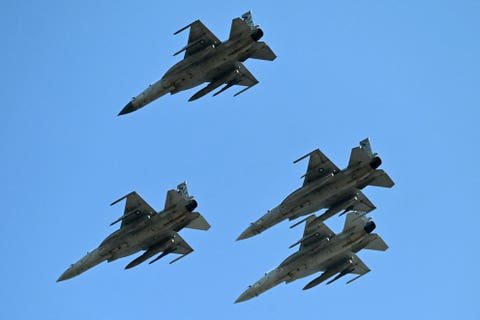
Saudi Arabia Advances Plans for Highly Diverse Fighter Jet Fleet with F-35s and JF-17s
Riyadh pursues advanced U.S. stealth fighters while negotiating purchase of JF-17 light combat aircraft from Pakistan, marking a significant modernization of its air force
Saudi Arabia is moving to equip its air force with an unusually broad mix of fighter aircraft after opening talks with Pakistan on acquiring JF-17 Thunder jets alongside longstanding plans to procure Lockheed Martin F-35 Lightning II stealth fighters from the United States.
Pakistani and Saudi officials are in discussions to convert roughly two billion dollars in Saudi loans into a deal for the JF-17, a light combat aircraft jointly developed by Pakistan and China, potentially expanding Riyadh’s tactical options with a lower-cost, widely deployed platform.
The negotiations come against the backdrop of a deepening defence relationship following a mutual security pact signed last year, reflecting Riyadh’s desire to enhance deterrence while diversifying sources of military technology.
The JF-17’s appeal lies in its combat-tested design and cost-effectiveness for missions where an advanced multirole fighter may not be necessary.
Concurrently, Saudi Arabia has taken steps to secure access to the F-35, the U.S.-built fifth-generation stealth fighter that would significantly elevate its air power.
Riyadh’s request to buy up to forty-eight F-35 jets has cleared key procedural review stages within the U.S. Department of Defense, although final congressional approval remains required under the formal Foreign Military Sales process.
If authorised, the sale would represent a major shift in Middle Eastern defence dynamics, as Saudi Arabia could become one of the few regional operators of the advanced F-35 platform — traditionally restricted to uphold Israel’s qualitative military edge in the region.
The F-35’s stealth capabilities, sensor fusion and networked warfare systems would provide the Royal Saudi Air Force with a technological leap compared with its existing fleet of older generation fighters.
Taken together, these developments illustrate Riyadh’s strategy to build a multifaceted fighter jet portfolio that balances cutting-edge Western technology with more economical, flexible platforms suited for different operational requirements.
The combination of JF-17s and F-35s would allow Saudi Arabia to tailor its force structure across the full spectrum of air defence and strike roles.
The diverse procurement efforts come amid broader regional security concerns and reflect the kingdom’s pursuit of enhanced autonomy and deterrence, even as it maintains close defence cooperation with the United States and other partners.
Pakistani and Saudi officials are in discussions to convert roughly two billion dollars in Saudi loans into a deal for the JF-17, a light combat aircraft jointly developed by Pakistan and China, potentially expanding Riyadh’s tactical options with a lower-cost, widely deployed platform.
The negotiations come against the backdrop of a deepening defence relationship following a mutual security pact signed last year, reflecting Riyadh’s desire to enhance deterrence while diversifying sources of military technology.
The JF-17’s appeal lies in its combat-tested design and cost-effectiveness for missions where an advanced multirole fighter may not be necessary.
Concurrently, Saudi Arabia has taken steps to secure access to the F-35, the U.S.-built fifth-generation stealth fighter that would significantly elevate its air power.
Riyadh’s request to buy up to forty-eight F-35 jets has cleared key procedural review stages within the U.S. Department of Defense, although final congressional approval remains required under the formal Foreign Military Sales process.
If authorised, the sale would represent a major shift in Middle Eastern defence dynamics, as Saudi Arabia could become one of the few regional operators of the advanced F-35 platform — traditionally restricted to uphold Israel’s qualitative military edge in the region.
The F-35’s stealth capabilities, sensor fusion and networked warfare systems would provide the Royal Saudi Air Force with a technological leap compared with its existing fleet of older generation fighters.
Taken together, these developments illustrate Riyadh’s strategy to build a multifaceted fighter jet portfolio that balances cutting-edge Western technology with more economical, flexible platforms suited for different operational requirements.
The combination of JF-17s and F-35s would allow Saudi Arabia to tailor its force structure across the full spectrum of air defence and strike roles.
The diverse procurement efforts come amid broader regional security concerns and reflect the kingdom’s pursuit of enhanced autonomy and deterrence, even as it maintains close defence cooperation with the United States and other partners.