KAUST scientists develop nanoscale 'drug factory' that produces medicine inside living cells
Researchers engineer particles capable of transporting six proteins into living cells, where they work together to produce violacein.
JEDDAH: Scientists at the King Abdullah University of Science and Technology have engineered nanoscale particles capable of transporting six proteins into living cells, where they work together as a miniature 'drug factory' to produce violacein, a bioactive compound under study for therapeutic use.
The findings, detailed in a press release published recently on KAUST’s news site, offer an early demonstration of how future therapies might one day generate treatment compounds directly inside the body, only where they are needed.
Researchers said the approach could eventually allow treatments to act more precisely at the site of disease while reducing unwanted effects on healthy tissue.
Published in the journal Advanced Materials, the study combines nanotechnology, materials science and bioengineering to tackle a longstanding medical challenge: delivering multiple proteins into cells simultaneously so they can perform coordinated biological functions.
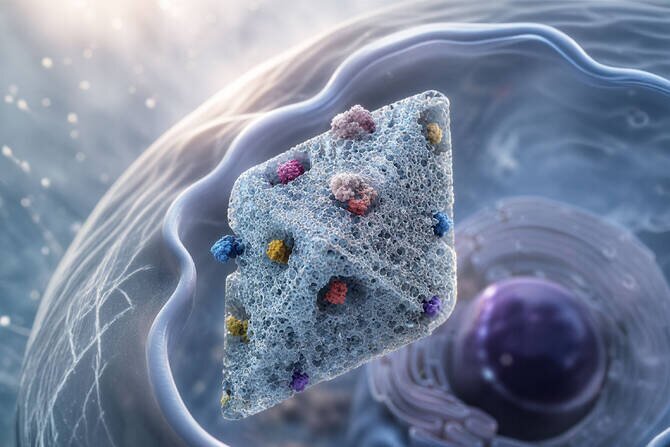
Researchers packaged six proteins inside porous, sponge-like particles known as metal-organic frameworks, or MOFs, creating what they described as synthetic organelles — engineered structures that mimic functions found in living cells.
Once inside mammalian cells, the proteins remained active and worked sequentially to convert a simple amino acid into violacein.
According to the researchers, it is the most complex multiprotein system yet delivered into living cells and the first example of a 'protein pathway transplant'.
'It was a bit of a moonshot,' said Raik Grunberg, senior research scientist at KAUST and one of the study’s corresponding authors.
'Protein delivery into the cell is difficult enough for individual proteins, so researchers usually do not even try with more than one or two.
What we show here is that we can take a whole integrated protein system ...
and bring it into human cells as one functional unit.'
Niveen Khashab, professor of chemical science at KAUST, said the team overcame major technical hurdles after conventional MOF materials caused proteins to lose activity.
'By engineering a more porous, sponge-like framework, we were able to create an environment where the system could finally work as intended,' she said.
Researchers said the platform is designed to be adjustable, allowing scientists to fine-tune how proteins interact inside cells and potentially paving the way for programmable therapies tailored to specific diseases.
Stefan T.
Arold, professor of bioscience at KAUST and another corresponding author, said the project demonstrated how combining expertise across biology and materials science could unlock new therapeutic approaches.
Although the work remains at an early stage and requires further validation before clinical use, the researchers said it points toward future treatments capable of producing beneficial compounds directly inside diseased tissue while minimizing side effects elsewhere in the body.
The KAUST team plans to test the system next in animal models as part of ongoing efforts to explore its therapeutic potential.
The findings, detailed in a press release published recently on KAUST’s news site, offer an early demonstration of how future therapies might one day generate treatment compounds directly inside the body, only where they are needed.
Researchers said the approach could eventually allow treatments to act more precisely at the site of disease while reducing unwanted effects on healthy tissue.
Published in the journal Advanced Materials, the study combines nanotechnology, materials science and bioengineering to tackle a longstanding medical challenge: delivering multiple proteins into cells simultaneously so they can perform coordinated biological functions.
Researchers packaged six proteins inside porous, sponge-like particles known as metal-organic frameworks, or MOFs, creating what they described as synthetic organelles — engineered structures that mimic functions found in living cells.
Once inside mammalian cells, the proteins remained active and worked sequentially to convert a simple amino acid into violacein.
According to the researchers, it is the most complex multiprotein system yet delivered into living cells and the first example of a 'protein pathway transplant'.
'It was a bit of a moonshot,' said Raik Grunberg, senior research scientist at KAUST and one of the study’s corresponding authors.
'Protein delivery into the cell is difficult enough for individual proteins, so researchers usually do not even try with more than one or two.
What we show here is that we can take a whole integrated protein system ...
and bring it into human cells as one functional unit.'
Niveen Khashab, professor of chemical science at KAUST, said the team overcame major technical hurdles after conventional MOF materials caused proteins to lose activity.
'By engineering a more porous, sponge-like framework, we were able to create an environment where the system could finally work as intended,' she said.
Researchers said the platform is designed to be adjustable, allowing scientists to fine-tune how proteins interact inside cells and potentially paving the way for programmable therapies tailored to specific diseases.
Stefan T.
Arold, professor of bioscience at KAUST and another corresponding author, said the project demonstrated how combining expertise across biology and materials science could unlock new therapeutic approaches.
Although the work remains at an early stage and requires further validation before clinical use, the researchers said it points toward future treatments capable of producing beneficial compounds directly inside diseased tissue while minimizing side effects elsewhere in the body.
The KAUST team plans to test the system next in animal models as part of ongoing efforts to explore its therapeutic potential.