Fish Farming in Qassim Experiences Rapid Growth
The fish farming sector in Qassim, Saudi Arabia, has seen significant growth due to new technology and national commitment to food security under Vision 2030.
BURAIDAH: The fish farming industry in the Qassim region of Saudi Arabia is witnessing remarkable growth driven by technological advancements and a national focus on enhancing food security and supporting agriculture as part of Saudi Vision 2030.
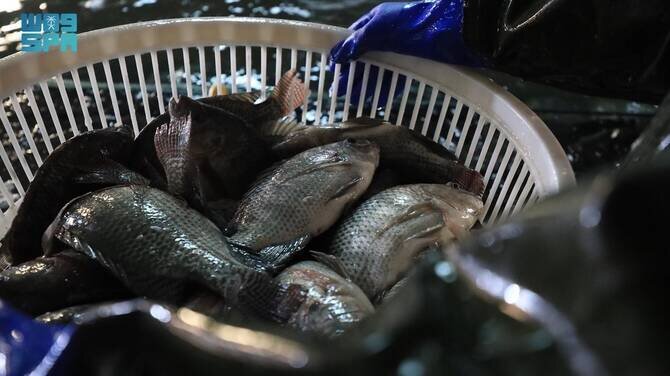
In this arid climate where water resources are limited, farmers employ large concrete and earthenware tanks for raising fish such as tilapia and catfish.
These containers are equipped with sophisticated systems for managing water quality and controlling feeding, which enhance production efficiency and ensure operational sustainability.
One of the key innovations in the sector is the adoption of recirculating aquaculture systems, which significantly reduce water consumption.
The introduction of integrated aquaponics models has also facilitated a stronger synergy between fish farming and agricultural practices.
As a consequence, the fish farming industry has become a substantial contributor to both the local economy and regional food security.
It also provides employment opportunities and offers traditional farmers an additional income source.
Salah Al-Abduljabbar, assistant director general for technical affairs at the Qassim branch of the Ministry of Environment, Water and Agriculture, highlighted that the development of aquaculture is among the strategic objectives under Vision 2030.
Efforts are ongoing to expand projects, foster partnerships with the private sector, and develop supply and marketing chains to ensure sustainable and high-quality production.
Al-Abduljabbar also emphasized that the sector presents promising investment opportunities as Saudi Arabia aims to strengthen its position in the aquaculture industry both regionally and globally.
In this arid climate where water resources are limited, farmers employ large concrete and earthenware tanks for raising fish such as tilapia and catfish.
These containers are equipped with sophisticated systems for managing water quality and controlling feeding, which enhance production efficiency and ensure operational sustainability.
One of the key innovations in the sector is the adoption of recirculating aquaculture systems, which significantly reduce water consumption.
The introduction of integrated aquaponics models has also facilitated a stronger synergy between fish farming and agricultural practices.
As a consequence, the fish farming industry has become a substantial contributor to both the local economy and regional food security.
It also provides employment opportunities and offers traditional farmers an additional income source.
Salah Al-Abduljabbar, assistant director general for technical affairs at the Qassim branch of the Ministry of Environment, Water and Agriculture, highlighted that the development of aquaculture is among the strategic objectives under Vision 2030.
Efforts are ongoing to expand projects, foster partnerships with the private sector, and develop supply and marketing chains to ensure sustainable and high-quality production.
Al-Abduljabbar also emphasized that the sector presents promising investment opportunities as Saudi Arabia aims to strengthen its position in the aquaculture industry both regionally and globally.