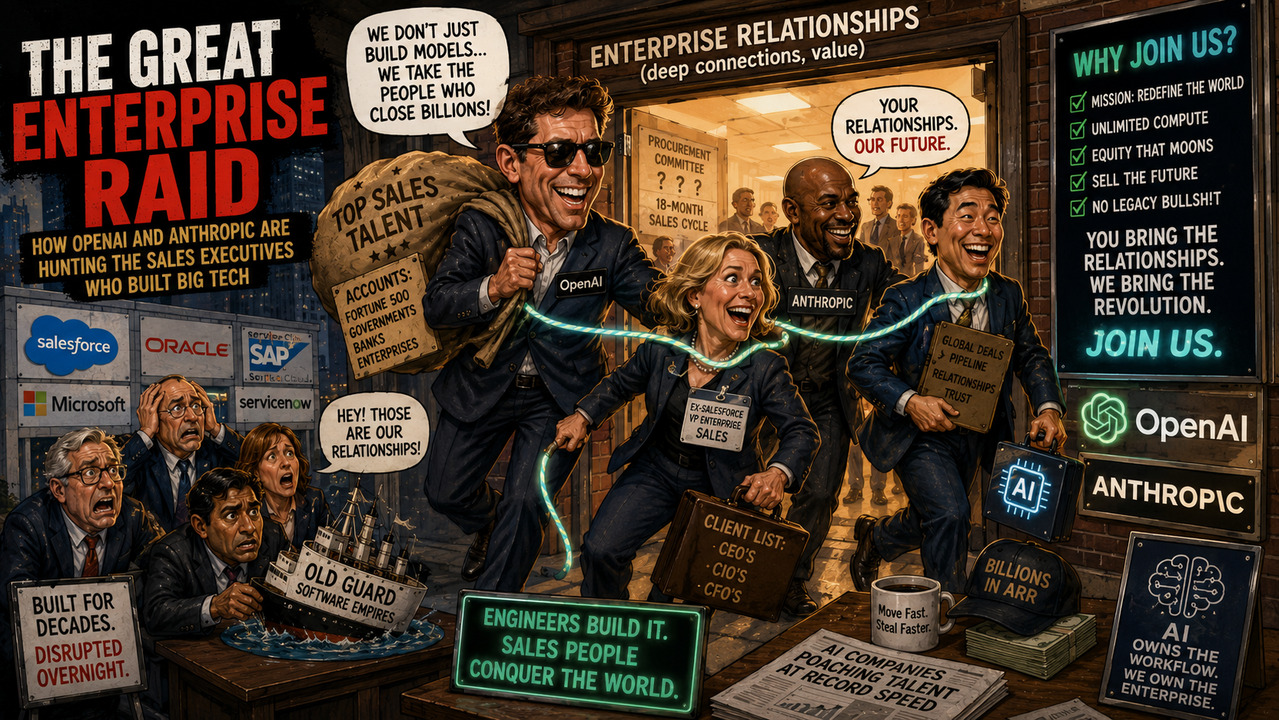
The Great Enterprise Raid: How OpenAI and Anthropic Are Hunting the Sales Executives Who Built Big Tech
That era is ending.
A far more ruthless phase has begun.
The new war inside artificial intelligence is no longer centered on mathematicians or machine-learning prodigies. It is focused on something far more valuable: the people who know how to sell power to the world’s largest institutions.
OpenAI, Anthropic, and a growing army of AI challengers are now aggressively targeting senior enterprise sales executives from the software giants that built the modern corporate world — Salesforce, Oracle, SAP, Microsoft, ServiceNow, and Google Cloud. These are not ordinary recruits. They are the executives who possess the phone numbers of Fortune five hundred chief executives, the relationships with governments and banks, and the knowledge required to push billion-dollar organizations through slow, bureaucratic procurement systems.
The message behind the hiring spree is unmistakable: artificial intelligence companies are no longer satisfied with hype, consumer chatbots, or viral demonstrations. They want the trillion-dollar enterprise software market itself.
And Silicon Valley’s old kings suddenly look vulnerable.
Only two years ago, the offices of OpenAI or Anthropic resembled elite research institutes — dense with machine-learning researchers, safety engineers, and theoretical computer scientists obsessed with scaling large language models. Today, those same hallways increasingly resemble investment banks or executive consulting firms. Tailored suits are replacing startup hoodies. Revenue strategy is replacing academic experimentation.
The transformation is not cosmetic. It reflects a brutal economic reality now hitting the AI industry.
The age of infinite investor patience is over.
For nearly three years, AI companies raised staggering sums of money on promises alone. Investors tolerated enormous losses because the technology appeared revolutionary enough to justify almost any valuation. But financial markets are beginning to demand something more concrete than viral demos and futuristic interviews. They want durable revenue, recurring enterprise contracts, and market dominance.
And that requires an entirely different type of talent.
A brilliant AI scientist may understand why a model hallucinates less frequently than its rivals. But that same scientist is unlikely to survive an eighteen-month procurement negotiation with a multinational insurance company, navigate European regulatory compliance requirements, or integrate AI systems into thirty-year-old banking infrastructure without breaking mission-critical operations.
Enterprise software is not won by intelligence alone. It is won by trust, relationships, politics, and persistence.
That is precisely why the recent executive migrations have sent shockwaves through the technology sector.
One of the most symbolic defections came when Denise Dresser, formerly the chief executive of Slack under Salesforce, officially joined OpenAI as Chief Revenue Officer. The move was more than a high-profile hire. It was a declaration of war against the enterprise empire Salesforce spent decades building.
Another major Salesforce executive, Jennifer Mageliner, also departed to join OpenAI’s commercial leadership ranks. Known for managing complex global sales strategies and cultivating relationships with senior corporate leadership, she represents exactly the type of executive AI firms now view as essential infrastructure.
Even Microsoft — OpenAI’s most important strategic partner — is no longer immune. Despite the deep alliance between the two companies, OpenAI has reportedly begun recruiting talent directly from Microsoft’s Azure division, particularly executives capable of helping OpenAI establish more independent relationships with governments and large institutions without relying entirely on Microsoft’s sales apparatus.
Anthropic is pursuing the same strategy with equal aggression.
The company appointed former Salesforce and ServiceNow executive Paul Smith as its Chief Commercial Officer, while Chris Chaudhary, previously tied to Salesforce and Google Cloud, now leads international expansion efforts targeting banking and financial institutions in London and Tokyo.
Anthropic no longer wants to be perceived merely as the “safe AI company.” It wants to become the trusted operating layer for global finance itself.
The battle extends beyond the American giants. French AI challenger Mistral has reportedly recruited teams of experienced Oracle project managers and enterprise architects, particularly those specializing in European public-sector and industrial clients — territories Oracle long considered secure.
The implications are enormous.
For decades, enterprise software companies built nearly unassailable moats around their businesses. Their greatest advantage was never the software alone. It was the relationships. The account managers who spent years earning the trust of banks, governments, hospitals, manufacturers, and logistics giants became the real infrastructure of corporate technology.
Now AI firms are systematically dismantling that advantage from the inside.
This explains why traditional enterprise software stocks have recently suffered some of their worst performances in years. Investors increasingly fear that AI platforms could eventually absorb or replace major portions of legacy enterprise software itself.
What makes the threat particularly dangerous is that AI companies are no longer approaching corporations merely as vendors of productivity tools or chatbot assistants. They are positioning themselves as foundational operating systems for the enterprise economy.
The goal is no longer to provide “AI features.”
The goal is to own the workflow.
To achieve that, AI firms require executives who understand how corporations actually function beneath the surface — how procurement committees think, how regulatory departments operate, how legacy ERP systems communicate with payroll infrastructure, how chief information officers assess operational risk, and how billion-dollar technology contracts are negotiated behind closed doors.
Artificial intelligence alone is not enough.
AI must connect to customer relationship management systems, enterprise resource planning platforms, financial reporting software, cybersecurity frameworks, and decades-old internal architecture that most startups barely understand. The executives being recruited from Salesforce, Oracle, SAP, and Microsoft are the translators capable of bridging those worlds.
This strategic shift also intersects with another reality haunting the technology sector: layoffs.
Major technology firms are increasingly cutting staff as they redirect resources toward AI initiatives. Oracle recently announced thousands of job reductions. Microsoft and Meta have both unveiled restructuring plans. For many senior executives, joining an AI company is not simply an exciting opportunity — it may also represent a calculated escape before deeper cuts arrive.
Analysts increasingly believe the recent executive departures are merely the beginning.
As artificial intelligence evolves from experimental novelty into the central infrastructure layer of the global economy, the battle for enterprise influence is expected to intensify dramatically. The companies that control the relationships inside governments, banks, healthcare systems, defense contractors, and multinational corporations may ultimately control the next technological era itself.
And that realization is sending fear through the heart of the old software empire.
Because the most dangerous thing about OpenAI and Anthropic is no longer their technology.
It is that they have finally learned how enterprise power actually works.