

Threat to evacuate US diplomats from Iraq raises fear of war
The United States has made preparations to withdraw diplomats from Iraq after warning Baghdad it could shut its embassy, two Iraqi officials and two Western diplomats say, a step Iraqis fear could turn their country into a battle zone.
Any move by the US to scale down its diplomatic presence in a country where it has up to 5,000 troops would be widely seen in the region as an escalation of its confrontation with Iran, which Washington blames for missile-and-bomb attacks.
That, in turn, would open the possibility of military action, with just weeks to go before an election in which US President Donald Trump has campaigned on a hard line towards Tehran and its proxies.
Secretary of State Mike Pompeo threatened to close the embassy in a phone call a week ago to President Barham Salih, two Iraqi government sources said. The conversation was initially reported by an Iraqi news website.
By Sunday, Washington had begun preparations to withdraw diplomatic staff if such a decision is taken, those sources and the two Western diplomats said.
The concern among Iraqis is that pulling out diplomats would be followed quickly by military action against forces Washington blamed for attacks.
Populist Iraqi leader Muqtada al-Sadr, who commands a following of millions of Iraqis, issued a statement last week pleading for groups to avoid an escalation that would turn Iraq into a battleground.
One of the Western diplomats said the US administration did not “want to be limited in their options” to weaken Iran or pro-Iranian militias in Iraq. Asked whether he expected Washington to respond with economic or military measures, the diplomat replied: “Strikes.”
The US State Department, asked about plans to withdraw from Iraq, said: “We never comment on the secretary’s private diplomatic conversations with foreign leaders … Iran-backed groups launching rockets at our embassy are a danger not only to us but to the government of Iraq.”
Earlier this month, the US military said it would reduce its presence in Iraq to 3,000 troops from 5,200.
The Pentagon said on Monday it was committed to supporting Iraq’s long-term “security, stability, and prosperity” and US military operations against the armed group ISIL (ISIS) continued.
Perennial Risk
In a region polarised between allies of Iran and the US, Iraq is the rare exception: a country that has close ties with both. But that has left it open to a perennial risk of becoming a battleground in a proxy war.
That risk was hammered home in January this year, when Washington killed Iran’s most important military commander, Qassem Soleimani, with a drone strike at Baghdad airport. Iran responded with missiles fired at US bases in Iraq.
Since then, a new prime minister has taken power in Iraq, supported by the US, while Tehran still maintains close links to powerful Shia armed movements.
Rockets regularly fly across the Tigris towards the heavily fortified US diplomatic compound, constructed to be the biggest US embassy in the world in central Baghdad’s so-called “Green Zone” during the US occupation after a 2003 invasion.
In recent weeks, rocket attacks near the embassy have increased and roadside bombs targeted convoys carrying equipment to the US-led military coalition.
One roadside attack hit a British convoy in Baghdad, the first of its kind against Western diplomats in Iraq for years.
On Monday, three children and two women were killed when two militia rockets hit a family home, the Iraqi military said. Police sources said Baghdad airport was the intended target.
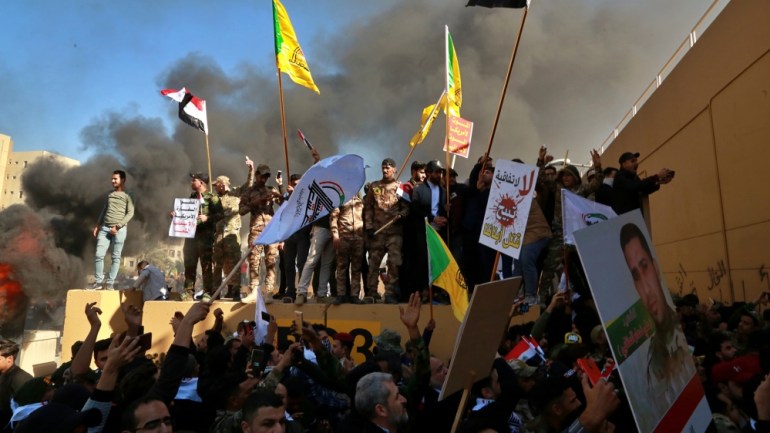
Two Iraqi intelligence sources suggested plans to withdraw American diplomats were not yet in motion, and would depend on whether Iraqi security forces were able to do a better job of halting attacks.
They said they had received orders to prevent attacks on US sites, and had been told that US evacuations would begin only if that effort failed.
Double-edged sword
Iraqis are concerned about the effect of November’s presidential election on the Trump administration’s decision-making.
While Trump has boasted of his hard line against Iran, he has also long promised to withdraw US troops from engagements in the Middle East. The US is already drawing down its force sent to help defeat ISIL fighters in Iraq from 2014-2017.
Some Iraqi officials dismissed Pompeo’s threat to pull out diplomats as bluster, designed to scare armed groups into stopping attacks. But they said it could backfire by provoking the militias instead, if they sense an opportunity to push Washington to retreat.
“The American threat to close their embassy is merely a pressure tactic, but is a double-edged sword,” said Gati Rikabi, a member of Iraq’s parliamentary security committee.
He and another committee member said US moves were designed to scare Iraqi leaders into supporting Prime Minister Mustafa al-Kadhimi, who has tried to check the power of Iran-aligned militia groups, with scant success.
Hawks on both sides
The militias are under public pressure to rein in supporters who might provoke Washington. Since last year, public opinion in Iraq has turned sharply against political groups seen as fomenting violence on behalf of Iran.
Publicly, the powerful Iran-backed Shia militia groups that control large factions in parliament have tried to distance themselves from attacks on Western targets.
US officials said they think the militias or their Iranian backers have created splinter offshoots to carry out such attacks, allowing the main organisations to evade blame.
A senior figure in a Shia political party said he thought Trump might want to pull out diplomats to keep them out of harm’s way and avoid an embarrassing pre-election incident.
Militia attacks were not necessarily under Tehran’s control, he said, noting Iran’s foreign ministry had publicly called for a halt to attacks on diplomatic missions in Iraq.
“Iran wants to boot the Americans out, but not at any cost. It doesn’t want instability on its western border,” the Shia leader said.
“Just like there are hawks in the US, there are hawks in Iran who have contact with the groups carrying out attacks, who aren’t necessarily following state policy.”