

The government agency that helped develop the COVID vaccine in record time can't get shots for its own workers, emails show
The vast majority of employees at the government agency that helped develop the coronavirus vaccine haven't been able to get the shot, internal emails obtained by Insider show.
The National Institutes of Health has vaccinated just over 3,000 of its employees within its Maryland locations, according to the emails and state data. That is a small fraction of NIH's overall workforce, including 20,260 at its headquarters in Bethesda, Maryland. It's unclear what arrangements the agency has for staffers in its other satellite offices across the US.
In the most recent email that Insider obtained dated February 5, the agency's top boss warned staff that its first supply of doses "has been exhausted."
That followed three other earlier emails sent in January updating employees on the status of the agency's plans to get them inoculated. None bore good news.
"We continue to await additional doses of COVID-19 vaccine — and to be honest, this has been a frustrating experience," Francis Collins, the NIH director, wrote in a staff-wide email on January 29.
The nation's leading health research agency has been at the forefront of the coronavirus vaccine work, including assisting and advising Operation Warp Speed, the program begun under former President Donald Trump to fast-track vaccine development.
The NIH — which employs Anthony Fauci, the federal government's top infectious diseases expert — conducts medical and public health research and provides billions of dollars in grants to fund medical research on cancer, addiction, Alzheimer's, infectious diseases, and other medical issues.
The agency's 300-acre Bethesda campus also has a research hospital called the Clinical Center where doctors can examine and treat COVID-19 patients.
Hospitals in most states have received shipments of vaccines to administer to their healthcare workers. In December, Maryland officials provided 2,300 doses of the state's vaccine allocation to NIH's frontline healthcare workers.
 Infectious diseases expert Anthony Fauci listens as President Joe Biden
(L) speaks as he tours the Viral Pathogenesis Laboratory at the National
Institutes of Health.
Infectious diseases expert Anthony Fauci listens as President Joe Biden
(L) speaks as he tours the Viral Pathogenesis Laboratory at the National
Institutes of Health.
'I do not have better news to share'
Since the December allocation, the NIH has received about 4,000 additional vaccine doses, emails show.
An email Collins sent to NIH staff on January 22 said that the agency received that one-time allocation of doses of the Moderna vaccine from Operation Warp Speed.
With the 2,300-dose allocation that the Maryland governor's office announced in December and the 4,000-dose allocation described in the emails in January, there would have been enough vaccines for 3,150 people.
The January 22 email said that staff who had received the first shots would take priority with the new batch of vaccines to ensure they could get the second shot to complete the dosage.
Collins also encouraged workers aged 65 and older to consider getting their shots through their local county programs where they live.
A week later on January 29, Collins sent another email to staff saying that he was working with the Maryland Department of Health and members of the Maryland congressional delegation on the issue.
Neither the NIH nor the White House responded to Insider's questions about why the agency was seeking vaccines from the state at that time rather than the federal government. A spokesperson at the Office of Management and Budget said that workers at most agencies were supposed to get vaccines when they became eligible under state and locality rules. States are providing the shots at different sites, including through pharmacies.
Collins's February 5 follow-up email informed staff that the agency only had enough vaccines left to make sure those who got the first dose could also get the second. He said Maryland wasn't sending more vaccines yet but that it was also working with federal agencies "to resolve this supply issue."
"I'm disappointed that I do not have better news to share on vaccine availability for NIH staff," he wrote.
It's not clear how many NIH workers who directly helped with the COVID-19 vaccine development have received a shot.
Collins, who has been director at NIH since 2009, got his shot publicly on December 22, as did Fauci, who has served as one of the government's top spokespersons on the pandemic. Fauci oversees the National Institute of Allergy and Infectious Diseases at the NIH.
The lead scientist on the COVID vaccine project, Kizzmekia Corbett, received the vaccine and posted about it on Instagram on December 30.
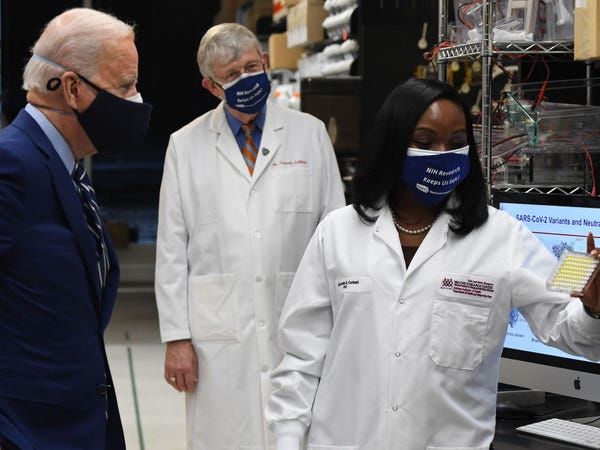 President Joe Biden (L) speaks with to Kizzmekia Corbett (R) as he tours the Viral Pathogenesis Laboratory at the National Institutes of Health.
 Elsewhere in the federal government
Vaccines are still in short supply and states have given certain groups of people priority, including healthcare workers and people living in nursing homes.
Fauci said on CNN Tuesday that vaccines wouldn't be widely available until early June as manufacturers ramp up their production.
The government employs more than 4 million people including those in the military. Most haven't received a vaccine yet.
That includes healthcare workers who've been fighting the pandemic. According to The Washington Post, 6,000 healthcare workers in the Public Health Services Corps are still waiting to get their vaccines. Many have been deployed to care for COVID-19 patients and to administer vaccines.
Over at the Environmental Protection Agency, the agency has not received federally allocated vaccines, but it has designated some of its workers as priority candidates for vaccines from states, according to an agency spokesperson.
The agency has identified emergency response workers and others who can't socially-distance because of their jobs — such as people working in labs — for potential early vaccines.
"EPA leadership is working with each state and the EPA's list of designated employees will be subject to that state's prioritization and rules," said the agency spokesperson.
The Centers for Disease Control and Prevention decided last year that the workers at the Bureau of Prisons, the Indian Health Service, the State Department, the Defense Department, and the Department of Veteran's Affairs should be first to get vaccinated.
A spokesman from the Office of Management and Budget said that federal agencies were asked to identify "a small subset of their workforce who are essential critical infrastructure workers and therefore might fit into categories that states and localities have prioritized." Those include emergency response and healthcare workers.
At the VA, 68% of workers were vaccinated as of February 10. The State Department had vaccinated 11,500 people both in the US and abroad as of January 28, according to an agency spokesperson.
The State Department said that in the US workers "deemed essential for mission-critical operations" and those who couldn't work from home got priority. When considering workers abroad it looked primarily at coronavirus infection rates where workers were stationed.
"Our goal is to offer the vaccine to 100% of department personnel as quickly as vaccine supply permits," the spokesperson said.
President Joe Biden, Vice President Kamala Harris — their spouses — and members of Congress were among the first in line in the US to get vaccinated. Hundreds of White House officials and political appointees already got their vaccines as well, according to CNN.
Insider previously reported that essential workers at the Capitol who clean, repair buildings, and provide food have not been eligible for vaccines.
Back at the NIH, Collins said in his email to staff that the goal was to have staff vaccinated as soon as possible.
"For some, this may be in your county," he wrote.