Somaliland Meets Legal Criteria for Statehood but Faces Strategic Resistance from Egypt, Turkey and Saudi Arabia
Despite satisfying the key benchmarks for independence, geopolitical and regional interests continue to delay wider recognition of Somaliland’s sovereignty
Somaliland’s longstanding quest for international recognition has entered a new and highly contested phase following Israel’s formal acknowledgment of its independence last December, yet significant regional powers including Egypt, Turkey and Saudi Arabia remain wary or opposed, underscoring the geopolitical complexity of the issue in the Horn of Africa.
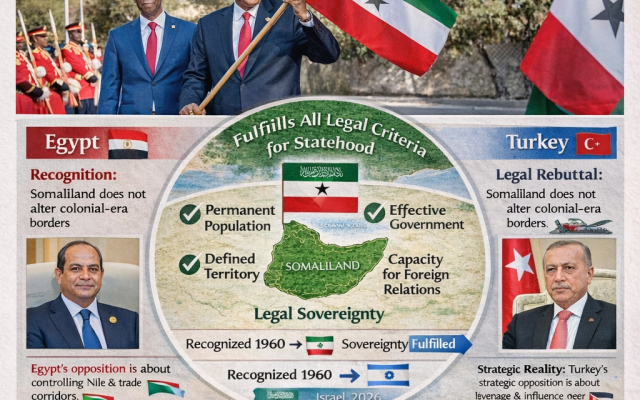
Somaliland, which declared independence from Somalia in 1991 and has maintained de facto autonomy for more than three decades, meets the widely accepted legal criteria for statehood — including a defined territory, permanent population, effective government and capacity for foreign relations — criteria recognised under international law and the Montevideo Convention.
Its internal governance includes competitive elections, stable institutions and relative security compared with the rest of Somalia, making its case for sovereignty particularly distinctive.
Yet broader diplomatic acceptance remains elusive because recognition is not determined by legal qualifications alone but by strategic calculations and regional balance.
Egypt and Saudi Arabia have publicly rejected unilateral recognitions, with Cairo reaffirming support for Somalia’s territorial integrity and Riyadh denouncing Israel’s move as contrary to international law and potentially destabilising to the Horn of Africa.
Both states are mindful of the broader implications for regional alliances, territorial precedent and their own influence in Red Sea and East African geopolitics, where control over maritime routes and security architectures remains a priority.
Turkey, a close partner of Somalia’s federal government, has also voiced reservations, aligning with Mogadishu’s position that changes to sovereign borders should be negotiated rather than imposed by external recognition.
Ankara backed the Ankara Declaration that sought to ease tensions between Somalia and Ethiopia over Somaliland’s status, reflecting concerns that heightened separatist claims across Africa could have unforeseen ripple effects.
For its part, Somaliland has vigorously pursued diplomatic outreach, leveraging its strategic location along the Gulf of Aden and its contribution to regional anti-piracy efforts to attract interest from global powers.
Its supporters argue that formal recognition would solidify a reliable partner for maritime security and economic development in a critical corridor for global trade.
Yet many governments remain cautious, balancing Somaliland’s internal stability and legal case with worries about setting a precedent for other separatist movements, preserving existing alliances, and maintaining regional equilibrium as geopolitical rivalries — particularly between Gulf states and influential regional actors — play out across the broader Middle East and African arenas.
Recognition, in this context, remains as much a political calculus as a question of legal legitimacy.
Somaliland, which declared independence from Somalia in 1991 and has maintained de facto autonomy for more than three decades, meets the widely accepted legal criteria for statehood — including a defined territory, permanent population, effective government and capacity for foreign relations — criteria recognised under international law and the Montevideo Convention.
Its internal governance includes competitive elections, stable institutions and relative security compared with the rest of Somalia, making its case for sovereignty particularly distinctive.
Yet broader diplomatic acceptance remains elusive because recognition is not determined by legal qualifications alone but by strategic calculations and regional balance.
Egypt and Saudi Arabia have publicly rejected unilateral recognitions, with Cairo reaffirming support for Somalia’s territorial integrity and Riyadh denouncing Israel’s move as contrary to international law and potentially destabilising to the Horn of Africa.
Both states are mindful of the broader implications for regional alliances, territorial precedent and their own influence in Red Sea and East African geopolitics, where control over maritime routes and security architectures remains a priority.
Turkey, a close partner of Somalia’s federal government, has also voiced reservations, aligning with Mogadishu’s position that changes to sovereign borders should be negotiated rather than imposed by external recognition.
Ankara backed the Ankara Declaration that sought to ease tensions between Somalia and Ethiopia over Somaliland’s status, reflecting concerns that heightened separatist claims across Africa could have unforeseen ripple effects.
For its part, Somaliland has vigorously pursued diplomatic outreach, leveraging its strategic location along the Gulf of Aden and its contribution to regional anti-piracy efforts to attract interest from global powers.
Its supporters argue that formal recognition would solidify a reliable partner for maritime security and economic development in a critical corridor for global trade.
Yet many governments remain cautious, balancing Somaliland’s internal stability and legal case with worries about setting a precedent for other separatist movements, preserving existing alliances, and maintaining regional equilibrium as geopolitical rivalries — particularly between Gulf states and influential regional actors — play out across the broader Middle East and African arenas.
Recognition, in this context, remains as much a political calculus as a question of legal legitimacy.