Saudi Arabia’s Red Sea Shift Signals Structural Break From Hormuz Dependency Amid Regional Energy Shock
As instability around the Strait of Hormuz disrupts global shipping, Riyadh is accelerating a long-planned pivot to Red Sea export routes, reshaping energy flows and regional power balance
Saudi Arabia’s accelerating reliance on Red Sea export routes reflects a systemic reconfiguration of global oil logistics triggered by sustained instability in and around the Strait of Hormuz, one of the world’s most critical energy chokepoints.
What is confirmed across recent reporting is that Iran’s military pressure and maritime disruption in and around the Strait of Hormuz have significantly reduced or complicated normal tanker traffic through the waterway, forcing producers and buyers to reroute shipments.
The Strait traditionally handles a large share of global seaborne oil trade, and even partial obstruction has immediate consequences for prices, insurance costs, and global supply chains.
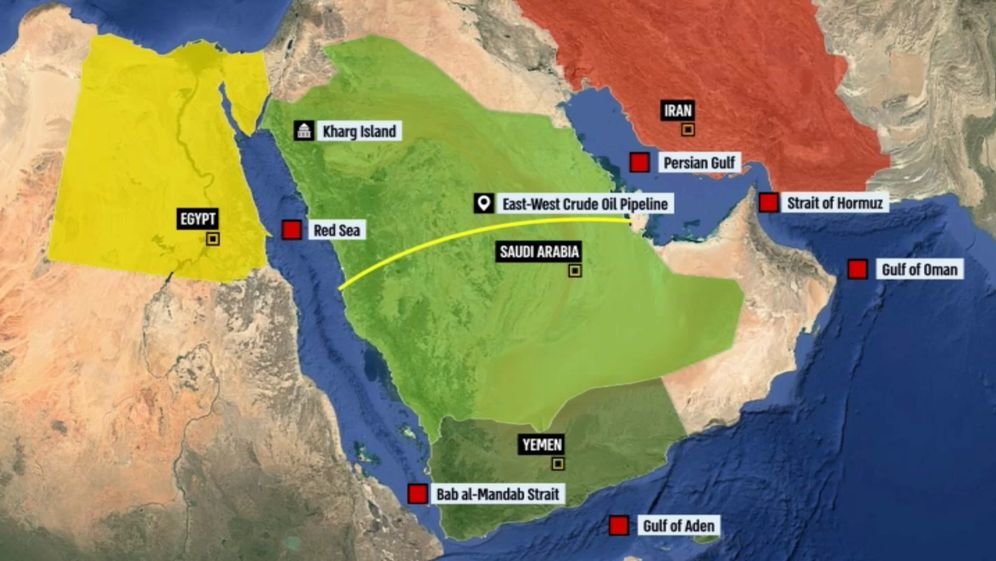
In response, Saudi Arabia has expanded and optimized its East–West pipeline system and increased utilization of Red Sea terminals, particularly Yanbu.
This infrastructure allows crude oil from eastern production fields to be transported overland and exported westward, bypassing the Persian Gulf entirely.
The system is designed as a strategic redundancy against exactly the kind of disruption now being experienced in the Gulf.
Recent logistical data shows that Saudi exports via the Red Sea have risen sharply as tanker operators divert cargoes away from the Strait of Hormuz.
The pipeline linking the Abqaiq processing hub to Yanbu has a capacity of several million barrels per day, and Riyadh has pushed flows close to operational limits during periods of peak disruption.
While this does not fully replace Gulf export capacity, it provides a critical partial offset that prevents a complete supply shock.
The broader mechanism at work is not simply rerouting, but a structural diversification of export geography.
For decades, Saudi oil exports have been heavily dependent on Gulf terminals exposed to Iranian pressure.
The Red Sea corridor reduces that vulnerability but introduces new dependencies, including longer maritime routes through the Bab el-Mandeb strait and increased exposure to instability in the Red Sea theatre.
This shift is occurring against a backdrop of wider regional escalation involving Iran, which has used asymmetric naval and missile capabilities to threaten shipping lanes and regional infrastructure.
Multiple governments and shipping operators have responded with heightened naval escorts, rerouting, and in some cases temporary suspension of transits through affected waters.
The economic stakes are immediate and global.
Any sustained disruption to Gulf shipping routes tightens oil supply, increases freight and insurance premiums, and amplifies volatility in energy markets.
Even when physical volumes are partially restored through alternative routes, the risk premium embedded in prices remains elevated due to uncertainty over future disruptions.
Strategically, Saudi Arabia’s Red Sea pivot reflects a long-term effort to insulate its export economy from chokepoint risk.
But it does not eliminate systemic exposure.
Instead, it redistributes it across a wider and more complex maritime network, where multiple narrow passages must remain secure simultaneously for global supply stability.
The result is a more fragmented and militarized energy geography, where infrastructure redundancy improves resilience but cannot fully neutralize geopolitical risk.
Energy security is increasingly determined not by production capacity alone, but by the reliability of maritime corridors spanning multiple conflict-prone regions.
What is confirmed across recent reporting is that Iran’s military pressure and maritime disruption in and around the Strait of Hormuz have significantly reduced or complicated normal tanker traffic through the waterway, forcing producers and buyers to reroute shipments.
The Strait traditionally handles a large share of global seaborne oil trade, and even partial obstruction has immediate consequences for prices, insurance costs, and global supply chains.
In response, Saudi Arabia has expanded and optimized its East–West pipeline system and increased utilization of Red Sea terminals, particularly Yanbu.
This infrastructure allows crude oil from eastern production fields to be transported overland and exported westward, bypassing the Persian Gulf entirely.
The system is designed as a strategic redundancy against exactly the kind of disruption now being experienced in the Gulf.
Recent logistical data shows that Saudi exports via the Red Sea have risen sharply as tanker operators divert cargoes away from the Strait of Hormuz.
The pipeline linking the Abqaiq processing hub to Yanbu has a capacity of several million barrels per day, and Riyadh has pushed flows close to operational limits during periods of peak disruption.
While this does not fully replace Gulf export capacity, it provides a critical partial offset that prevents a complete supply shock.
The broader mechanism at work is not simply rerouting, but a structural diversification of export geography.
For decades, Saudi oil exports have been heavily dependent on Gulf terminals exposed to Iranian pressure.
The Red Sea corridor reduces that vulnerability but introduces new dependencies, including longer maritime routes through the Bab el-Mandeb strait and increased exposure to instability in the Red Sea theatre.
This shift is occurring against a backdrop of wider regional escalation involving Iran, which has used asymmetric naval and missile capabilities to threaten shipping lanes and regional infrastructure.
Multiple governments and shipping operators have responded with heightened naval escorts, rerouting, and in some cases temporary suspension of transits through affected waters.
The economic stakes are immediate and global.
Any sustained disruption to Gulf shipping routes tightens oil supply, increases freight and insurance premiums, and amplifies volatility in energy markets.
Even when physical volumes are partially restored through alternative routes, the risk premium embedded in prices remains elevated due to uncertainty over future disruptions.
Strategically, Saudi Arabia’s Red Sea pivot reflects a long-term effort to insulate its export economy from chokepoint risk.
But it does not eliminate systemic exposure.
Instead, it redistributes it across a wider and more complex maritime network, where multiple narrow passages must remain secure simultaneously for global supply stability.
The result is a more fragmented and militarized energy geography, where infrastructure redundancy improves resilience but cannot fully neutralize geopolitical risk.
Energy security is increasingly determined not by production capacity alone, but by the reliability of maritime corridors spanning multiple conflict-prone regions.