Saudi Arabia’s Defence Spending Surge Raises Strategic Questions Over Scale and Industrial Ambition
Riyadh’s rising military budget reflects regional tensions, Vision 2030 industrial goals, and shifting global defence supply chains
Saudi Arabia’s defence spending trajectory is increasingly shaped by a system-level shift in state priorities: the integration of national security, economic diversification, and industrial policy under its Vision 2030 programme.
The latest reporting indicates that military expenditure has continued to expand from already elevated levels, with official estimates placing annual defence outlays at around $75–80 billion in recent years and new fiscal data showing further increases in overall government spending, including a sharp rise in military allocations.
What is confirmed is that Saudi Arabia remains one of the world’s largest defence spenders, consistently ranking among the top five globally.
Recent budget disclosures and defence industry statements show military spending has been maintained at roughly one-fifth of total government expenditure, reflecting both sustained procurement cycles and ongoing investment in domestic defence manufacturing capacity.
This includes the expansion of the General Authority for Military Industries’ localisation programme, which aims to significantly increase domestic production of military equipment and reduce reliance on foreign suppliers over the next decade.
The immediate driver of recent increases is a combination of regional security pressures and domestic industrial strategy.
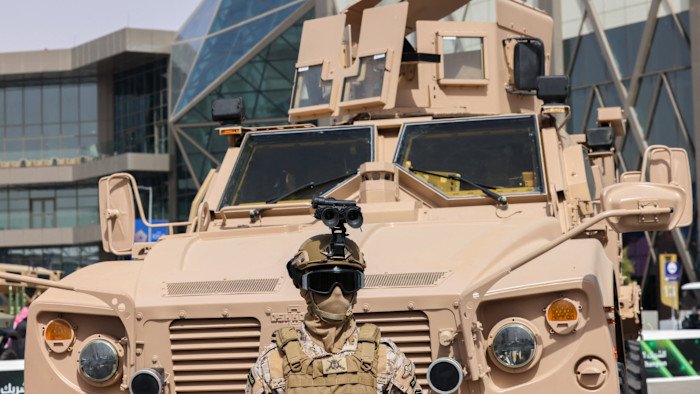
Regional instability in the Gulf has contributed to higher operational and procurement costs, while Saudi Arabia’s broader state strategy is pushing toward building a self-sufficient defence sector capable of producing advanced systems ranging from armoured vehicles to aerospace components and electronic warfare systems.
The state-backed Saudi Arabian Military Industries entity has been central to this effort, coordinating partnerships with global defence contractors and attempting to develop local supply chains.
At the same time, fiscal data indicates that rising defence expenditure is occurring alongside widening budget deficits and increased public borrowing.
Higher spending across multiple sectors, not just defence, has placed pressure on public finances even as non-oil revenue grows.
This reflects a structural trade-off embedded in Vision 2030: sustained state-led investment intended to transform the economy away from hydrocarbons dependence, even at the cost of short- to medium-term fiscal strain.
The strategic implication extends beyond Saudi Arabia’s domestic economy.
As one of the largest importers of advanced weapons systems globally, any sustained increase in its defence budget influences international arms manufacturers, particularly in the United States, Europe, and increasingly Asia.
At the same time, localisation efforts aim to shift part of that value chain into Saudi territory, which could gradually alter procurement patterns and reduce external dependency over time.
For global defence markets, the significance lies in scale and direction rather than any single procurement decision.
Saudi Arabia’s spending growth reinforces its role as a stabilising anchor of demand for major arms suppliers while simultaneously signalling a long-term ambition to become a regional defence industrial hub.
That dual objective—high external procurement alongside rapid internal industrialisation—defines the current phase of its military expansion and will continue to shape both regional security dynamics and global defence trade flows.
The latest reporting indicates that military expenditure has continued to expand from already elevated levels, with official estimates placing annual defence outlays at around $75–80 billion in recent years and new fiscal data showing further increases in overall government spending, including a sharp rise in military allocations.
What is confirmed is that Saudi Arabia remains one of the world’s largest defence spenders, consistently ranking among the top five globally.
Recent budget disclosures and defence industry statements show military spending has been maintained at roughly one-fifth of total government expenditure, reflecting both sustained procurement cycles and ongoing investment in domestic defence manufacturing capacity.
This includes the expansion of the General Authority for Military Industries’ localisation programme, which aims to significantly increase domestic production of military equipment and reduce reliance on foreign suppliers over the next decade.
The immediate driver of recent increases is a combination of regional security pressures and domestic industrial strategy.
Regional instability in the Gulf has contributed to higher operational and procurement costs, while Saudi Arabia’s broader state strategy is pushing toward building a self-sufficient defence sector capable of producing advanced systems ranging from armoured vehicles to aerospace components and electronic warfare systems.
The state-backed Saudi Arabian Military Industries entity has been central to this effort, coordinating partnerships with global defence contractors and attempting to develop local supply chains.
At the same time, fiscal data indicates that rising defence expenditure is occurring alongside widening budget deficits and increased public borrowing.
Higher spending across multiple sectors, not just defence, has placed pressure on public finances even as non-oil revenue grows.
This reflects a structural trade-off embedded in Vision 2030: sustained state-led investment intended to transform the economy away from hydrocarbons dependence, even at the cost of short- to medium-term fiscal strain.
The strategic implication extends beyond Saudi Arabia’s domestic economy.
As one of the largest importers of advanced weapons systems globally, any sustained increase in its defence budget influences international arms manufacturers, particularly in the United States, Europe, and increasingly Asia.
At the same time, localisation efforts aim to shift part of that value chain into Saudi territory, which could gradually alter procurement patterns and reduce external dependency over time.
For global defence markets, the significance lies in scale and direction rather than any single procurement decision.
Saudi Arabia’s spending growth reinforces its role as a stabilising anchor of demand for major arms suppliers while simultaneously signalling a long-term ambition to become a regional defence industrial hub.
That dual objective—high external procurement alongside rapid internal industrialisation—defines the current phase of its military expansion and will continue to shape both regional security dynamics and global defence trade flows.