
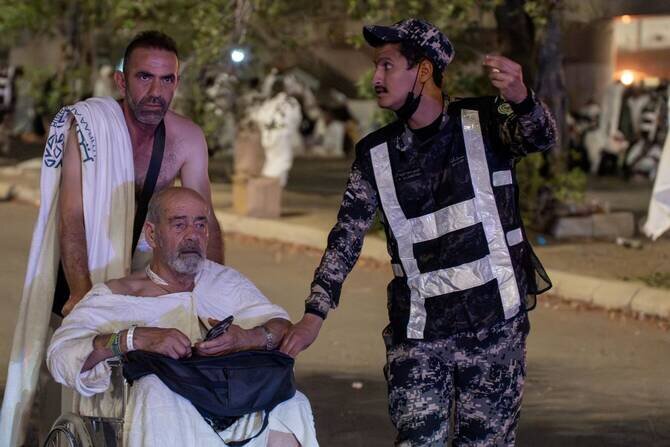
Saudi Arabia Enhances Services for Elderly and Disabled Pilgrims at Grand Mosque
Authority sets up gates, elevators, prayer areas and offers free electric carts to help elderly and disabled pilgrims during Hajj.
In a display of the care Saudi Arabia lavishes on pilgrims, the General Authority for the Affairs of the Grand Mosque and the Prophet’s Mosque expanded its services this year at the Grand Mosque for elderly pilgrims and those with disabilities.
The goal is to allow them to perform rituals with ease and reassurance, in surroundings designed around their human, medical, and mobility needs.The authority said it set aside suitable gates, elevators, and prayer areas for these groups, supplied free electric carts, and assigned teams of male and female volunteers to help with movement and offer guidance directly inside the mosque and its courtyards.
Modern and smart tools were also used to ease movement and access.
Digital screens and interactive maps were placed throughout the mosque and its courtyards to steer elderly and disabled worshippers swiftly and simply to the locations, services, and routes best suited to them.During peak hours, the authority laid on dedicated operating routes to keep these groups safe and moving freely.
One prominent route — from the arrival point at Shi’b Amer through to Bab Al-Fath (the Gate of Conquest) — featured volunteers pushing manual carts, special directional signs for people with disabilities, white canes for the blind, sign-language interpreters, and a volunteer medical team on call around the clock for emergencies and health needs.The arrangement is meant to keep people moving, thin out crowding, and deliver the highest possible standard of safety and comfort.
Electric carts were stationed in the northern plaza, running from the Jarwal tunnel to the King Abdullah Gate, with additional electric carts reserved for tawaf and sa’i.
Volunteers and guides fluent in several world languages provide on-site escorts, and sign-language interpretation is on hand for worshippers who are deaf or hard of hearing.Ahmed Al-Sayed, an elderly Egyptian pilgrim, voiced his gratitude for what he found inside the Grand Mosque: "From the moment I arrived, there were volunteers ready to help me move around," he told Arab News.
"The routes were clear and easy to follow, the electric carts saved us an enormous amount of effort, and I felt a genuine sense of care for elderly and disabled pilgrims".
He added that this year was completely different from before.To gauge worshipper satisfaction, the authority said it uses field and online surveys, the direct tracking of comments and complaints, and specialized field-observation teams that measure the quality of service and the speed of response.
Looking ahead, the authority confirmed it is continuing to expand dedicated pathways and on-site facilities, develop multilingual digital guidance systems, strengthen services for the hearing and visually impaired, and use crowd analytics technology to further improve movement and service delivery at both holy mosques.
All of it is aligned with the targets of Saudi Vision 2030.