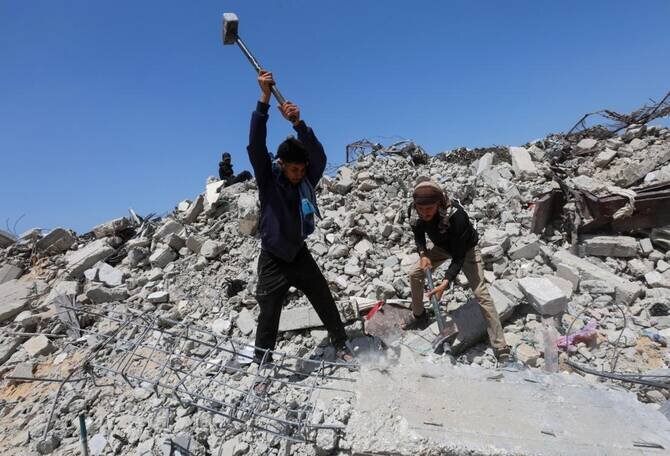
Palestinians Tackle Reconstruction Using Gaza Rubble as US Plan Hits Snag
Locally led initiatives emerge as international aid efforts face hurdles in post-war rebuilding.
In the wake of Israel's two-year assault on Gaza, Palestinians are employing a pragmatic strategy to rebuild their damaged cities by repaving streets with crushed concrete and metal from the war rubble.
This initiative, spearheaded by the United Nations Development Programme (UNDP), aims to clear an estimated 61 million tons of debris that has impeded access to essential services like hospitals and water wells, hindering economic revival.
The UNDP's Alessandro Mrakic explains that besides collecting rubble, they are now sorting, crushing, and reusing it for road rehabilitation and constructing shelters and community kitchens.
In Khan Younis, the heavy machinery grinds through mountains of concrete and steel remnants, a testament to the scale of destruction left in its wake.
However, progress is slow due to the risks associated with unexploded ordnance and the proximity to volatile areas, as workers like Ibrahim Al-Sarsawi, 32, face dangers that threaten their very livelihoods.
The UNDP estimates that complete rubble clearance could take up to seven years under ideal conditions—accelerated access, consistent fuel supply—yet these remain significant challenges in the resource-constrained Gaza.
To date, they have managed to remove approximately 287,000 tons of debris, a fraction of what is needed.
The cost of comprehensive recovery and reconstruction in Gaza is estimated at $71.4 billion over the next decade.
For many Palestinians like Sobhi Dawoud, a displaced resident in Khan Younis tent encampment, this post-war phase marks not just the physical removal of rubble but also the beginning of infrastructure restoration—electricity, water, schools, and streets.
The path ahead promises to be long and fraught with obstacles, yet these local efforts represent an essential initial step towards healing the scars of conflict.
This initiative, spearheaded by the United Nations Development Programme (UNDP), aims to clear an estimated 61 million tons of debris that has impeded access to essential services like hospitals and water wells, hindering economic revival.
The UNDP's Alessandro Mrakic explains that besides collecting rubble, they are now sorting, crushing, and reusing it for road rehabilitation and constructing shelters and community kitchens.
In Khan Younis, the heavy machinery grinds through mountains of concrete and steel remnants, a testament to the scale of destruction left in its wake.
However, progress is slow due to the risks associated with unexploded ordnance and the proximity to volatile areas, as workers like Ibrahim Al-Sarsawi, 32, face dangers that threaten their very livelihoods.
The UNDP estimates that complete rubble clearance could take up to seven years under ideal conditions—accelerated access, consistent fuel supply—yet these remain significant challenges in the resource-constrained Gaza.
To date, they have managed to remove approximately 287,000 tons of debris, a fraction of what is needed.
The cost of comprehensive recovery and reconstruction in Gaza is estimated at $71.4 billion over the next decade.
For many Palestinians like Sobhi Dawoud, a displaced resident in Khan Younis tent encampment, this post-war phase marks not just the physical removal of rubble but also the beginning of infrastructure restoration—electricity, water, schools, and streets.
The path ahead promises to be long and fraught with obstacles, yet these local efforts represent an essential initial step towards healing the scars of conflict.