Philippines and US Conduct Largest Joint Counter-Landing Drills Near South China Sea
The Balikatan exercises involve over 17,000 troops from the Philippines, the United States, Australia, New Zealand, and Japan, showcasing advanced weapons capabilities in coastal defense maneuvers.
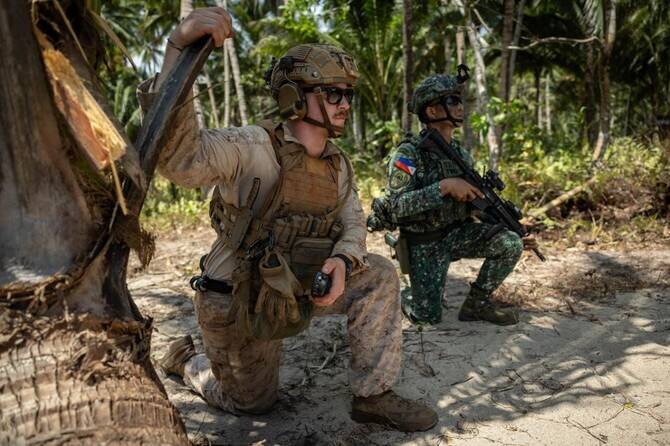
PALAWAN, Philippines: As simulated enemy boats and unmanned craft approached the shores of Palawan island, facing the South China Sea, Philippine and US forces conducted counter-landing drills on Monday.
These exercises were part of the annual Balikatan or "shoulder to shoulder" drills, which also involve forces from Australia and New Zealand.
The drills aim to enhance coastal defense capabilities and interoperability among participating nations in protecting territorial waters.
Philippine military chief Romeo Brawner highlighted the strategic significance of Palawan's location, given its proximity to the South China Sea and the Kalayaan Island Group, part of the Spratly Islands that Manila claims as part of its exclusive economic zone.
"We are defending our exclusive economic zone, where we get our resources, food, and energy.
So it’s really very important that we defend this territory of the Philippines," Brawner stated.
This year's drills feature a heavier emphasis on unmanned systems compared to previous exercises, including HIMARS and drones.
China has criticized these joint military exercises, stating they escalate regional tensions.
The Philippines and China have been involved in maritime confrontations in recent years over disputed areas in the South China Sea.
A 2016 arbitral ruling invalidated China's claims to most of the area.
The current iteration of Balikatan is the largest to date, with more than 17,000 troops participating from the Philippines and the United States.
Another phase of the drills will take place in northern Luzon, where Japanese combat troops will conduct a maritime strike exercise using Type 88 missiles.
This increased defense engagement between Japan and the Philippines follows the signing of a reciprocal access agreement and Japan's decision to lift restrictions on overseas arms sales.
The scale of this year’s Balikatan exercises underscores Washington's defense commitments to the region, even as it remains engaged in the Middle East.
These exercises were part of the annual Balikatan or "shoulder to shoulder" drills, which also involve forces from Australia and New Zealand.
The drills aim to enhance coastal defense capabilities and interoperability among participating nations in protecting territorial waters.
Philippine military chief Romeo Brawner highlighted the strategic significance of Palawan's location, given its proximity to the South China Sea and the Kalayaan Island Group, part of the Spratly Islands that Manila claims as part of its exclusive economic zone.
"We are defending our exclusive economic zone, where we get our resources, food, and energy.
So it’s really very important that we defend this territory of the Philippines," Brawner stated.
This year's drills feature a heavier emphasis on unmanned systems compared to previous exercises, including HIMARS and drones.
China has criticized these joint military exercises, stating they escalate regional tensions.
The Philippines and China have been involved in maritime confrontations in recent years over disputed areas in the South China Sea.
A 2016 arbitral ruling invalidated China's claims to most of the area.
The current iteration of Balikatan is the largest to date, with more than 17,000 troops participating from the Philippines and the United States.
Another phase of the drills will take place in northern Luzon, where Japanese combat troops will conduct a maritime strike exercise using Type 88 missiles.
This increased defense engagement between Japan and the Philippines follows the signing of a reciprocal access agreement and Japan's decision to lift restrictions on overseas arms sales.
The scale of this year’s Balikatan exercises underscores Washington's defense commitments to the region, even as it remains engaged in the Middle East.