Oil Prices Surge as Markets Remain Cautionary Over Iran War Uncertainty
Uncertainty surrounding the end of the Iran war leads to mixed stock performance and increased oil prices.
World shares exhibited divergent trends on Wednesday, following a decline in US stocks, while oil prices experienced a notable surge of more than 3 percent due to uncertainties regarding the Iranian conflict's timeline.
The S&P 500 and Dow Jones Industrial Average futures demonstrated minor gains, less than 0.1 percent.
The Federal Reserve was anticipated to maintain its key interest rate at 3.6 percent following its policy meeting on Wednesday.
Most policymakers believe that this rate can manage inflation without significantly affecting employment or unemployment levels.
In early European trading, the FTSE 100, DAX, and CAC 40 indices experienced declines of 0.6 percent, 0.3 percent, and 0.6 percent respectively.
Japanese markets were closed for a holiday.
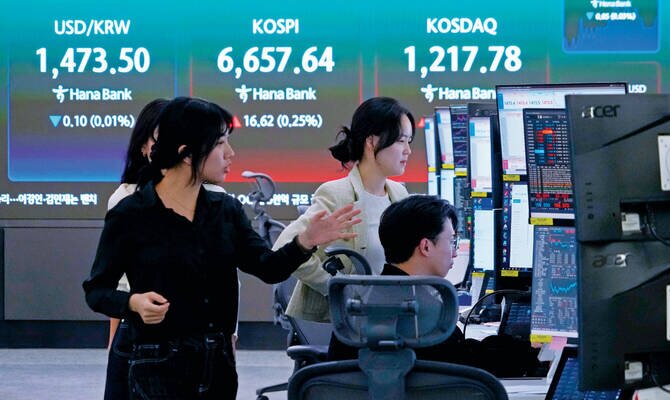
Asian indices presented varied outcomes, with South Korea's Kospi increasing by 0.8 percent, Hong Kong's Hang Seng rising by 1.7 percent, the Shanghai Composite advancing by 0.7 percent, Australia's S&P/ASX 200 decreasing by 0.3 percent, Taiwan's Taiex dropping by 0.6 percent, and India's Sensex climbing by 0.9 percent.
The price of Brent crude oil for June delivery saw a significant increase of 3.1 percent, reaching $114.70 per barrel.
July Brent contracts also witnessed a 3 percent surge, pricing at $107.61 per barrel.
Prior to the conflict escalation in late February, Brent oil traded around $70 per barrel.
The United Arab Emirates' decision to exit the Organization of the Petroleum Exporting Countries (OPEC) on Friday has garnered considerable attention from oil markets.
OPEC represents approximately 40 percent of global oil production, with the UAE being one of its largest producers.
The UAE has consistently opposed OPEC's production quotas in recent years, seeking to expand its global oil sales.
Initially, oil prices dropped due to expectations of increased supply following the UAE's departure.
However, ING Bank strategists Warren Patterson and Ewa Manthey stated that the UAE's exit will result in higher output levels.
The ongoing US-Iran negotiations for a permanent ceasefire remain stalled, and the Strait of Hormuz remains largely closed.
Consequently, short-term impacts on oil prices continue to be heavily influenced by prospects of re-establishing passage through this critical waterway.
The S&P 500 and Dow Jones Industrial Average futures demonstrated minor gains, less than 0.1 percent.
The Federal Reserve was anticipated to maintain its key interest rate at 3.6 percent following its policy meeting on Wednesday.
Most policymakers believe that this rate can manage inflation without significantly affecting employment or unemployment levels.
In early European trading, the FTSE 100, DAX, and CAC 40 indices experienced declines of 0.6 percent, 0.3 percent, and 0.6 percent respectively.
Japanese markets were closed for a holiday.
Asian indices presented varied outcomes, with South Korea's Kospi increasing by 0.8 percent, Hong Kong's Hang Seng rising by 1.7 percent, the Shanghai Composite advancing by 0.7 percent, Australia's S&P/ASX 200 decreasing by 0.3 percent, Taiwan's Taiex dropping by 0.6 percent, and India's Sensex climbing by 0.9 percent.
The price of Brent crude oil for June delivery saw a significant increase of 3.1 percent, reaching $114.70 per barrel.
July Brent contracts also witnessed a 3 percent surge, pricing at $107.61 per barrel.
Prior to the conflict escalation in late February, Brent oil traded around $70 per barrel.
The United Arab Emirates' decision to exit the Organization of the Petroleum Exporting Countries (OPEC) on Friday has garnered considerable attention from oil markets.
OPEC represents approximately 40 percent of global oil production, with the UAE being one of its largest producers.
The UAE has consistently opposed OPEC's production quotas in recent years, seeking to expand its global oil sales.
Initially, oil prices dropped due to expectations of increased supply following the UAE's departure.
However, ING Bank strategists Warren Patterson and Ewa Manthey stated that the UAE's exit will result in higher output levels.
The ongoing US-Iran negotiations for a permanent ceasefire remain stalled, and the Strait of Hormuz remains largely closed.
Consequently, short-term impacts on oil prices continue to be heavily influenced by prospects of re-establishing passage through this critical waterway.