Asian Development Bank Cuts Regional Growth Forecasts Amid War in Middle East
ADB President Masato Kanda noted the significant downward revision due to the war's impact on energy prices, financial conditions, and economic activity across Asia.
The Asian Development Bank (ADB) has revised its economic growth forecast for the region.
According to ADB President Masato Kanda, the institution now predicts a growth rate of 4.7 percent for this year and 4.8 percent for next year, down from previous projections of 5.1 percent for both years.
This downward revision stems directly from the ongoing war in the Middle East.
The conflict has led to increased energy prices, tighter financial conditions, and decreased economic activity throughout Asia.
Kanda emphasizes that these disruptions are systemic and will have long-lasting effects on global energy and trade networks.
The ADB report also warns of rising inflation rates across the region, with a forecasted increase to 5.2 percent in 2026 from an earlier projection of 3.6 percent.
The International Monetary Fund (IMF) previously adjusted its 2026 global growth outlook due to the Iran war, citing concerns over diminished production and exports from commodity-exporting countries directly affected by the conflict.
The impact of these disruptions on GDP growth projections for 2026 depends largely on damage to energy and transportation infrastructure as well as the dependency on the Strait of Hormuz and availability of alternative export routes.
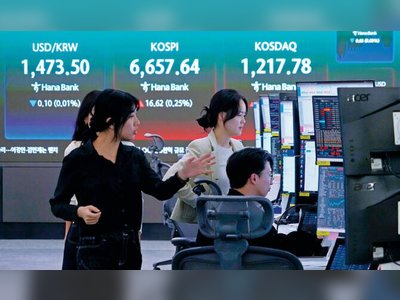
The IMF has also observed a decline in global equity prices, with an 8 percent decrease since February, and significant increases in sovereign bond yields.
This market turmoil is driven by rising energy costs and heightened inflation expectations.
Furthermore, volatility in the bond market has been exacerbated by increasing debt-to-GDP levels and the greater issuance of short-term securities that are more susceptible to rollover risks during periods of high inflation.
The ADB suggests that if the conflict escalates further, its impact on economic growth and inflation could worsen significantly.
For instance, if oil prices were to peak in May and remain elevated, growth in developing Asia and the Pacific could slow to 4.2 percent this year and 4 percent in 2027, with inflation reaching 7.4 percent in 2026.
In response to these developments, the ADB advises central banks to focus on controlling market volatility while closely monitoring inflation expectations.
These measures are aimed at mitigating some of the adverse economic effects caused by the war in the Middle East.
According to ADB President Masato Kanda, the institution now predicts a growth rate of 4.7 percent for this year and 4.8 percent for next year, down from previous projections of 5.1 percent for both years.
This downward revision stems directly from the ongoing war in the Middle East.
The conflict has led to increased energy prices, tighter financial conditions, and decreased economic activity throughout Asia.
Kanda emphasizes that these disruptions are systemic and will have long-lasting effects on global energy and trade networks.
The ADB report also warns of rising inflation rates across the region, with a forecasted increase to 5.2 percent in 2026 from an earlier projection of 3.6 percent.
The International Monetary Fund (IMF) previously adjusted its 2026 global growth outlook due to the Iran war, citing concerns over diminished production and exports from commodity-exporting countries directly affected by the conflict.
The impact of these disruptions on GDP growth projections for 2026 depends largely on damage to energy and transportation infrastructure as well as the dependency on the Strait of Hormuz and availability of alternative export routes.
The IMF has also observed a decline in global equity prices, with an 8 percent decrease since February, and significant increases in sovereign bond yields.
This market turmoil is driven by rising energy costs and heightened inflation expectations.
Furthermore, volatility in the bond market has been exacerbated by increasing debt-to-GDP levels and the greater issuance of short-term securities that are more susceptible to rollover risks during periods of high inflation.
The ADB suggests that if the conflict escalates further, its impact on economic growth and inflation could worsen significantly.
For instance, if oil prices were to peak in May and remain elevated, growth in developing Asia and the Pacific could slow to 4.2 percent this year and 4 percent in 2027, with inflation reaching 7.4 percent in 2026.
In response to these developments, the ADB advises central banks to focus on controlling market volatility while closely monitoring inflation expectations.
These measures are aimed at mitigating some of the adverse economic effects caused by the war in the Middle East.