Gazans Trapped in West Bank Struggle to Survive Amid Uncertainty
Thousands of Gazans displaced by war now face an uncertain future in the West Bank, where they struggle for stability and connection with their homeland.
Under the bleachers of a West Bank stadium, a dozen men from Gaza reside in a former changing room, cut off from their homes by the conflict that erupted over two and a half years ago.
Among them is Sameer Abu Salah, 54, who was working in Tel Aviv before entering Nablus just four days before the war began.
Now, he lives off collecting recyclables, sending money home to his family after losing two sons to Israeli airstrikes.
Counting all those stranded is challenging; however, the Palestinian Authority's labor ministry reported providing cash assistance to 4,605 Gazans stuck in the West Bank as of March.
While leaving the city's boundaries may be tolerated, these men still fear crossing Israeli army checkpoints, with friends reporting being turned back to Gaza.
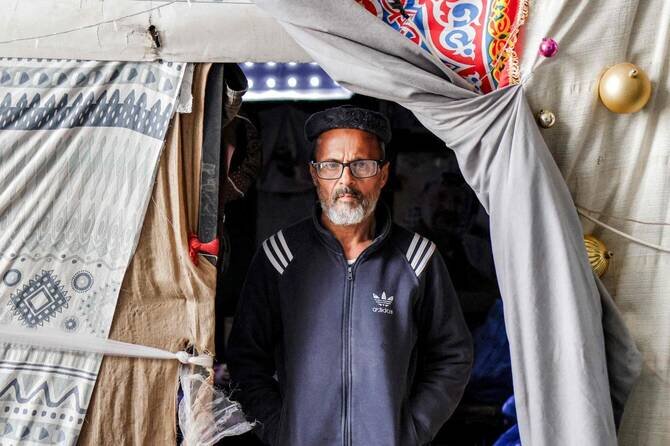
Another individual, Sameh, arrived in Nablus ten days before the war for his son's medical treatment and stayed behind to support his family after his son returned.
He fashioned a living space similar to the tent camps of Gaza using sheets on ropes.
All men interviewed had lost their homes due to airstrikes; they showed videos and photos as evidence.
Nahed Al-Hilou, a 43-year-old Gaza businessman now residing in Ramallah, fears leaving the central West Bank city he moved to after the war broke out.
Hilou left Gaza two days before October 7 on a business permit to import goods into the blockaded territory but found success in Ramallah with his falafel restaurant, employing nine Gazans and cooking dishes from his homeland.
Zaarb, a fortunate few among these individuals, holds West Bank residency.
He has established a farm in Qalqilya after moving from Beit Lahia, northern Gaza, known for its strawberry fields before the war.
Despite his relative freedom, Zaarb has not seen his children since 2021 and shares the same dilemma of being separated from his family due to restrictions on crossing into Gaza.
The United Nations reported that 81 percent of Gaza's structures were destroyed during the conflict, leading to an unemployment rate of 80 percent and high prices for goods due to Israeli restrictions.
Since a US-brokered ceasefire in October 2025, at least 846 people have been killed by Israel as it still controls about half of Gaza.
While some find solace in their work and relative stability within the West Bank, these Gazans face an uncertain future, longing for stability and connection with their homeland.
Among them is Sameer Abu Salah, 54, who was working in Tel Aviv before entering Nablus just four days before the war began.
Now, he lives off collecting recyclables, sending money home to his family after losing two sons to Israeli airstrikes.
Counting all those stranded is challenging; however, the Palestinian Authority's labor ministry reported providing cash assistance to 4,605 Gazans stuck in the West Bank as of March.
While leaving the city's boundaries may be tolerated, these men still fear crossing Israeli army checkpoints, with friends reporting being turned back to Gaza.
Another individual, Sameh, arrived in Nablus ten days before the war for his son's medical treatment and stayed behind to support his family after his son returned.
He fashioned a living space similar to the tent camps of Gaza using sheets on ropes.
All men interviewed had lost their homes due to airstrikes; they showed videos and photos as evidence.
Nahed Al-Hilou, a 43-year-old Gaza businessman now residing in Ramallah, fears leaving the central West Bank city he moved to after the war broke out.
Hilou left Gaza two days before October 7 on a business permit to import goods into the blockaded territory but found success in Ramallah with his falafel restaurant, employing nine Gazans and cooking dishes from his homeland.
Zaarb, a fortunate few among these individuals, holds West Bank residency.
He has established a farm in Qalqilya after moving from Beit Lahia, northern Gaza, known for its strawberry fields before the war.
Despite his relative freedom, Zaarb has not seen his children since 2021 and shares the same dilemma of being separated from his family due to restrictions on crossing into Gaza.
The United Nations reported that 81 percent of Gaza's structures were destroyed during the conflict, leading to an unemployment rate of 80 percent and high prices for goods due to Israeli restrictions.
Since a US-brokered ceasefire in October 2025, at least 846 people have been killed by Israel as it still controls about half of Gaza.
While some find solace in their work and relative stability within the West Bank, these Gazans face an uncertain future, longing for stability and connection with their homeland.