Gaza's Unexploded Ordnance Threatens Decades of Recovery Efforts
The Gaza Strip faces significant challenges due to widespread unexploded ordnance, posing a substantial risk to its population and hindering long-term recovery efforts.
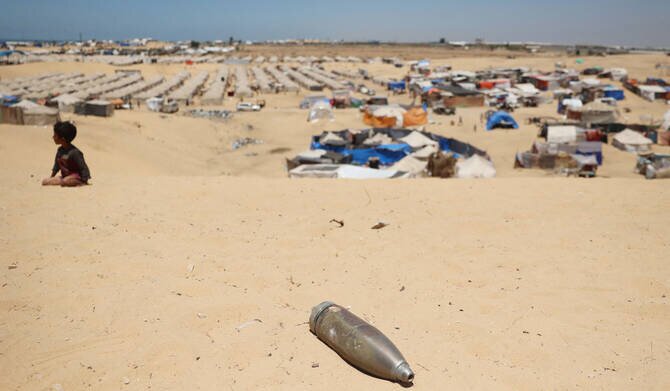
GENEVA: The war-torn Gaza Strip is heavily contaminated with unexploded ordnance, which frequently results in deaths and injuries.
According to the UN Mine Action Service (UNMAS), since the conflict began, over 1,000 individuals have lost their lives due to 'indirect conflict' from remnants of war.
Julius Van der Walt, UNMAS chief in the Occupied Palestinian Territory, emphasized that this figure is likely a significant underestimation.
In a press conference on global mine action efforts, Narmina Strishenets from Save the Children UK highlighted the severe impact on children, noting that in 2024 alone, an average of 475 children per month suffered from potentially lifelong disabilities, including amputations, due to explosive weapons used in Gaza.
Strishenets further stated that Gaza now has 'the largest cohort of child amputees' worldwide.
UNMAS has identified over 1,000 items of explosive ordnance during missions conducted since the conflict escalated 2.5 years ago.
This translates to approximately one piece of unexploded ordnance for every 600 meters in the densely populated Gaza Strip.
The threat is exacerbated by Gaza's extremely high population density, which was already among the highest on Earth prior to the conflict, and has been further intensified by the reduced available space.
The presence of explosive weapons across the territories, including within refugee camps, poses a continuous danger to both residents and humanitarian workers, effectively halting early recovery efforts.
According to assessments, addressing this issue could require up to $541 million in funding under optimal circumstances, assuming necessary permissions are granted and equipment is accessible.
However, given the vast and varied extent of contamination, it is 'very close to impossible' to perform a comprehensive assessment, suggesting that explosive ordnance will remain an issue for decades.
The situation bears similarity to World War II-era unexploded bombs still being discovered in construction projects in Britain, implying that similar challenges may persist in Gaza for generations.
According to the UN Mine Action Service (UNMAS), since the conflict began, over 1,000 individuals have lost their lives due to 'indirect conflict' from remnants of war.
Julius Van der Walt, UNMAS chief in the Occupied Palestinian Territory, emphasized that this figure is likely a significant underestimation.
In a press conference on global mine action efforts, Narmina Strishenets from Save the Children UK highlighted the severe impact on children, noting that in 2024 alone, an average of 475 children per month suffered from potentially lifelong disabilities, including amputations, due to explosive weapons used in Gaza.
Strishenets further stated that Gaza now has 'the largest cohort of child amputees' worldwide.
UNMAS has identified over 1,000 items of explosive ordnance during missions conducted since the conflict escalated 2.5 years ago.
This translates to approximately one piece of unexploded ordnance for every 600 meters in the densely populated Gaza Strip.
The threat is exacerbated by Gaza's extremely high population density, which was already among the highest on Earth prior to the conflict, and has been further intensified by the reduced available space.
The presence of explosive weapons across the territories, including within refugee camps, poses a continuous danger to both residents and humanitarian workers, effectively halting early recovery efforts.
According to assessments, addressing this issue could require up to $541 million in funding under optimal circumstances, assuming necessary permissions are granted and equipment is accessible.
However, given the vast and varied extent of contamination, it is 'very close to impossible' to perform a comprehensive assessment, suggesting that explosive ordnance will remain an issue for decades.
The situation bears similarity to World War II-era unexploded bombs still being discovered in construction projects in Britain, implying that similar challenges may persist in Gaza for generations.