Exiled Tibetans to Elect Government in Vote Condemned by China
Tibetans outside Chinese control vote on a government-in-exile, an election of heightened significance as they prepare for the future without their spiritual leader.
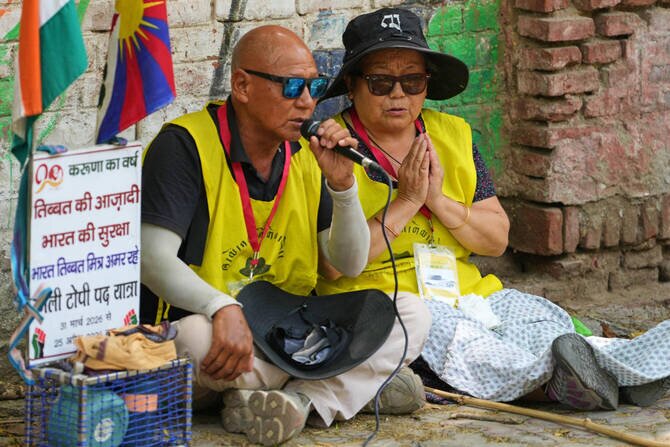
BYALKUPPE, India: Exiled Tibetans will vote on Sunday for a government-in-exile, with heightened significance as they anticipate life beyond their revered spiritual leader, the Dalai Lama.
The Central Tibetan Administration (CTA), based in India and condemned by China as a "separatist political group," plays a crucial role among exiles, especially after the Dalai Lama transferred political power in 2011.
Tenzin Tsering, a 19-year-old first-time voter, expressed the importance of their votes: "We need voices that reflect where our community is going, not just where it has been".
This sentiment was echoed in Bylakuppe, one of India's southern states and home to one of the largest Tibetan communities outside Tibet.
Polling will take place in 27 countries, excluding China.
The election includes approximately 91,000 registered voters, ranging from Buddhist monks in the Himalayas to refugees in Australia, Europe, and North America.
Despite the Dalai Lama's assertion that his office is the only one with the right to identify his successor, Beijing has stated that it must approve the Buddhist leader's eventual replacement.
The 90-year-old Dalai Lama, who fled Lhasa after a Chinese crackdown in 1959, remains optimistic about his longevity.
However, Tibetans are aware of China's claim to have a say in the selection of his successor.
The position of the Dalai Lama, believed by Tibetans to be the reincarnation of a spiritual leader first born in 1391, is crucial.
The Tibetan government-in-exile, which meets twice annually and comprises 45 members from around the world, functions as a representative body for an estimated 150,000 exiled Tibetans.
Penpa Tsering, the Sikyong or leader of the government, was re-elected on February 1st, taking 61% of the preliminary vote to secure another term.
However, the government does not seek full independence for Tibet, aligning with the Dalai Lama's long-standing "Middle Way" policy advocating autonomy.
The Central Tibetan Administration (CTA), based in India and condemned by China as a "separatist political group," plays a crucial role among exiles, especially after the Dalai Lama transferred political power in 2011.
Tenzin Tsering, a 19-year-old first-time voter, expressed the importance of their votes: "We need voices that reflect where our community is going, not just where it has been".
This sentiment was echoed in Bylakuppe, one of India's southern states and home to one of the largest Tibetan communities outside Tibet.
Polling will take place in 27 countries, excluding China.
The election includes approximately 91,000 registered voters, ranging from Buddhist monks in the Himalayas to refugees in Australia, Europe, and North America.
Despite the Dalai Lama's assertion that his office is the only one with the right to identify his successor, Beijing has stated that it must approve the Buddhist leader's eventual replacement.
The 90-year-old Dalai Lama, who fled Lhasa after a Chinese crackdown in 1959, remains optimistic about his longevity.
However, Tibetans are aware of China's claim to have a say in the selection of his successor.
The position of the Dalai Lama, believed by Tibetans to be the reincarnation of a spiritual leader first born in 1391, is crucial.
The Tibetan government-in-exile, which meets twice annually and comprises 45 members from around the world, functions as a representative body for an estimated 150,000 exiled Tibetans.
Penpa Tsering, the Sikyong or leader of the government, was re-elected on February 1st, taking 61% of the preliminary vote to secure another term.
However, the government does not seek full independence for Tibet, aligning with the Dalai Lama's long-standing "Middle Way" policy advocating autonomy.