Saudi Press

Saudi Arabia and the world
Thursday, Dec 25, 2025

Climate change and war send Syria’s bees further afield

Climate change and war send Syria’s bees further afield

Beekeepers in northwestern Syria have to do whatever they can to produce honey – despite the dangers they face.

Ahmad al-Hassan arranges a wide array of colourful honey jars on his shelf in his shop in Idlib city.

Beekeeping is the only work the 29-year-old Syrian has ever known, but conflict, economic deterioration, and even climate change have become painful stings to his livelihood.

A short drive away from his shop, al-Hassan and four employees wear their protective clothing before checking in on their 50 hives.

“There isn’t enough land for the bees any more,” the frustrated beekeeper said as he looked into the distance. “Before the current situation, we had swathes of land to work with.”

Now, they may have to relocate their bee colony to another plot of land, where the bees can forage for nectar and pollen.

Idlib is in northwestern Syria, where an estimated 97 percent of the residents live in extreme poverty, and most are internally displaced from the country’s 11-year uprising-turned-war. Many live in tents in displacement camps.

Al-Hassan has taken risks with his bee colonies, often moving them close to the Turkish border or even near de facto front lines with Syrian government-held areas so his bees have access to flowers and plants.

“We worry when we place the hives near a front line, but it’s better than letting the bees just die,” he said with a sigh.
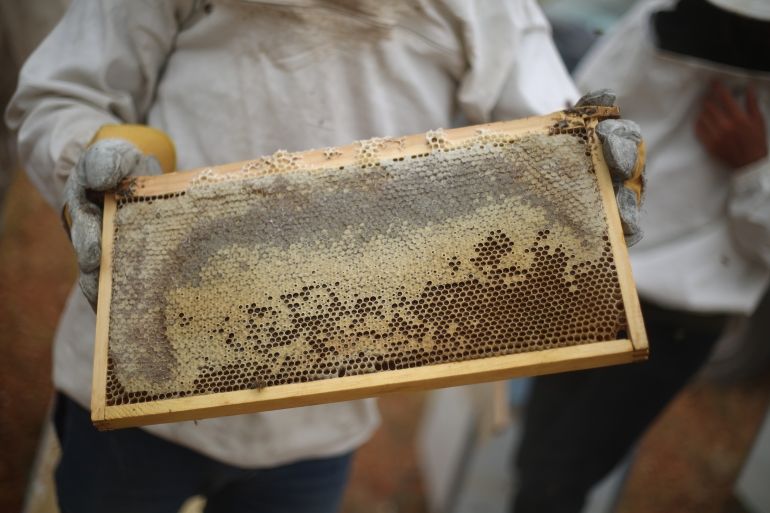
Al-Hassan has had to cut back on his use of foreign bees, as they are too expensive


Production has continued to decline every year, and so has business.

“We don’t export anything,” al-Hassan said as he rearranged jars of honey on his shelf. “All we rely on is local demand.”

But the local market in northwestern Syria has been financially shattered.

Economic woes have compounded for millions across opposition-held Idlib and northern Aleppo provinces.

The Turkish lira, the primary currency used in the region, has sharply lost value, and the area is also over-reliant on imports for wheat, fuel, and essential food items.

To make matters worse, with the Ukrainian conflict in full swing, international donor fatigue has continued, leaving food assistance and free-of-charge medical programmes on shoestring budgets.


Climate crisis effects


And even when al-Hassan and his crew find some open land for his bees, they often discover there are fewer plants and flowers. “There is less fennel flower, anise, and cotton,” he explained. “Less flowers means less production.”

The beekeeper was only able to produce half of the honey, wax, pollen, and royal jelly he had yielded the year prior.

Climate change has been a factor.

“Winter is like summer, and summer is like winter,” al-Hassan explained, as he pointed to the unexpected gloomy and cloudy weather. “Our bees continue to die at increasing rates.”

Warming temperatures and a decline in rainfall have ravaged northern Syria in recent years. Humanitarian and development agencies have said that climate change could further worsen economic conditions, public health, and food insecurity in the war-torn country.

“Rainfall is sporadic and happens at more unexpected times – even the wind patterns have changed,” al-Hassan said. “We can barely break even every season now.”

Going forward, the beekeeper is revisiting his budget to keep his business afloat. He used to be able to import bees that produce more honey, honey pollen, and other derivatives, unlike Syrian bees, which produce less honey and wax.

“It costs almost $200 to run a hive of foreign bees, as opposed to about $35 for a local one,” al-Hassan said. “But Syrian bees don’t produce nearly as much honey.”

For now, al-Hassan and his team of beekeepers are moving their colonies towards the Turkish border, hoping the bees will venture to greener pastures and return safely with pollen and nectar – and provide a financial lifeline amid the country’s economic crisis.


Newsletter

Related Articles

Saudi Press
0:00
0:00
Close
Riyadh Air’s First Boeing 787-9 Dreamliner Completes Initial Test Flight, Advancing Saudi Carrier’s Launch
Saudi Arabia’s 2025: A Pivotal Year of Global Engagement and Domestic Transformation
Saudi Arabia to Introduce Sugar-Content Based Tax on Sweetened Drinks from January 2026
Saudi Hotels Prepare for New Hospitality Roles as Alcohol Curbs Ease
Global Airports Forum Highlights Saudi Arabia’s Emergence as a Leading Aviation Powerhouse
Saudi Arabia Weighs Strategic Choice on Iran Amid Regional Turbulence
Not Only F-35s: Saudi Arabia to Gain Access to the World’s Most Sensitive Technology
Saudi Arabia Condemns Sydney Bondi Beach Shooting and Expresses Solidarity with Australia
Washington Watches Beijing–Riyadh Rapprochement as Strategic Balance Shifts
Saudi Arabia Urges Stronger Partnerships and Efficient Aid Delivery at OCHA Donor Support Meeting in Geneva
Saudi Arabia’s Vision 2030 Drives Measurable Lift in Global Reputation and Influence
Alcohol Policies Vary Widely Across Muslim-Majority Countries, With Many Permitting Consumption Under Specific Rules
Saudi Arabia Clarifies No Formal Ban on Photography at Holy Mosques for Hajj 2026
Libya and Saudi Arabia Sign Strategic MoU to Boost Telecommunications Cooperation
Elon Musk’s xAI Announces Landmark 500-Megawatt AI Data Center in Saudi Arabia
Israel Moves to Safeguard Regional Stability as F-35 Sales Debate Intensifies
Cardi B to Make Historic Saudi Arabia Debut at Soundstorm 2025 Festival
U.S. Democratic Lawmakers Raise National Security and Influence Concerns Over Paramount’s Hostile Bid for Warner Bros. Discovery
Hackers Are Hiding Malware in Open-Source Tools and IDE Extensions
Traveling to USA? Homeland Security moving toward requiring foreign travelers to share social media history
Wall Street Analysts Clash With Riyadh Over Saudi Arabia’s Deficit Outlook
Trump and Saudi Crown Prince Cement $1 Trillion-Plus Deals in High-Profile White House Summit
Saudi Arabia Opens Alcohol Sales to Wealthy Non-Muslim Residents Under New Access Rules
U.S.–Saudi Rethink Deepens — Washington Moves Ahead Without Linking Riyadh to Israel Normalisation
Saudi Arabia and Israel Deprioritise Diplomacy: Normalisation No Longer a Middle-East Priority
Saudi Arabia Positions Itself as the Backbone of the Global AI Era
As Trump Deepens Ties with Saudi Arabia, Push for Israel Normalization Takes a Back Seat
Thai Food Village Debuts at Saudi Feast Food Festival 2025 Under Thai Commerce Minister Suphajee’s Lead
Saudi Arabia Sharpens Its Strategic Vision as Economic Transformation Enters New Phase
Saudi Arabia Projects $44 Billion Budget Shortfall in 2026 as Economy Rebalances
OPEC+ Unveils New Capacity-Based System to Anchor Future Oil Output Levels
Will Saudi Arabia End Up Bankrolling Israel’s Post-Ceasefire Order in Lebanon?
Saudi Arabia’s SAMAI Initiative Surpasses One-Million-Citizen Milestone in National AI Upskilling Drive
Saudi Arabia’s Specialty Coffee Market Set to Surge as Demand Soars and New Exhibition Drops in December
Saudi Arabia Moves to Open Two New Alcohol Stores for Foreigners Under Vision 2030 Reform
Saudi Arabia’s AI Ambitions Gain Momentum — but Water, Talent and Infrastructure Pose Major Hurdles
Tensions Surface in Trump-MBS Talks as Saudi Pushes Back on Israel Normalisation
Saudi Arabia Signals Major Maritime Crack-Down on Houthi Routes in Red Sea
Italy and Saudi Arabia Seal Over 20 Strategic Deals at Business Forum in Riyadh
COP30 Ends Without Fossil Fuel Phase-Out as US, Saudi Arabia and Russia Align in Obstruction Role
Saudi-Portuguese Economic Horizons Expand Through Strategic Business Council
DHL Commits $150 Million for Landmark Logistics Hub in Saudi Arabia
Saudi Aramco Weighs Disposals Amid $10 Billion-Plus Asset Sales Discussion
Trump Hosts Saudi Crown Prince for Major Defence and Investment Agreements
Families Accuse OpenAI of Enabling ‘AI-Driven Delusions’ After Multiple Suicides
Riyadh Metro Records Over One Hundred Million Journeys as Saudi Capital Accelerates Transit Era
Trump’s Grand Saudi Welcome Highlights U.S.–Riyadh Pivot as Israel Watches Warily
U.S. Set to Sell F-35 Jets to Saudi Arabia in Major Strategic Shift
Saudi Arabia Doubles Down on U.S. Partnership in Strategic Move
Saudi Arabia Charts Tech and Nuclear Leap Under Crown Prince’s U.S. Visit
×