At Beijing Auto Show, Chinese Carmakers Flaunt New Technologies Amid Global Competition
Chinese automakers are showcasing their latest models and technologies at the Beijing auto show, emphasizing advancements in electric vehicles and batteries.
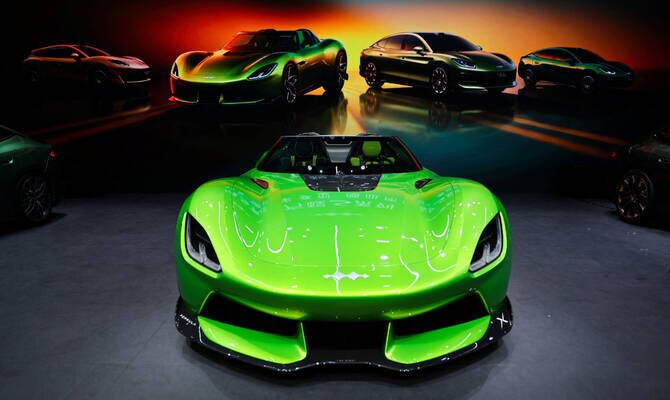
Chinese top automakers have unveiled their latest models and cutting-edge technologies at the biennial Beijing Auto Show.
The event, which is open to media and runs until May 3, features over 1,450 vehicles, including 181 global debuts.
This year's show highlights China's leadership in developing advanced automotive technologies such as electric vehicles (EVs) and batteries, surpassing many foreign brands that previously dominated the global market.
Chinese EV maker XPeng is presenting its GX model, a six-seater SUV with innovative features like intelligent driving systems that can detect when a driver falls asleep or becomes unwell and automatically pull over to alert emergency services.
Another prominent exhibitor, BYD, has showcased its new generation of fast-charging "blade" EV battery, capable of achieving a near-full charge in just nine minutes.
Yijing, an EV joint venture between Dongfeng Motor Corp. and Huawei, also displayed the X9, their flagship six-seater SUV, featuring advanced technologies like Huawei's next-generation Qiankun intelligent driving system and HarmonyOS cockpit.
CATL, one of China's leading battery manufacturers, has unveiled a new version of its "Shenxing" battery that can charge from 10 percent to 98 percent in approximately six-and-a-half minutes.
The rapid advancements demonstrated by Chinese automakers have caught the attention of analysts who highlight the speed and aggressiveness of their progress in important sectors like EVs, batteries, and intelligent driving.
Despite facing intense price wars domestically, Chinese automakers have managed to become China's largest car exporter.
They benefit from significant cost advantages, government subsidies, and support that enable them to rapidly develop new models and technologies compared to foreign competitors.
However, the reduction in EV and plug-in hybrid subsidies has impacted domestic demand, leading to a 23 percent decline in sales of passenger cars during the January-March quarter.
Exports have seen a surge, with Chinese cars gaining popularity in regions like Europe, Southeast Asia, and Latin America.
Omdia forecasts that China's passenger vehicle exports will grow by around 14 percent year-on-year in 2026.
The hypercompetitive domestic market has resulted in a 20 percent decline in vehicle prices over the past two years.
Although few of the new technologies showcased at the auto show may be immediately exported to overseas markets due to regulatory and safety challenges, they signal capabilities that can be refined and adapted for global markets in the future.
Despite losing market share in recent years, foreign automakers are making a comeback with plans for advanced AI integration and new EV models.
Chinese automakers have increasingly shifted their focus towards building factories overseas to meet growing demand and avoid trade friction.
AlixPartners estimates that Chinese carmakers will almost triple their overseas production by 2030, reaching 3.4 million vehicles from the current 1.2 million.
The event, which is open to media and runs until May 3, features over 1,450 vehicles, including 181 global debuts.
This year's show highlights China's leadership in developing advanced automotive technologies such as electric vehicles (EVs) and batteries, surpassing many foreign brands that previously dominated the global market.
Chinese EV maker XPeng is presenting its GX model, a six-seater SUV with innovative features like intelligent driving systems that can detect when a driver falls asleep or becomes unwell and automatically pull over to alert emergency services.
Another prominent exhibitor, BYD, has showcased its new generation of fast-charging "blade" EV battery, capable of achieving a near-full charge in just nine minutes.
Yijing, an EV joint venture between Dongfeng Motor Corp. and Huawei, also displayed the X9, their flagship six-seater SUV, featuring advanced technologies like Huawei's next-generation Qiankun intelligent driving system and HarmonyOS cockpit.
CATL, one of China's leading battery manufacturers, has unveiled a new version of its "Shenxing" battery that can charge from 10 percent to 98 percent in approximately six-and-a-half minutes.
The rapid advancements demonstrated by Chinese automakers have caught the attention of analysts who highlight the speed and aggressiveness of their progress in important sectors like EVs, batteries, and intelligent driving.
Despite facing intense price wars domestically, Chinese automakers have managed to become China's largest car exporter.
They benefit from significant cost advantages, government subsidies, and support that enable them to rapidly develop new models and technologies compared to foreign competitors.
However, the reduction in EV and plug-in hybrid subsidies has impacted domestic demand, leading to a 23 percent decline in sales of passenger cars during the January-March quarter.
Exports have seen a surge, with Chinese cars gaining popularity in regions like Europe, Southeast Asia, and Latin America.
Omdia forecasts that China's passenger vehicle exports will grow by around 14 percent year-on-year in 2026.
The hypercompetitive domestic market has resulted in a 20 percent decline in vehicle prices over the past two years.
Although few of the new technologies showcased at the auto show may be immediately exported to overseas markets due to regulatory and safety challenges, they signal capabilities that can be refined and adapted for global markets in the future.
Despite losing market share in recent years, foreign automakers are making a comeback with plans for advanced AI integration and new EV models.
Chinese automakers have increasingly shifted their focus towards building factories overseas to meet growing demand and avoid trade friction.
AlixPartners estimates that Chinese carmakers will almost triple their overseas production by 2030, reaching 3.4 million vehicles from the current 1.2 million.