Saudi Press

Saudi Arabia and the world
Friday, Jan 30, 2026

Views on TikTok hashtags hosting eating disorder content continue to climb, research says

Views on TikTok hashtags hosting eating disorder content continue to climb, research says

New analysis from the Centre for Countering Digital Hate found that views on TikTok content using hashtags it previously identified as hosting eating-disorder material grew by 1.6 billion from November to January. But TikTok says it has removed harmful content.

TikTok videos using hashtags previously identified as hosting eating-disorder content are continuing to attract views, new research by the Centre for Countering Digital Hate has found.

A December report by the campaign group identified "coded" hashtags where users could access potentially harmful videos promoting restrictive diets and so-called "thinspo" content, designed to encourage harmful weight loss.

New analysis of those hashtags by the organisation found that since the study, just seven had been removed from the platform and only three carried a health warning on the UK version of the app.

But TikTok said it had removed content which violates its rules, which do not allow the promotion or glorification of eating disorders.

The Centre for Countering Digital Hate (CCDH) said the hashtags it found still on the platform had amassed 1.6 billion more views, which the UK's leading eating disorder charity Beat has called "extremely concerning".

"There is no excuse for harmful hashtags and videos being on TikTok in the first place," Andrew Radford, Beat's Chief Executive said.

"The company should immediately identify and remove damaging content as soon as it is uploaded," he told Sky News.

Content warning: this article contains references to eating disorders.
TikTok's community guidelines restrict eating disorder-related content on its platform and this includes hashtags explicitly associated with it.

But users will often make subtle edits to terminology so they can continue posting potentially harmful material about eating disorders without being spotted by TikTok's moderators.

'Coded' language to avoid detection

In its December report, the CCDH identified 56 TikTok hashtags using "coded" language, under which it found potentially harmful eating disorder content.

The CCDH also found 35 of the hashtags contained a high concentration of pro-eating disorder videos, while it said 21 contained a mix of harmful content and healthy discussion.

Among the material found in both categories were videos promoting unhealthy weight loss, restrictive diets and "thinspo".

In November, the views across these hashtags stood at 13.2 billion. When CCDH reviewed them in January, it found that the number of views on videos using the hashtags had grown to more than 14.8 billion.

Since the original study, CCDH says seven of the hashtags it identified had been removed from the platform altogether.

Four of those hosted predominantly pro-eating disorder content, while three contained both positive and harmful videos.

In the review, the CCDH found when accessed by US users, 37 of the hashtags they identified carried a safety warning directing users to the US's leading eating disorder charity.

However, the same review found that for UK users, just three of those hashtags carry the same kind of warning.
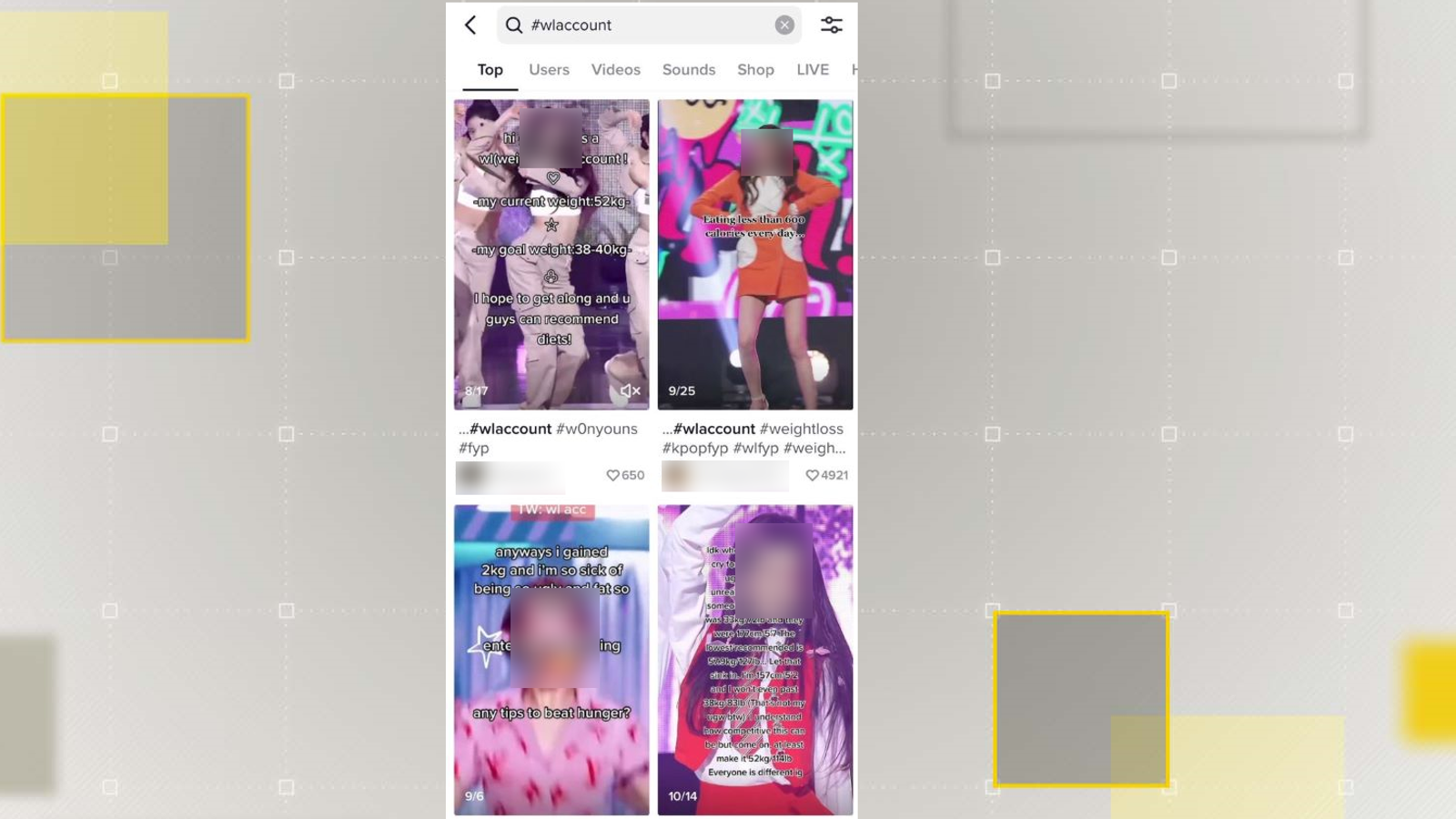
Centre for Countering Digital Hate found 56 hashtags associated with eating disorder content. 35 of those contained a high concentration of pro-eating disorder content.
'Outcry' by parents

"TikTok is clearly capable of adding warnings to English language content that might harm but is choosing not to implement this for English language content in the UK," said Imran Ahmed, CEO of the Centre for Countering Digital Hate.

"There can be no clearer example of the way the enforcement of purportedly universal rules of these platforms are actually implemented partially, selectively, and only when platforms feel under real pressure by governments," he told Sky News.

The new research also indicates that most of the people accessing material under these hashtags are young.

Using TikTok's own data analytics tool, CCDH found that 91% of views on 21 of the hashtags came from users under the age of 24. This tool, however, is limited as TikTok does not include data for any users under the age of 18.

"Despite an outcry from parents, politicians and the general public, three months later this content continues to grow and spread unchecked," Mr Ahmed added.

"Every view represents a potential victim - someone whose mental health might be harmed by negative body image content, someone who might start restricting their diet to dangerously low levels," he said.

Following CCDH's findings, a group of charities - including the NSPCC, the Molly Russell Foundation and the US and UK arms of the American Psychological Foundation - have called on TikTok to improve its moderation policies in a letter to its head of safety, Eric Han.

Responding to the findings, a spokesperson for TikTok said: "Our community guidelines are clear that we do not allow the promotion, normalisation or glorification of eating disorders, and we have removed content mentioned in this report that violates these rules.

"We are open to feedback and scrutiny, and we seek to engage constructively with partners who have expertise on these complex issues, as we do with NGOs in the US and UK."

Newsletter

Related Articles

Saudi Press
0:00
0:00
Close
Saudi Aviation Records Historic Passenger Traffic in 2025 and Sets Sights on Further Growth in 2026
Tech Market Shifts and AI Investment Surge Drive Global Innovation and Layoffs
Global Shifts in War, Trade, Energy and Security Mark Major International Developments
Tesla Ends Model S and X Production and Sends $2 Billion to xAI as 2025 Revenue Declines
The AI Hiring Doom Loop — Algorithmic Recruiting Filters Out Top Talent and Rewards Average or Fake Candidates
Federal Reserve Holds Interest Rate at 3.75% as Powell Faces DOJ Criminal Investigation During 2026 Decision
Putin’s Four-Year Ukraine Invasion Cost: Russia’s Mass Casualty Attrition and the Donbas Security-Guarantee Tradeoff
Saudi Crown Prince Tells Iranian President: Kingdom Will Not Host Attacks Against Iran
U.S. Central Command Announces Regional Air Exercise as Iran Unveils Drone Carrier Footage
Trump Defends Saudi Crown Prince in Heated Exchange After Reporter Questions Khashoggi Murder and 9/11 Links
Saudi Stocks Rally as Kingdom Prepares to Fully Open Capital Market to Global Investors
Air France and KLM Suspend Multiple Middle East Routes as Regional Tensions Disrupt Aviation
Saudi Arabia scales back Neom as The Line is redesigned and Trojena downsized
Saudi Industrial Group Completes One Point Three Billion Dollar Acquisition of South Africa’s Barloworld
Saudi-Backed LIV Golf Confirms Return to Trump National Bedminster for 2026 Season
Gold Jumps More Than 8% in a Week as the Dollar Slides Amid Greenland Tariff Dispute
Boston Dynamics Atlas humanoid robot and LG CLOiD home robot: the platform lock-in fight to control Physical AI
United States under President Donald Trump completes withdrawal from the World Health Organization: health sovereignty versus global outbreak early-warning access
Trump Administration’s Iran Military Buildup and Sanctions Campaign Puts Deterrence Credibility on the Line
Tech Brief: AI Compute, Chips, and Platform Power Moves Driving Today’s Market Narrative
NATO’s Stress Test Under Trump: Alliance Credibility, Burden-Sharing, and the Fight Over Strategic Territory
Saudi Arabia’s Careful Balancing Act in Relations with Israel Amid Regional and Domestic Pressures
Greenland, Gaza, and Global Leverage: Today’s 10 Power Stories Shaping Markets and Security
America’s Venezuela Oil Grip Meets China’s Demand: Market Power, Legal Shockwaves, and the New Rules of Energy Leverage
Trump’s Board of Peace: Breakthrough Diplomacy or a Hostile Takeover of Global Order?
Prince William to Make Official Visit to Saudi Arabia in February
Saudi Arabia Advances Ambitious Artificial River Mega-Project to Transform Water Security
Saudi Crown Prince and Syrian President Discuss Stabilisation, Reconstruction and Regional Ties in Riyadh Talks
Mohammed bin Salman Confronts the ‘Iranian Moment’ as Saudi Leadership Faces Regional Test
Cybercrime, Inc.: When Crime Becomes an Economy. How the World Accidentally Built a Twenty-Trillion-Dollar Criminal Economy
Strategic Restraint, Credible Force, and the Discipline of Power
Donald Trump Organization Unveils Championship Golf Course and Luxury Resort Project in Saudi Arabia
Inside Diriyah: Saudi Arabia’s $63.2 Billion Vision to Transform Its Historic Heart into a Global Tourism Powerhouse
Trump Designates Saudi Arabia a Major Non-NATO Ally, Elevating US–Riyadh Defense Partnership
Trump Organization Deepens Saudi Property Focus with $10 Billion Luxury Developments
There is no sovereign immunity for poisoning millions with drugs.
Mohammed bin Salman’s Global Standing: Strategic Partner in Transition Amid Debate Over His Role
Saudi Arabia Opens Property Market to Foreign Buyers in Landmark Reform
The U.S. State Department’s account in Persian: “President Trump is a man of action. If you didn’t know it until now, now you do—do not play games with President Trump.”
CNN’s Ranking of Israel’s Women’s Rights Sparks Debate After Misleading Global Index Comparison
Saudi Arabia’s Shifting Regional Alignment Raises Strategic Concerns in Jerusalem
OPEC+ Holds Oil Output Steady Amid Member Tensions and Market Oversupply
Iranian Protests Intensify as Another Revolutionary Guard Member Is Killed and Khamenei Blames the West
President Trump Says United States Will Administer Venezuela Until a Secure Leadership Transition
Delta Force Identified as Unit Behind U.S. Operation That Captured Venezuela’s President
Trump Announces U.S. Large-Scale Strike on Venezuela, Declares President Maduro and Wife Captured
Saudi-UAE Rift Adds Complexity to Middle East Diplomacy as Trump Signals Firm Leadership
OPEC+ to Keep Oil Output Policy Unchanged Despite Saudi-UAE Tensions Over Yemen
Saudi Arabia and UAE at Odds in Yemen Conflict as Southern Offensive Deepens Gulf Rift
Abu Dhabi ‘Capital of Capital’: How Abu Dhabi Rose as a Sovereign Wealth Power
×