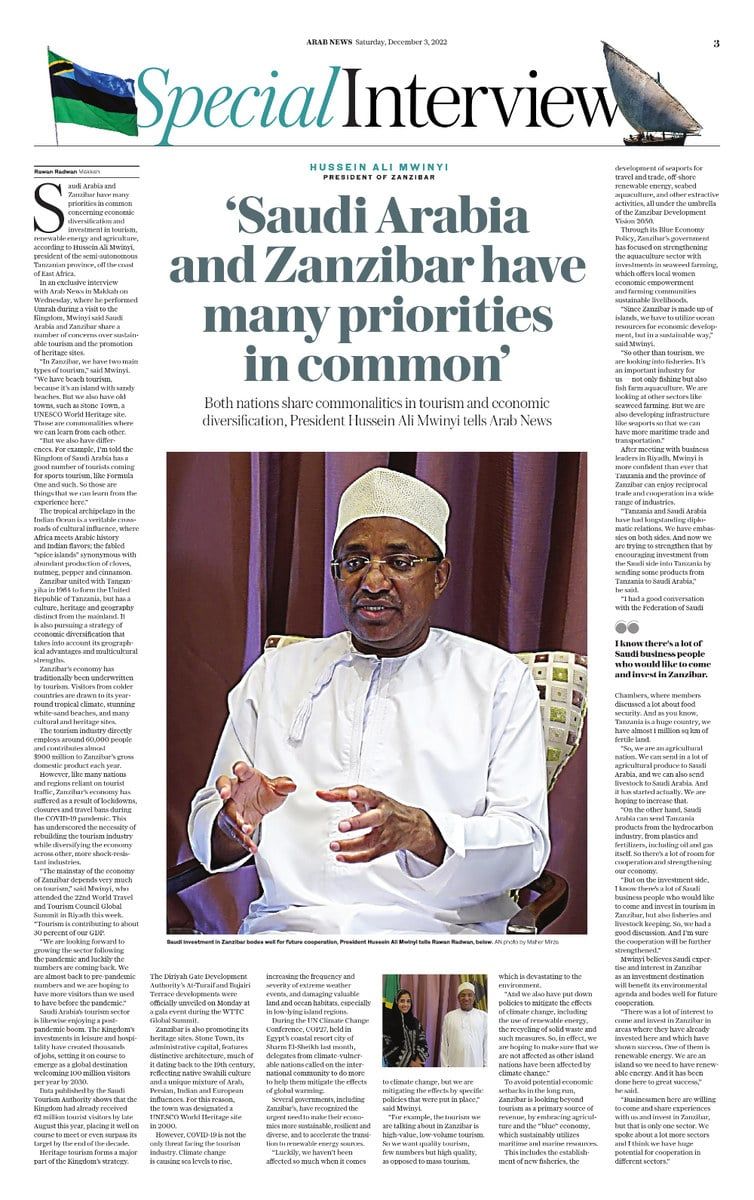
Saudi Arabia and Zanzibar have many development priorities in common, President Hussein Ali Mwinyi tells
In an exclusive interview with Arab News in Makkah on Wednesday, where he performed Umrah during a visit to the Kingdom, Mwinyi said Saudi Arabia and Zanzibar share a number of concerns over sustainable tourism and the promotion of heritage sites.
“In Zanzibar, we have two main types of tourism,” said Mwinyi. “We have beach tourism, because it’s an island with sandy beaches. But we also have old towns, such as Stone Town, a UNESCO World Heritage site. Those are commonalities where we can learn from each other.
“But we also have differences. For example, I’m told the Kingdom of Saudi Arabia has a good number of tourists coming for sports tourism, like Formula One and such. So those are things that we can learn from the experience here.”
The tropical archipelago in the Indian Ocean is a veritable crossroads of cultural influence, where Africa meets Arabic history and Indian flavors; the fabled “spice islands” synonymous with abundant production of cloves, nutmeg, pepper and cinnamon.
 Rama, a kite surfing teacher, surfs in Paje beach, Zanzibar. During high
season, Zanzibar’s beaches attract thousands of people for kite
surfing, economically benefitting local businesses.
Rama, a kite surfing teacher, surfs in Paje beach, Zanzibar. During high
season, Zanzibar’s beaches attract thousands of people for kite
surfing, economically benefitting local businesses.
Zanzibar’s economy has traditionally been underwritten by tourism. Visitors from colder countries are drawn to its year-round tropical climate, stunning white-sand beaches, and many cultural and heritage sites.
The tourism industry directly employs around 60,000 people and contributes almost $900 million to Zanzibar’s gross domestic product each year.
However, like many nations and regions reliant on tourist traffic, Zanzibar’s economy has suffered as a result of lockdowns, closures and travel bans during the COVID-19 pandemic. This has underscored the necessity of rebuilding the tourism industry while diversifying the economy across other, more shock-resistant industries.
“The mainstay of the economy of Zanzibar depends very much on tourism,” said Mwinyi, who attended the 22nd World Travel and Tourism Council Global Summit in Riyadh this week. “Tourism is contributing to about 30 percent of our GDP.
“We are looking forward to growing the sector following the pandemic and luckily the numbers are coming back. We are almost back to pre-pandemic numbers and we are hoping to have more visitors than we used to have before the pandemic.”
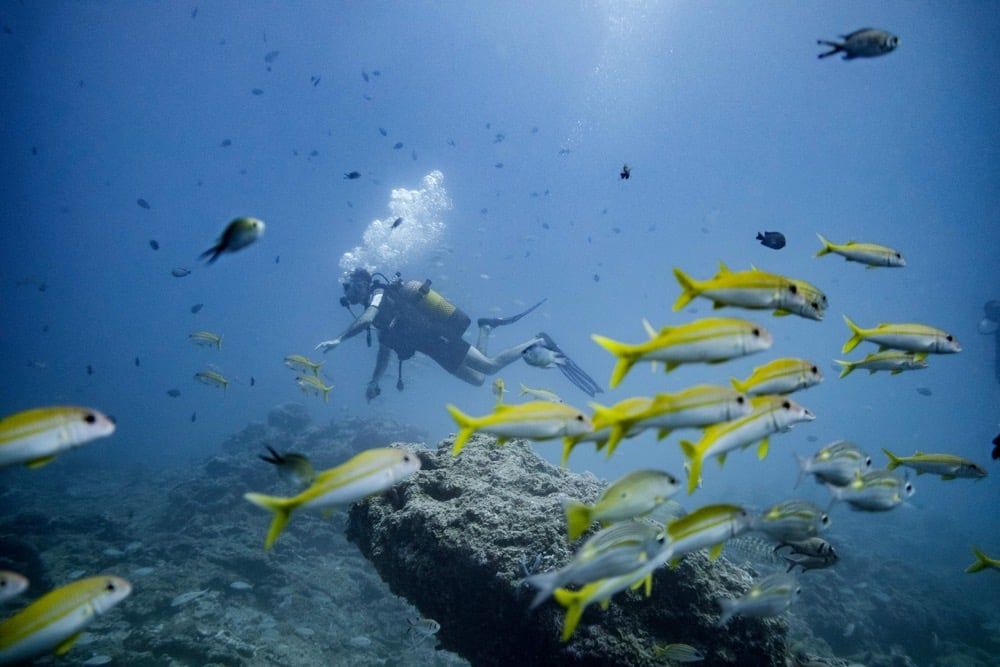 A tourist dives at Matemwe’s reef. Zanzibar's clear waters and lively
reefs attract scuba diving tourists from all over the world.
A tourist dives at Matemwe’s reef. Zanzibar's clear waters and lively
reefs attract scuba diving tourists from all over the world.
Saudi Arabia’s tourism sector is likewise enjoying a post-pandemic boom. The Kingdom’s investments in leisure and hospitality have created thousands of jobs, setting it on course to emerge as a global destination welcoming 100 million visitors per year by 2030.
Data published by the Saudi Tourism Authority shows that the Kingdom had already received 62 million tourist visitors by late August this year, placing it well on course to meet or even surpass its target by the end of the decade.
Heritage tourism forms a major part of the Kingdom’s strategy. The Diriyah Gate Development Authority’s At-Turaif and Bujairi Terrace developments were officially unveiled on Monday at a gala event during the WTTC Global Summit.
Zanzibar is also promoting its heritage sites. Stone Town, its administrative capital, features distinctive architecture, much of it dating back to the 19th century, reflecting native Swahili culture and a unique mixture of Arab, Persian, Indian and European influences. For this reason, the town was designated a UNESCO World Heritage site in 2000.
However, COVID-19 is not the only threat facing the tourism industry. Climate change is causing sea levels to rise, increasing the frequency and severity of extreme weather events, and damaging valuable land and ocean habitats, especially in low-lying island regions.
During the UN Climate Change Conference — COP27 — held in Egypt’s coastal resort city of Sharm El-Sheikh last month, delegates from climate-vulnerable nations called on the international community to do more to help them mitigate the effects of global warming.
 Dago Roots (R) performs a set with other artists at the International
African music festival “Sauti za Busara” at the Old Fort in Stone town.
Dago Roots (R) performs a set with other artists at the International
African music festival “Sauti za Busara” at the Old Fort in Stone town.
Several governments, including Zanzibar’s, have recognized the urgent need to make their economies more sustainable, resilient and diverse, and to accelerate the transition to renewable energy sources.
“Luckily, we haven’t been affected so much when it comes to climate change, but we are mitigating the effects by specific policies that were put in place,” said Mwinyi.
“For example, the tourism we are talking about in Zanzibar is high-value, low-volume tourism. So we want quality tourism, few numbers but high quality, as opposed to mass tourism, which is devastating to the environment.
“And we also have put down policies to mitigate the effects of climate change, including the use of renewable energy, the recycling of solid waste and such measures. So, in effect, we are hoping to make sure that we are not affected as other island nations have been affected by climate change.”
To avoid potential economic setbacks in the long run, Zanzibar is looking beyond tourism as a primary source of revenue, by embracing agriculture and the “blue” economy, which sustainably utilizes maritime and marine resources.
This includes the establishment of new fisheries, the development of seaports for travel and trade, off-shore renewable energy, seabed aquaculture, and other extractive activities, all under the umbrella of the Zanzibar Development Vision 2050.
Through its Blue Economy Policy, Zanzibar’s government has focused on strengthening the aquaculture sector with investments in seaweed farming, which offers local women economic empowerment and farming communities sustainable livelihoods.
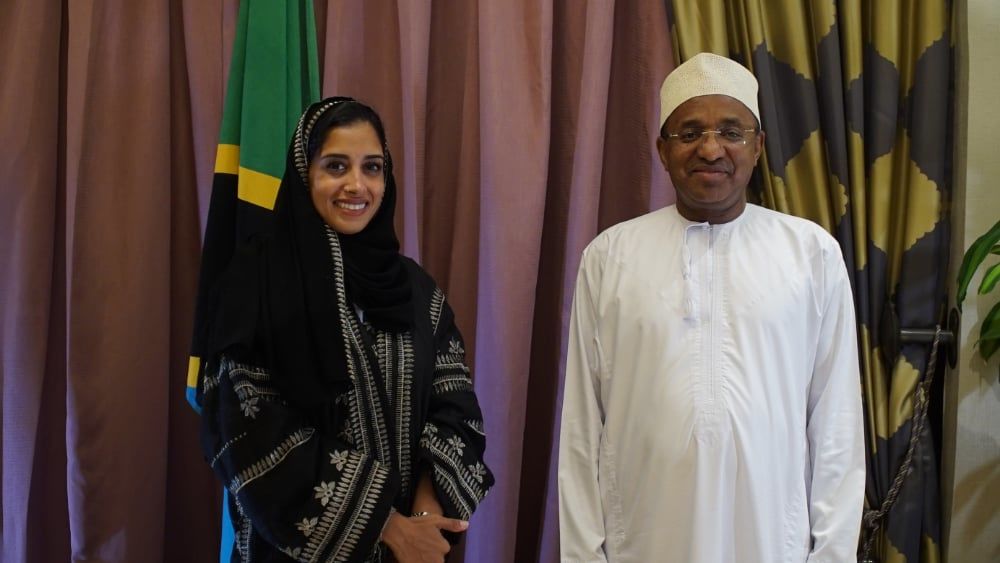 Hussein Ali Mwinyi with Arab News’ Rawan Radwan.
“Since Zanzibar is made up of islands, we have to utilize ocean resources for economic development, but in a sustainable way,” said Mwinyi.
“So other than tourism, we are looking into fisheries. It’s an important industry for us — not only fishing but also fish farm aquaculture. We are looking at other sectors like seaweed farming. But we are also developing infrastructure like seaports so that we can have more maritime trade and transportation.”
After meeting with business leaders in Riyadh, Mwinyi is more confident than ever that Tanzania and the province of Zanzibar can enjoy reciprocal trade and cooperation in a wide range of industries.
“Tanzania and Saudi Arabia have had longstanding diplomatic relations. We have embassies on both sides. And now we are trying to strengthen that by encouraging investment from the Saudi side into Tanzania by sending some products from Tanzania to Saudi Arabia,” he said.
“I had a good conversation with the Federation of Saudi Chambers, where members discussed a lot about food security. And as you know, Tanzania is a huge country, we have almost 1 million sq km of fertile land.
“So, we are an agricultural nation. We can send in a lot of agricultural produce to Saudi Arabia, and we can also send livestock to Saudi Arabia. And it has started actually. We are hoping to increase that.
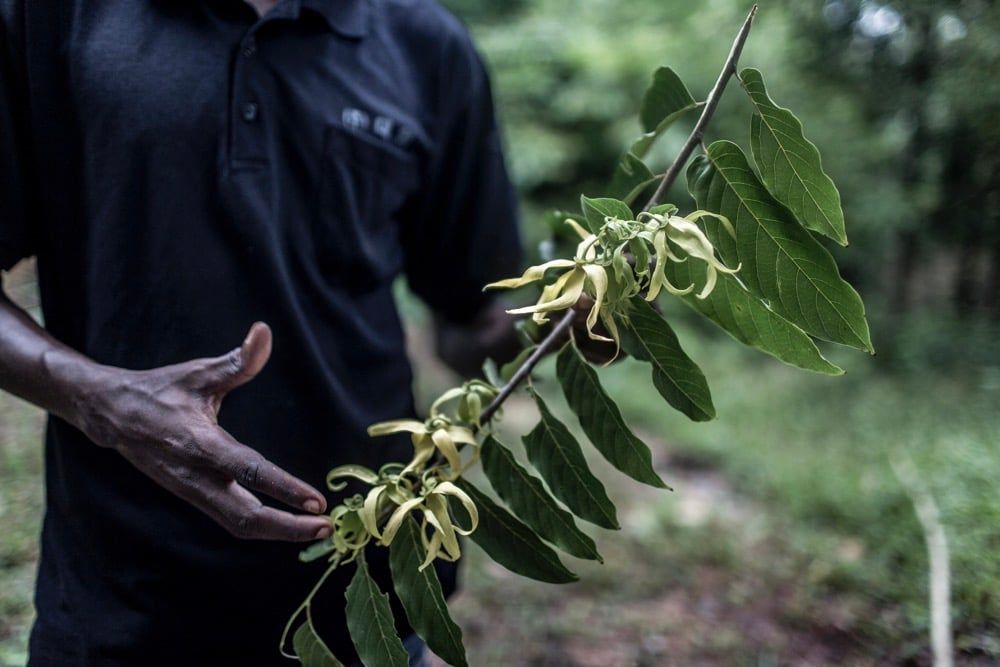 A spice tour guide holds a a Ylang-ylang flower on a spice farm outside Stone Town.
“On the other hand, Saudi Arabia can send Tanzania products from the hydrocarbon industry, from plastics and fertilizers, including oil and gas itself. So there’s a lot of room for cooperation and strengthening our economy.
“But on the investment side, I know there’s a lot of Saudi business people who would like to come and invest in tourism in Zanzibar, but also fisheries and livestock keeping. So, we had a good discussion. And I’m sure the cooperation will be further strengthened.”
Mwinyi believes Saudi expertise and interest in Zanzibar as an investment destination will benefit its environmental agenda and bodes well for future cooperation.
“There was a lot of interest to come and invest in Zanzibar in areas where they have already invested here and which have shown success. One of them is renewable energy. We are an island so we need to have renewable energy. And it has been done here to great success,” he said.
“Businessmen here are willing to come and share experiences with us and invest in Zanzibar, but that is only one sector. We spoke about a lot more sectors and I think we have huge potential for cooperation in different sectors.”