Peak Devotion as Pilgrims Gather in Arafat for Most Sacred Hajj Rite
Pilgrims attend annual Hajj sermon at Namirah Mosque, perform combined shortened prayers.
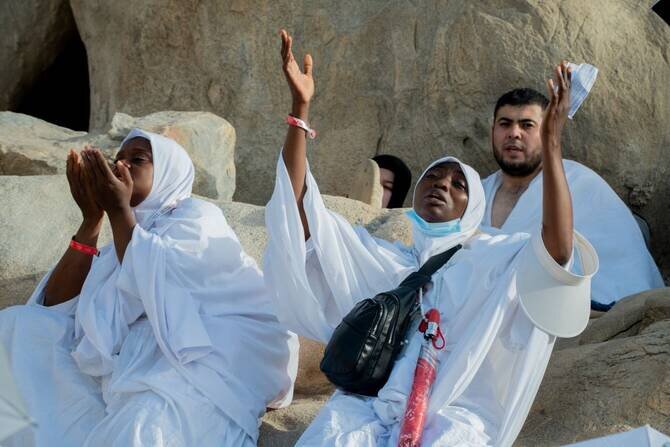
ARAFAT: Pilgrims gathered on the Plain of Arafat on Dhul Hijjah 9, Tuesday, for the most sacred and spiritually defining stage of the ritual, amid strict security and health measures.
They also attended the annual Hajj sermon at Namirah Mosque, the second-largest facility in the Makkah region, where Dhuhr and Asr prayers were performed in combination and shortened.
The shortening of prayers follows a tradition established by Prophet Muhammad more than 14 centuries ago.
The sermon was delivered by Sheikh Ali bin Abdulrahman Al-Hudhaifi, imam of the Prophet’s Mosque.
After performing Fajr prayer in the tent city of Mina, pilgrims moved toward Arafat.
The transportation process was completed before 8 a.m. — two hours earlier than last year — according to the General Transport Center operating under the Royal Commission for Makkah City and Holy Sites.
Arafat, about 20 km southeast of Makkah, is an expansive plain dominated by Jabal Al-Rahmah, or the Mount of Mercy, where pilgrims gather for prayer and reflection.
In Islamic tradition, the site is associated with the reunion of Adam and Eve, and holds profound spiritual significance for Muslims.
The Arafat ritual is the central pillar of Hajj and an essential obligation of Islam; without standing at Arafat, the pilgrimage is considered invalid.
Pilgrims spend the day in prayer and supplication, seeking forgiveness until sunset before proceeding to Muzdalifah and later returning to Mina to complete the remaining rites.
In an atmosphere of tranquility and devotion, the only sounds were chants of supplication, reflecting the pilgrims’ readiness to respond to Allah’s call and affirm His oneness and sovereignty.
Saudi authorities implemented extensive operational plans to facilitate the movement and safety of pilgrims, deploying 24,000 buses alongside integrated crowd-control systems, medical services, transportation networks, and emergency response units across the holy sites.
The Facilities Security Forces is playing a key role in supporting Hajj operations by safeguarding vital infrastructure.
They are responsible for monitoring facilities, preventing disruptions, and coordinating with relevant authorities to maintain order and safety.
The Ministry of Health has confirmed that there has been no reported cases of outbreaks of disease or epidemics.
It attributed this to the preventive measures in place, coordination among relevant authorities, and the preparedness of the healthcare system across the holy sites.
Makkah’s Deputy Chairman of the Permanent Committee for Hajj and Umrah and Deputy Gov. Prince Saud bin Mishaal bin Abdulaziz said the Kingdom has been honored to serve Allah, making the service of pilgrims a deeply rooted mission passed down through generations.
In a statement delivered at Arafat, he welcomed pilgrims, noting that the Day of Arafat embodies the highest meanings of unity and equality as pilgrims perform the greatest pillar of Hajj in an atmosphere of security, peace, and reassurance.
"The Kingdom has mobilized all its capabilities and resources to implement development projects, enhance infrastructure, and deploy modern technologies and national expertise to facilitate your pilgrimage in an organized and secure atmosphere," he told pilgrims.
He also commended pilgrims for their cooperation and adherence to instructions and guidelines, calling for continued awareness and discipline to ensure smooth service delivery and a tranquil spiritual experience.
Prince Saud praised the efforts of workers across all sectors serving pilgrims, noting that their dedication reflects the noble values and humanitarian principles of the Saudi people and underscores the honor of serving the guests of Allah.
He concluded by praying that Allah accepts the pilgrims’ Hajj and righteous deeds, return them safely to their countries, and preserve Saudi Arabia with continued security, stability, and prosperity.
The sermon highlighted Hajj as a powerful expression of Islamic unity, bringing together Muslims of all languages, ethnicities, and nationalities in worship grounded in equality, cooperation, and compassion.
Al-Hudhaifi, in his sermon, urged the public to be mindful of Allah in all their actions and preparation for the Hereafter, reaffirming monotheism as the foundation of faith and urging sincerity in worship, alongside patience, gratitude, and moral integrity.
He also emphasized the sanctity and discipline of Hajj, calling for strict adherence to its rituals in line with the prophet’s example, while warning against disputes, disorder, and any conduct that undermines the pilgrimage’s spiritual purpose.
The sermon further underscored the significance of the Day of Arafat as a moment of divine mercy and the completion of religion, concluding with an emphasis on supplication and prayers for the acceptance of pilgrims’ Hajj and the unity of the Muslim community.
Several pilgrims expressed excitement at participating in this year’s Hajj.
Aliyu Biu, from Nigeria, said: "I feel very nice.
The Saudi government has done (a lot for us), and we enjoyed it, and we thank them for that.
We’re good.
I don’t know how to express my feelings, but I am very, very happy".
Kazi Habiburahman from Bangladesh told Arab News that he never thought he would be on Arafat.
"We are witnessing something very special in this moment.
So, we are so excited to join and complete the Hajj.
I think we all have the same feelings".
He added: "I pray for all the Muslims.
I pray for all the sahaba (prophet’s companions) who (were) martyred or died.
So, this is the feelings from my side".
Kassim Assadi, from Jordan, said it was an "indescribable" feeling to perform Hajj.
He prayed that Allah would bless Saudi Arabia for the "excellent" services provided for the pilgrims.
While pilgrims spend the day in Arafat, Saudi authorities are intensifying preparations in Muzdalifah and Mina to receive them in the next stages of the pilgrimage.
Extensive cleaning and sanitation operations are underway on the streets and in public spaces, alongside ongoing maintenance of infrastructure and service facilities.
They also attended the annual Hajj sermon at Namirah Mosque, the second-largest facility in the Makkah region, where Dhuhr and Asr prayers were performed in combination and shortened.
The shortening of prayers follows a tradition established by Prophet Muhammad more than 14 centuries ago.
The sermon was delivered by Sheikh Ali bin Abdulrahman Al-Hudhaifi, imam of the Prophet’s Mosque.
After performing Fajr prayer in the tent city of Mina, pilgrims moved toward Arafat.
The transportation process was completed before 8 a.m. — two hours earlier than last year — according to the General Transport Center operating under the Royal Commission for Makkah City and Holy Sites.
Arafat, about 20 km southeast of Makkah, is an expansive plain dominated by Jabal Al-Rahmah, or the Mount of Mercy, where pilgrims gather for prayer and reflection.
In Islamic tradition, the site is associated with the reunion of Adam and Eve, and holds profound spiritual significance for Muslims.
The Arafat ritual is the central pillar of Hajj and an essential obligation of Islam; without standing at Arafat, the pilgrimage is considered invalid.
Pilgrims spend the day in prayer and supplication, seeking forgiveness until sunset before proceeding to Muzdalifah and later returning to Mina to complete the remaining rites.
In an atmosphere of tranquility and devotion, the only sounds were chants of supplication, reflecting the pilgrims’ readiness to respond to Allah’s call and affirm His oneness and sovereignty.
Saudi authorities implemented extensive operational plans to facilitate the movement and safety of pilgrims, deploying 24,000 buses alongside integrated crowd-control systems, medical services, transportation networks, and emergency response units across the holy sites.
The Facilities Security Forces is playing a key role in supporting Hajj operations by safeguarding vital infrastructure.
They are responsible for monitoring facilities, preventing disruptions, and coordinating with relevant authorities to maintain order and safety.
The Ministry of Health has confirmed that there has been no reported cases of outbreaks of disease or epidemics.
It attributed this to the preventive measures in place, coordination among relevant authorities, and the preparedness of the healthcare system across the holy sites.
Makkah’s Deputy Chairman of the Permanent Committee for Hajj and Umrah and Deputy Gov. Prince Saud bin Mishaal bin Abdulaziz said the Kingdom has been honored to serve Allah, making the service of pilgrims a deeply rooted mission passed down through generations.
In a statement delivered at Arafat, he welcomed pilgrims, noting that the Day of Arafat embodies the highest meanings of unity and equality as pilgrims perform the greatest pillar of Hajj in an atmosphere of security, peace, and reassurance.
"The Kingdom has mobilized all its capabilities and resources to implement development projects, enhance infrastructure, and deploy modern technologies and national expertise to facilitate your pilgrimage in an organized and secure atmosphere," he told pilgrims.
He also commended pilgrims for their cooperation and adherence to instructions and guidelines, calling for continued awareness and discipline to ensure smooth service delivery and a tranquil spiritual experience.
Prince Saud praised the efforts of workers across all sectors serving pilgrims, noting that their dedication reflects the noble values and humanitarian principles of the Saudi people and underscores the honor of serving the guests of Allah.
He concluded by praying that Allah accepts the pilgrims’ Hajj and righteous deeds, return them safely to their countries, and preserve Saudi Arabia with continued security, stability, and prosperity.
The sermon highlighted Hajj as a powerful expression of Islamic unity, bringing together Muslims of all languages, ethnicities, and nationalities in worship grounded in equality, cooperation, and compassion.
Al-Hudhaifi, in his sermon, urged the public to be mindful of Allah in all their actions and preparation for the Hereafter, reaffirming monotheism as the foundation of faith and urging sincerity in worship, alongside patience, gratitude, and moral integrity.
He also emphasized the sanctity and discipline of Hajj, calling for strict adherence to its rituals in line with the prophet’s example, while warning against disputes, disorder, and any conduct that undermines the pilgrimage’s spiritual purpose.
The sermon further underscored the significance of the Day of Arafat as a moment of divine mercy and the completion of religion, concluding with an emphasis on supplication and prayers for the acceptance of pilgrims’ Hajj and the unity of the Muslim community.
Several pilgrims expressed excitement at participating in this year’s Hajj.
Aliyu Biu, from Nigeria, said: "I feel very nice.
The Saudi government has done (a lot for us), and we enjoyed it, and we thank them for that.
We’re good.
I don’t know how to express my feelings, but I am very, very happy".
Kazi Habiburahman from Bangladesh told Arab News that he never thought he would be on Arafat.
"We are witnessing something very special in this moment.
So, we are so excited to join and complete the Hajj.
I think we all have the same feelings".
He added: "I pray for all the Muslims.
I pray for all the sahaba (prophet’s companions) who (were) martyred or died.
So, this is the feelings from my side".
Kassim Assadi, from Jordan, said it was an "indescribable" feeling to perform Hajj.
He prayed that Allah would bless Saudi Arabia for the "excellent" services provided for the pilgrims.
While pilgrims spend the day in Arafat, Saudi authorities are intensifying preparations in Muzdalifah and Mina to receive them in the next stages of the pilgrimage.
Extensive cleaning and sanitation operations are underway on the streets and in public spaces, alongside ongoing maintenance of infrastructure and service facilities.