Middle East Powers Invest Trillions in Ambitious Projects to Transform Desert Landscapes
Saudi Arabia, UAE and Egypt accelerate vast development plans to reshape terrain, climate resilience and urban living
Saudi Arabia, the United Arab Emirates and Egypt are committing vast financial resources to large-scale projects aimed at transforming their desert environments, signalling a bold shift in how the region approaches development, sustainability and economic diversification.
Across multiple initiatives, governments are investing trillions of dollars into infrastructure, green technologies and urban planning designed to counter harsh desert conditions and create more habitable, productive landscapes.
These efforts reflect long-term strategies to reduce dependence on traditional industries while positioning the region as a global leader in innovation and environmental adaptation.
In Saudi Arabia, flagship developments are reimagining entire regions through advanced urban design, renewable energy integration and large-scale greening programmes.
The focus includes reducing extreme temperatures, improving air quality and expanding livable space through ambitious environmental engineering.
The United Arab Emirates is similarly advancing projects that combine cutting-edge architecture with sustainability initiatives, including water management systems, climate-controlled environments and energy-efficient cities.
These developments are intended to enhance quality of life while maintaining economic competitiveness.
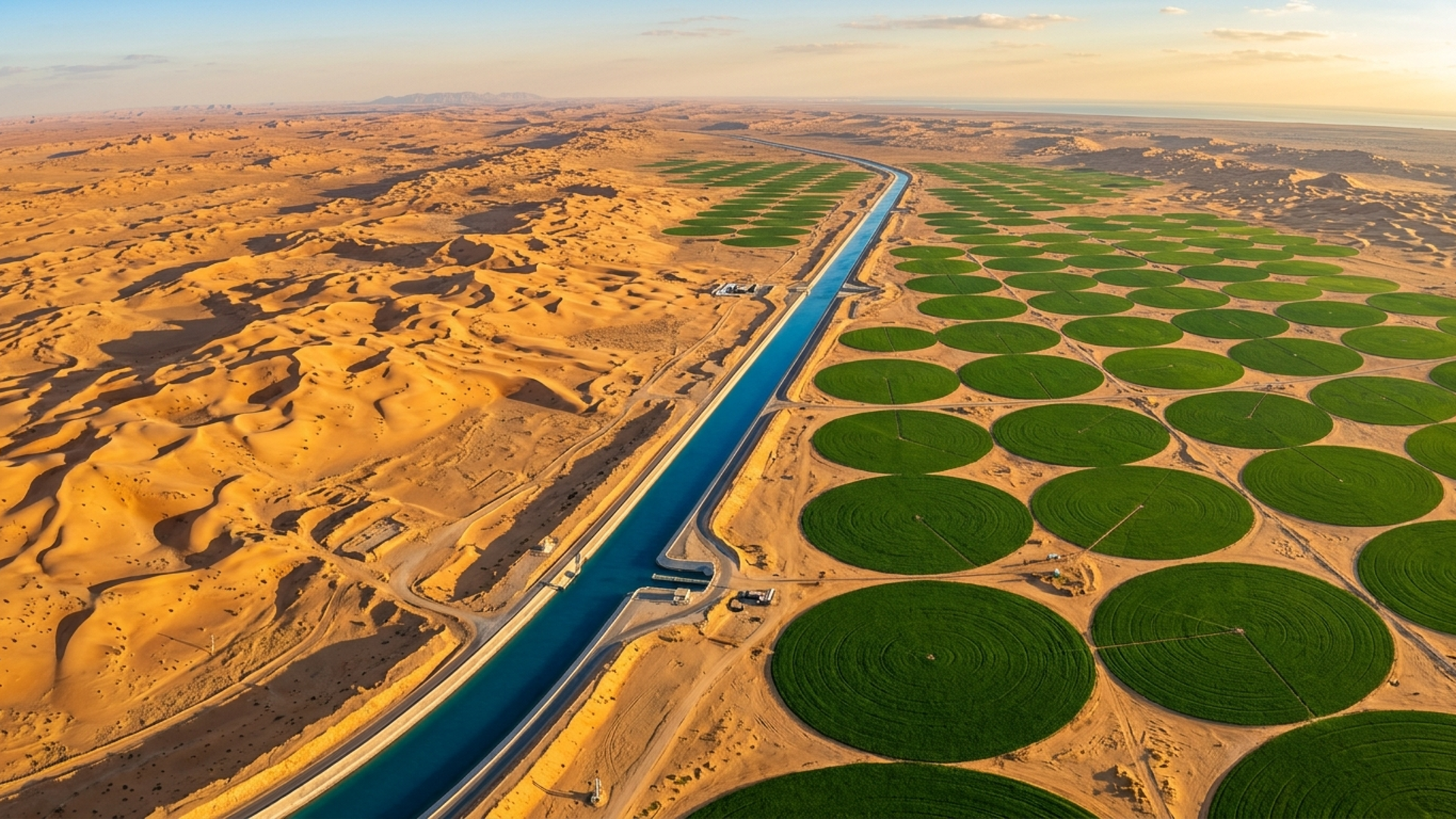
Egypt’s approach includes major agricultural and land reclamation schemes, seeking to expand arable land and address population pressures.
By investing in irrigation systems and modern farming techniques, the country aims to turn previously inhospitable terrain into productive areas capable of supporting long-term growth.
Collectively, these initiatives represent one of the most extensive efforts globally to reshape natural environments through coordinated policy, technology and capital investment.
While challenges remain, including resource demands and long-term sustainability, the scale of ambition reflects a determination to redefine the limits of development in arid regions.
The transformation of desert landscapes is increasingly seen not only as an environmental objective but also as a strategic economic priority, with the potential to influence global approaches to climate adaptation and urban planning in the decades ahead.
Across multiple initiatives, governments are investing trillions of dollars into infrastructure, green technologies and urban planning designed to counter harsh desert conditions and create more habitable, productive landscapes.
These efforts reflect long-term strategies to reduce dependence on traditional industries while positioning the region as a global leader in innovation and environmental adaptation.
In Saudi Arabia, flagship developments are reimagining entire regions through advanced urban design, renewable energy integration and large-scale greening programmes.
The focus includes reducing extreme temperatures, improving air quality and expanding livable space through ambitious environmental engineering.
The United Arab Emirates is similarly advancing projects that combine cutting-edge architecture with sustainability initiatives, including water management systems, climate-controlled environments and energy-efficient cities.
These developments are intended to enhance quality of life while maintaining economic competitiveness.
Egypt’s approach includes major agricultural and land reclamation schemes, seeking to expand arable land and address population pressures.
By investing in irrigation systems and modern farming techniques, the country aims to turn previously inhospitable terrain into productive areas capable of supporting long-term growth.
Collectively, these initiatives represent one of the most extensive efforts globally to reshape natural environments through coordinated policy, technology and capital investment.
While challenges remain, including resource demands and long-term sustainability, the scale of ambition reflects a determination to redefine the limits of development in arid regions.
The transformation of desert landscapes is increasingly seen not only as an environmental objective but also as a strategic economic priority, with the potential to influence global approaches to climate adaptation and urban planning in the decades ahead.