Global Oil Prices Climb as Middle East Tensions Escalate
Rising tensions in the Middle East have led to an increase in global oil prices.
Oil prices rose on Monday due to ongoing Middle East tensions, with Brent crude increasing by 1.7 percent to over $103 per barrel.
President Donald Trump's rejection of Iran's latest proposal to end the conflict has contributed to this rise.
The price of Brent has risen from approximately $70 per barrel prior to the war.
Meanwhile, benchmark US crude rose by $2.55 to $98 per barrel.
The Strait of Hormuz, a crucial waterway for global oil and gas transport, remains largely closed, further contributing to higher oil prices.
As the US maintains its sea blockade of Iranian ports, analysts predict that oil prices will remain elevated for an extended period.
This outlook comes as corporate earnings season draws to a close this week, with rising energy prices and new US inflation data expected to dominate market discussions.
Additionally, a high-stakes summit between Trump and Chinese President Xi Jinping is set to take place, with the Iran war anticipated to be a significant topic of discussion.
China's economic ties with Iran and its potential influence over the country will be closely watched in this context.
While there is still some hope that positive results may emerge from talks between Trump and Xi later in the week, particularly regarding China's ability to encourage Iran toward a peace deal, this remains a challenging prospect.
The oil market is heavily influenced by headlines related to these developments.
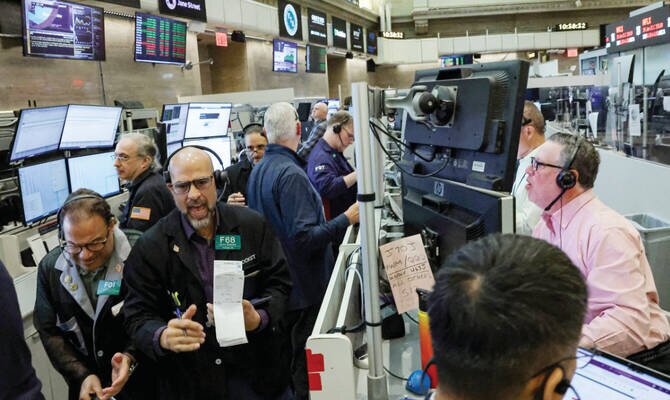
In Europe, stock markets were mixed, with Britain's FTSE 100 remaining unchanged, Germany's DAX falling 0.2 percent, and France's CAC 40 declining 1.1 percent.
Asian markets saw varying results, as Tokyo's Nikkei 225 fell 0.5 percent to 62,417.88 despite briefly reaching an intraday record high.
In contrast, South Korea's Kospi gained 4.3 percent to 7,822.24, reaching its own all-time intraday high due in part to gains from tech-related stocks such as Samsung Electronics and memory chip maker SK Hynix.
Despite the ongoing conflict, technology-focused markets in Japan and South Korea have experienced notable growth, with the Nikkei 225 and Kospi increasing by more than 10 percent and 30 percent, respectively, over the past month.
Hong Kong's Hang Seng index rose less than 0.1 percent to 26,406.84, while Australia's S&P/ASX 200 lost 0.5 percent.
Taiwan's Taiex gained 0.5 percent, and India's Sensex fell by 1.7 percent.
President Donald Trump's rejection of Iran's latest proposal to end the conflict has contributed to this rise.
The price of Brent has risen from approximately $70 per barrel prior to the war.
Meanwhile, benchmark US crude rose by $2.55 to $98 per barrel.
The Strait of Hormuz, a crucial waterway for global oil and gas transport, remains largely closed, further contributing to higher oil prices.
As the US maintains its sea blockade of Iranian ports, analysts predict that oil prices will remain elevated for an extended period.
This outlook comes as corporate earnings season draws to a close this week, with rising energy prices and new US inflation data expected to dominate market discussions.
Additionally, a high-stakes summit between Trump and Chinese President Xi Jinping is set to take place, with the Iran war anticipated to be a significant topic of discussion.
China's economic ties with Iran and its potential influence over the country will be closely watched in this context.
While there is still some hope that positive results may emerge from talks between Trump and Xi later in the week, particularly regarding China's ability to encourage Iran toward a peace deal, this remains a challenging prospect.
The oil market is heavily influenced by headlines related to these developments.
In Europe, stock markets were mixed, with Britain's FTSE 100 remaining unchanged, Germany's DAX falling 0.2 percent, and France's CAC 40 declining 1.1 percent.
Asian markets saw varying results, as Tokyo's Nikkei 225 fell 0.5 percent to 62,417.88 despite briefly reaching an intraday record high.
In contrast, South Korea's Kospi gained 4.3 percent to 7,822.24, reaching its own all-time intraday high due in part to gains from tech-related stocks such as Samsung Electronics and memory chip maker SK Hynix.
Despite the ongoing conflict, technology-focused markets in Japan and South Korea have experienced notable growth, with the Nikkei 225 and Kospi increasing by more than 10 percent and 30 percent, respectively, over the past month.
Hong Kong's Hang Seng index rose less than 0.1 percent to 26,406.84, while Australia's S&P/ASX 200 lost 0.5 percent.
Taiwan's Taiex gained 0.5 percent, and India's Sensex fell by 1.7 percent.