

Coronavirus doctor's diary: We're getting self-harming 10-year-olds in A&E
Children are a lost tribe in the pandemic. While they remain (for the most part) perplexingly immune to the health consequences of Covid-19, their lives and daily routines have been turned upside down.
From surveys and interviews carried out for the Born in Bradford study, we know that they are anxious, isolated and bored, and we see the tip of this iceberg of mental ill health in the hospital.
Children in mental health crisis used to be brought to A&E about twice a week. Since the summer it's been more like once or twice a day. Some as young as 10 have cut themselves, taken overdoses, or tried to asphyxiate themselves.
There was even one child aged eight.
Lockdown "massively exacerbates any pre-existing mental health issues - fears, anxieties, feelings of disconnection and isolation," says A&E consultant Dave Greenhorn.
While Bradford has been in lockdown longer than some other parts of the country, there is no reason to believe this is a local problem. Dave says fellow A&E consultants he's spoken to in Scotland, Portsmouth and Northern Ireland all report a significant increase in mental health attendances - among all age groups, children as well as adults.
Self-harming "used to be the mind-set of older teenagers but we are seeing much younger children doing this now" says Ruth Tolley, a matron on the paediatric ward where children are taken if it is not safe for them to return home.
It may then take the combined efforts of several nurses to prevent further self-harm on the ward.
Eating disorders are also on the rise, says paediatrician Helen Jepp. So are overdoses - where children take their parents' medication, or their own - and cases where children rush out of the house and behave recklessly or dangerously on the street.
A child psychiatrist who works with Bradford's Child and Adolescent Mental Health Services (Camhs) says the caseload fell at the start of the pandemic then returned to normal levels. For him what's new is not the quantity but the severity of the work. "We have been seeing more intense distress," he says. "Young people are in a worse state than usual."
Consultant Dave Greenhorn describes a recent evening in A&E. It's a busy one - there are 94 people in the department, including a pale-looking teenage boy, lying quietly in a cubicle.
Dave asks if he's OK, but there is no answer and no eye contact.
The notes show that the boy has attended the Emergency Department every other day for two weeks. Before now he has taken small overdoses and told staff he wants to die. He has a child and adolescent psychiatrist and support worker but there is no firm diagnosis of mental illness.
One of the problems is that lockdown has prevented everyone from accessing their own safety valves. The boy has previously mentioned that he misses going out with his friends. Now he's stuck at home, and so are other members of his family. Unable to get away for a few hours peace, the mum says she's at the end of her tether and can't deal with her son at home on this particular night.
Dave's attempts to coax the boy to talk to him are unsuccessful, so he makes sure the youngster has some juice and a sandwich and asks the nurses to keep trying to get him to engage when they have a minute - though they rarely do.
On previous admissions to the paediatric ward the boy has been hard to look after, so it's been agreed he shouldn't be sent there, but he doesn't want to go to an adult ward. In the end he spends the night in A&E.
The pandemic has underlined for all to see just how important school is for children. Education is only part of it. There is also the social life, and children benefit from routine, boundaries and adult authority figures outside the home.
Teachers are also experts at spotting problems such as anxiety and self-harm that has taken place at home. A lot of referrals would normally arise in this way.
For older children, school is the framework that will enable them to reach university or employment, and some struggle when it appears to give way.
Seema [not her real name] attempted suicide and started self-harming when exams were cancelled last summer.
"We tried very hard for our exams - you're taught that your entire future revolves around these exams, but that crumbles right in front of you and it's really shocking. It has a huge impact," she says.
"I felt like stabbing myself… I was in a constant state of anxiety."
Now 17, she is doing a lot better, though she still misses contact with teachers and friends, and would like schools to organise online groups for students to socialise, not just meet for lessons.
Her family hasn't been able to understand her problem, but she has now been getting help.
Front-line diary
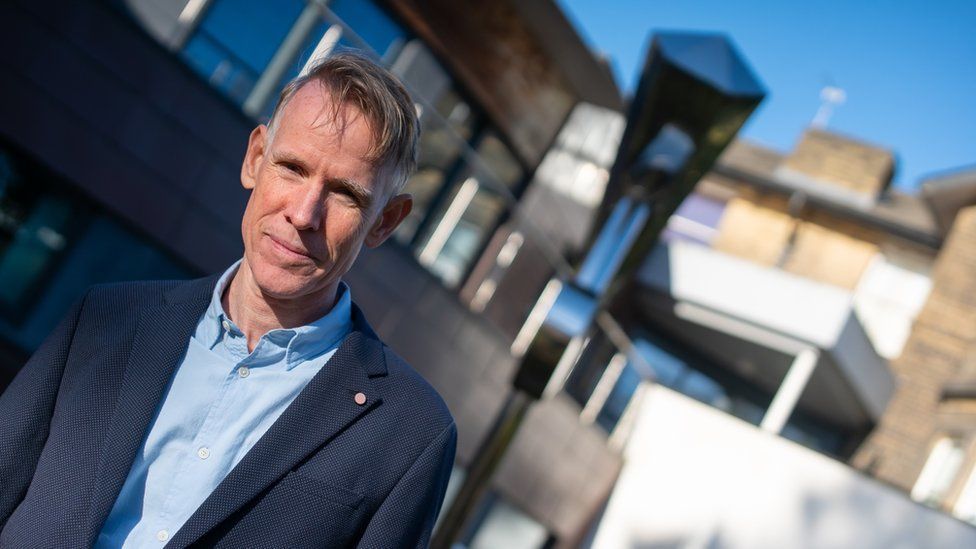
Prof John Wright, a doctor and epidemiologist, is head of the Bradford Institute for Health Research, and a veteran of cholera, HIV and Ebola epidemics in sub-Saharan Africa. He is writing this diary for BBC News and recording from the hospital wards for BBC Radio.
One crucial beneficial change that has come out of this epidemic of mental ill-health is that professionals from all the different agencies in Bradford have come together to support the children in their time of crisis.
Gone are the delays in referrals between different teams - the health service and social services are acting as one.
"Covid has brought services closer together," says paediatric ward matron Ruth Tolley. "We needed an urgent meeting with the safeguarding team and various other agencies and we were able to pull that meeting together in two hours - getting people together and getting a plan, that is really positive."
Paediatrician Helen Jepps agrees. She got a call about a teenager one morning, logged on and saw that a number of teams were already discussing the case - social workers, Camhs and voluntary organisations. "It feels a real privilege at the moment to have that close contact," she says.
But this is little consolation for the damage that is being done to children's lives.
The past 10 months of lockdown and school closures may have seemed unending for parents, but for a 10-year-old it will have felt like a lifetime. Their youth is being stolen from them.