

Boris Johnson says 'very low' Covid case rate key to easing lockdown
Boris Johnson is closely monitoring coronavirus case rates as a requirement for easing restrictions in England, stressing the need for a layer of caution alongside four key criteria set out at the beginning of lockdown.
Last month Matt Hancock, the health secretary, said the success of the vaccine programme, reducing hospitalisations, reducing deaths and controlling the spread of new variants were the four criteria used to decide when the strictest measures could be lifted.
On Monday the prime minister struck a cautious note as he repeatedly emphasised his desire for a slow, controlled easing of restrictions that would not have to be rolled back again – a process he described as “cautious but irreversible”. Johnson said he would “like to see the rates of infection come down very low indeed … we’ll want to see those rates really, really low”.
The emphasis on infection rates as a key factor in the easing of restrictions is likely to inflame tensions with Conservative MPs, some of whom privately pointed out that Hancock committed to the four criteria as recently as 9 February.
Anti-lockdown MPs argue that case rates will matter less once vaccinations take effect. One said on Monday: “Looks like the goalposts left the ground.” A Downing Street source said the four criteria had “never been exclusionary” of other factors and that Johnson had always said the general state of the pandemic would be the key driver.
The prime minister confirmed that he would set out a roadmap for ending restrictions on Monday 22 February, including a concrete timetable with “earliest possible” dates for reopenings – a clarification many MPs had been clamouring for. But he also said the rate of infection would need to be studied at every turn.
“If we possibly can, we’ll be setting out dates,” he said. “The dates that we will be setting out will be the dates by which we hope we can do something at the earliest … If, because of the rate of infection, we have to push something off a little bit to the right – delay it for a little bit – we won’t hesitate to do that.”
Asked if coronavirus could eventually be allowed to circulate in the same way as flu does, Johnson again said infection rates could not be allowed to rise too high.
“The risk is that if you have a large volume of circulation, if you’ve got loads of people, even young people, getting the disease, then a couple of things happen,” he said. “First of all, you have a higher risk of new variants and mutations within the population where the disease is circulating. Secondly, there will also be a greater risk of the disease spreading out into the older groups again.”
On Monday night, MPs were sharing on WhatsApp quotes from Hancock when he was previously asked by the Tory MP William Wragg about whether the number of cases was a key criteria. “No. The prime minister has set out the four conditions that need to be met and will be saying more about that on 22 February,” Hancock said last Tuesday.
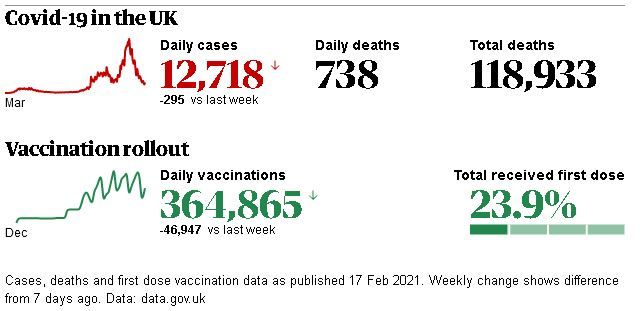
The latest figures show 9,765 new positive coronavirus tests recorded in the UK, the first time the daily figure has been under 10,000 since 2 October, though figures are often lower due to reporting lags at the weekend. The government is awaiting key Public Health England data showing the effect of more than 12m first vaccine doses administered.
“We need to drive infection rates down much lower than they are right now to avoid the mutations you get when there is high prevalence,” one Whitehall official said. “The reason numbers are coming down now is by and large not vaccine-related yet, even though there are some early signs. If you unlock from a high level of people in hospital, then numbers will go straight back up again – we saw that happen in Israel. We cannot deal with high levels of it knocking around – we need much, much lower levels.”
Downing Street and government scientists are hoping to be able to take into account key studies into vaccine efficacy as the roadmap takes shape. Johnson said the government still did not have enough data “about the exact effectiveness of the vaccines in reducing the spread of infection”, saying there were some “interesting straws in the wind”, but adding: “We don’t today have all the hard facts that we need.”
One government source said the absence of sufficient data on vaccine efficacy meant other factors were being taken into account, though it is still expected that enough data can be gathered this week to feed into the roadmap next Monday.
England’s chief medical officer, Prof Chris Whitty, said there had been a number of case control studies, but a wider set of data should be available when rates began rapidly decreasing in the age groups that had been vaccinated.
“I think what we really want to get to is the point where we can see, in a sense with the naked eye, the big effect of the vaccines rather than having to do quite complex calculations of the vaccinated against the unvaccinated, which is where we are at the moment,” he told a Downing Street press conference on Monday.
PHE is conducting a number of surveillance studies, in care homes and the NHS, which are expected to be key to decision-making. The deputy chief medical officer, Jonathan Van-Tam, is said to be “fairly bullish” that studies will show an effect on transmission, according to one official.
One important study that may not come until the end of the month is the Pfizer “real-world study” on efficacy, but some promising findings have already leaked out in recent weeks.
“Ultimately, what matters is whether it is preventing death and preventing the kind of illness that puts pressure on the NHS, because those are the things that lead to the introduction or prolonging of lockdowns,” a Department of Health and Social Care source said.