Saudi Press

Saudi Arabia and the world
Tuesday, Jan 13, 2026

US cites 'great sacrifice' as it pulls 2,200 troops out of Iraq

US cites 'great sacrifice' as it pulls 2,200 troops out of Iraq

American military presence in Iraq will be reduced from 5,200 to 3,000 troops this month, US Central Command announces.

The United States military on Wednesday announced it will reduce its presence in Iraq from 5,200 to 3,000 troops this month, formalising a move that had been long expected.

"We are continuing to expand on our partner capacity programmes that enable Iraqi forces and allow us to reduce our footprint in Iraq," Marine General Frank McKenzie, the head of US Central Command, said during a visit to Iraq.


US soldiers entered Iraq during the American-led invasion in March 2003 to remove Saddam Hussein


The US and Iraq in June affirmed their commitment to the reduction of American troops in the country in coming months, with no plans by Washington to maintain permanent bases or a permanent military presence.

The US has about 5,200 troops that were deployed in Iraq to fight the armed group ISIL (ISIS). Officials in the US-led coalition said Iraqi forces are now mostly able to handle the ISIL remnants on their own.

Late Tuesday, a senior Trump administration official, speaking on condition of anonymity, told reporters on board Air Force One that such an announcement was coming and an announcement on the withdrawal of additional troops from Afghanistan also could be expected in the coming days.

'Continued commitment'


The US invaded Iraq in 2003 and left in 2011, but returned in 2014 after ISIL overran large parts of the country.

"In recognition of the great progress the Iraqi forces have made and in consultation and coordination with the government of Iraq and our coalition partners, the United States has decided to reduce our troop presence in Iraq from about 5,200 to 3,000 troops during the month of September," McKenzie said, according to an excerpt of his remarks provided by his office.

The remaining US forces will continue advising and assisting Iraqi security forces as they attempt to root out ISIL fighters, McKenzie said.

"The US decision is a clear demonstration of our continued commitment to the ultimate goal, which is an Iraqi security force that is capable of preventing an ISIS resurgence and of securing Iraq's sovereignty without external assistance," McKenzie said.

"The journey has been difficult, the sacrifice has been great, but the progress has been significant."


'Endless wars'


In 2016, Trump campaigned on ending the US's "endless wars" but US troops remain in countries such as Afghanistan, Iraq and Syria, albeit in smaller numbers.

"We kept America out of new wars and we're bringing our troops back home, we're bringing them back home from all these faraway places," Trump said in a campaign speech on Tuesday. "We've spent hundreds of billions of dollars, and what do we get out of it?"

Last month, during a meeting with the Iraqi prime minister, Trump redoubled his promise to withdraw the US troops still in Iraq.

Iraq's parliament voted earlier this year for the departure of foreign troops from Iraq, and US and other coalition troops have been leaving as part of a withdrawal.

Trump's meeting with the Iraqi Prime Minister Mustafa al-Kadhimi came amid a new spike in tensions between Washington and Tehran after Washington said it would seek to reinstate all previously suspended US sanctions on neighbouring Iran at the United Nations. Iraq and Iran have close political, economic, and military ties.

Fears of open conflict between the US and Iran grew in January after an American drone strike near Baghdad's airport killed top Iranian General Qassem Soleimani and Iraqi militia leader Abu Mahdi al-Muhandis.

Angry Iraqi legislators, spurred on by Shia political factions, passed a non-binding resolution to remove all US-led coalition forces from the country.

In response to the Soleimani killing, Iran, on January 8, launched a ballistic missile attack on al-Asad airbase in Iraq, which resulted in traumatic brain injuries to more than 100 American troops.
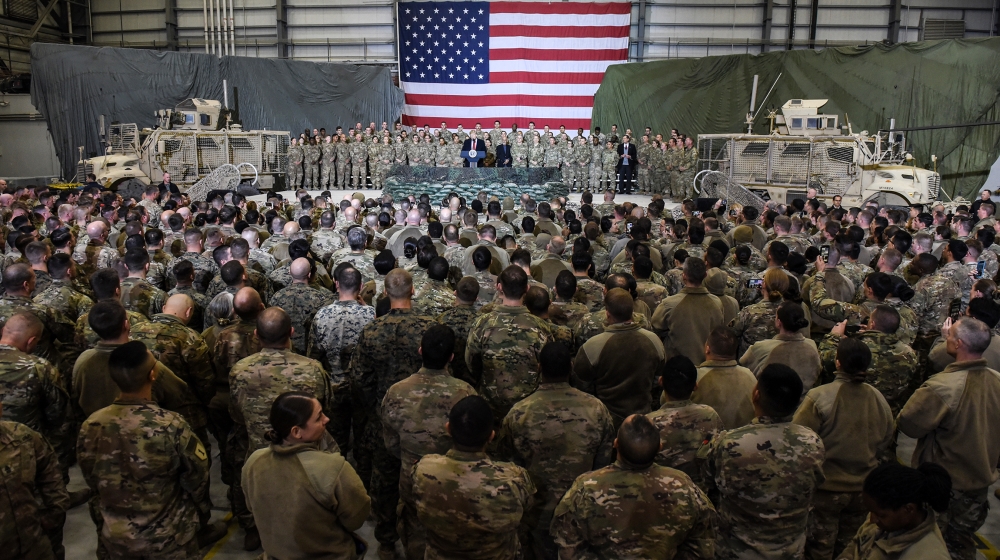

US President Donald Trump speaks to the troops during a surprise Thanksgiving day visit at Bagram Airbase in Afghanistan


Afghanistan next?


Trump has also pushed hard to pull back US forces from Afghanistan, where they rose to more than 12,000 under his watch to pressure the Taliban and ISIL.

The number fell to about 8,600 in July following the February peace accord with the Taliban and McKenzie has said they could all be gone by May 2021 if the Taliban and the Afghan government reach their own agreement.

But Trump's pressure on the Pentagon to more quickly disengage in the Middle East and Afghanistan has strained relations between the White House and US defence chiefs.

Former defence secretary James Mattis quit in December 2018 after Trump declared all US troops would leave Syria.

Under Mattis' successor Mark Esper, the Pentagon has remained wary of hasty withdrawals, cautious that the Taliban would overwhelm Afghan government forces if the US pulls out too quickly.

It has also taken account of Iran's influence in Iraq and the Middle East, which could grow if American forces vacate the region.


Newsletter

Related Articles

Saudi Press
0:00
0:00
Close
Trump Designates Saudi Arabia a Major Non-NATO Ally, Elevating US–Riyadh Defense Partnership
Trump Organization Deepens Saudi Property Focus with $10 Billion Luxury Developments
There is no sovereign immunity for poisoning millions with drugs.
Mohammed bin Salman’s Global Standing: Strategic Partner in Transition Amid Debate Over His Role
Saudi Arabia Opens Property Market to Foreign Buyers in Landmark Reform
The U.S. State Department’s account in Persian: “President Trump is a man of action. If you didn’t know it until now, now you do—do not play games with President Trump.”
CNN’s Ranking of Israel’s Women’s Rights Sparks Debate After Misleading Global Index Comparison
Saudi Arabia’s Shifting Regional Alignment Raises Strategic Concerns in Jerusalem
OPEC+ Holds Oil Output Steady Amid Member Tensions and Market Oversupply
Iranian Protests Intensify as Another Revolutionary Guard Member Is Killed and Khamenei Blames the West
President Trump Says United States Will Administer Venezuela Until a Secure Leadership Transition
Delta Force Identified as Unit Behind U.S. Operation That Captured Venezuela’s President
Trump Announces U.S. Large-Scale Strike on Venezuela, Declares President Maduro and Wife Captured
Saudi-UAE Rift Adds Complexity to Middle East Diplomacy as Trump Signals Firm Leadership
OPEC+ to Keep Oil Output Policy Unchanged Despite Saudi-UAE Tensions Over Yemen
Saudi Arabia and UAE at Odds in Yemen Conflict as Southern Offensive Deepens Gulf Rift
Abu Dhabi ‘Capital of Capital’: How Abu Dhabi Rose as a Sovereign Wealth Power
Diamonds Are Powering a New Quantum Revolution
Trump Threatens Strikes Against Iran if Nuclear Programme Is Restarted
Why Saudi Arabia May Recalibrate Its US Spending Commitments Amid Rising China–America Rivalry
Riyadh Air’s First Boeing 787-9 Dreamliner Completes Initial Test Flight, Advancing Saudi Carrier’s Launch
Saudi Arabia’s 2025: A Pivotal Year of Global Engagement and Domestic Transformation
Saudi Arabia to Introduce Sugar-Content Based Tax on Sweetened Drinks from January 2026
Saudi Hotels Prepare for New Hospitality Roles as Alcohol Curbs Ease
Global Airports Forum Highlights Saudi Arabia’s Emergence as a Leading Aviation Powerhouse
Saudi Arabia Weighs Strategic Choice on Iran Amid Regional Turbulence
Not Only F-35s: Saudi Arabia to Gain Access to the World’s Most Sensitive Technology
Saudi Arabia Condemns Sydney Bondi Beach Shooting and Expresses Solidarity with Australia
Washington Watches Beijing–Riyadh Rapprochement as Strategic Balance Shifts
Saudi Arabia Urges Stronger Partnerships and Efficient Aid Delivery at OCHA Donor Support Meeting in Geneva
Saudi Arabia’s Vision 2030 Drives Measurable Lift in Global Reputation and Influence
Alcohol Policies Vary Widely Across Muslim-Majority Countries, With Many Permitting Consumption Under Specific Rules
Saudi Arabia Clarifies No Formal Ban on Photography at Holy Mosques for Hajj 2026
Libya and Saudi Arabia Sign Strategic MoU to Boost Telecommunications Cooperation
Elon Musk’s xAI Announces Landmark 500-Megawatt AI Data Center in Saudi Arabia
Israel Moves to Safeguard Regional Stability as F-35 Sales Debate Intensifies
Cardi B to Make Historic Saudi Arabia Debut at Soundstorm 2025 Festival
U.S. Democratic Lawmakers Raise National Security and Influence Concerns Over Paramount’s Hostile Bid for Warner Bros. Discovery
Hackers Are Hiding Malware in Open-Source Tools and IDE Extensions
Traveling to USA? Homeland Security moving toward requiring foreign travelers to share social media history
Wall Street Analysts Clash With Riyadh Over Saudi Arabia’s Deficit Outlook
Trump and Saudi Crown Prince Cement $1 Trillion-Plus Deals in High-Profile White House Summit
Saudi Arabia Opens Alcohol Sales to Wealthy Non-Muslim Residents Under New Access Rules
U.S.–Saudi Rethink Deepens — Washington Moves Ahead Without Linking Riyadh to Israel Normalisation
Saudi Arabia and Israel Deprioritise Diplomacy: Normalisation No Longer a Middle-East Priority
Saudi Arabia Positions Itself as the Backbone of the Global AI Era
As Trump Deepens Ties with Saudi Arabia, Push for Israel Normalization Takes a Back Seat
Thai Food Village Debuts at Saudi Feast Food Festival 2025 Under Thai Commerce Minister Suphajee’s Lead
Saudi Arabia Sharpens Its Strategic Vision as Economic Transformation Enters New Phase
Saudi Arabia Projects $44 Billion Budget Shortfall in 2026 as Economy Rebalances
×