

UAE leader breaks with tradition, appoints son as crown prince
United Arab Emirates — United Arab Emirates President Sheikh Mohammed bin Zayed Al Nahyan appointed his son as crown prince of Abu Dhabi and elevated his brothers to top positions, in a consolidation of power that broke from the tradition of passing leadership succession to another brother.
Sheikh Khaled bin Mohammed bin Zayed Al Nahyan, the UAE leader’s eldest son, is now the oil-rich Middle Eastern country’s crown prince, effectively next in line for its leadership.
The 62-year-old Sheikh Mohammed also appointed his brother Sheikh Mansour — a longtime senior minister, chair of the Mubadala sovereign wealth fund and owner of Manchester City soccer club — as UAE vice president, alongside already-sitting Vice President Sheikh Mohammed bin Rashid Al Maktoum, who is the ruler of Dubai.
Sheikh Mohammed’s brother Sheikh Tahnoon, the UAE’s powerful national security advisor, was appointed deputy ruler of Abu Dhabi, as was Sheikh Mohammed’s youngest brother Hazza bin Zayed. Sheikh Tahnoon was already named chair of the $790 billion Abu Dhabi Investment Authority, the emirate’s main sovereign wealth fund, earlier in March.
Developments in the Gulf state are closely watched in the world’s major capitals, as the UAE’s power and influence has increased dramatically in the past several years — politically, militarily and economically.
The UAE, a federation of seven sheikhdoms and home to roughly 10 million people, some 90% of whom are expats, oversees some of the world’s largest sovereign wealth funds. Its military is one of the most powerful and advanced in the region, and it is a leading OPEC member and longtime ally of the U.S. while also rapidly expanding its diplomatic and trade ties with Russia and China.
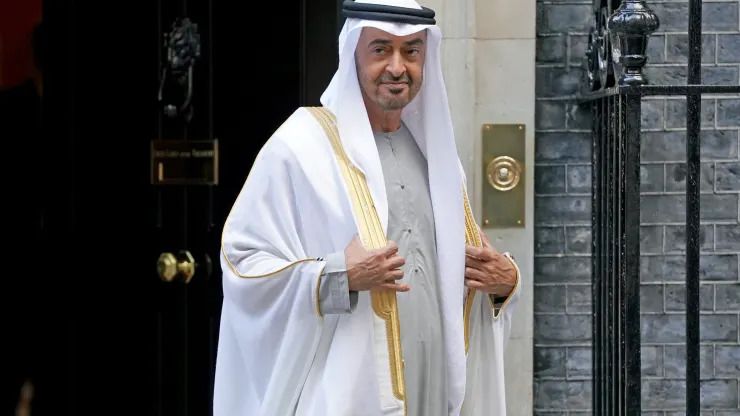 Sheikh Mohammed bin Zayed Al Nahyan, Crown Prince of the Emirate of Abu Dhabi.
Sheikh Mohammed became UAE president and Abu Dhabi ruler in May 2022 following the death of his brother Sheikh Khalifa, having served as crown prince and de-facto ruler of the powerful Gulf state for many years prior.
In a clear demonstration of Sheikh Mohammed’s soft power and global reach, news footage at the time showed top leaders from all over the world lined up to offer condolences and congratulations to the new president in Abu Dhabi, including then-British Prime Minister Boris Johnson, U.S. Vice President Kamala Harris, Secretary of State Antony Blinken and French President Emmanuel Macron.
‘A master stroke’
Some analysts view the president’s move as furthering a concentration of power in Emirati capital Abu Dhabi and away from its commercial capital, Dubai.
“There are now two vice presidents of the UAE, it seems, Sheikh Mohammed bin Rashid of Dubai and Sheikh Mansour bin Zayed of Abu Dhabi,” Ryan Bohl, a senior Middle East and North Africa analyst at Rane, wrote in a post on Twitter. He described the decision as “formalizing the leverage Abu Dhabi has over Dubai, and how little Dubai will be allowed to say in foreign policy.”
Cinzia Bianco, a research fellow on Europe and the Gulf at the European Council on Foreign Relations, described Sheikh Mohammed’s appointment of his son as “a jump towards the next generation,” adding that the move did not come as a surprise.
“As expected, MbZ also appointed his prominent brothers to new roles, keeping some power-sharing balance, but only within the Al-Nahyan clan,” she said, referring to Sheikh Mohammed by his initials.
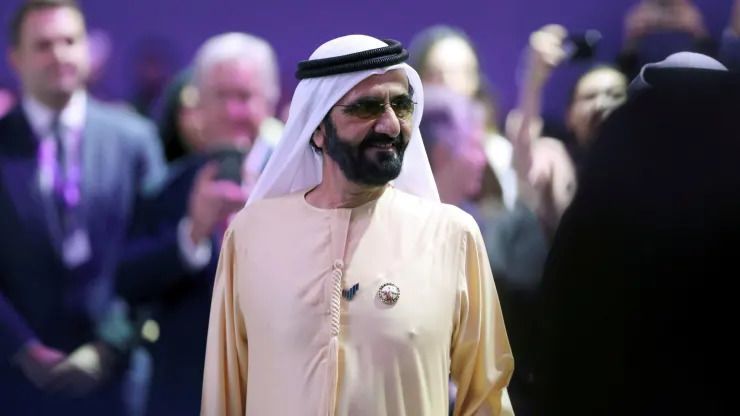 Prime Minister and Vice-President of the United Arab Emirates and ruler
of Dubai Sheikh Mohammed bin Rashid al-Maktoum attends the Global
Women’s Forum in Dubai, United Arab Emirates, February 16, 2020.
Prime Minister and Vice-President of the United Arab Emirates and ruler
of Dubai Sheikh Mohammed bin Rashid al-Maktoum attends the Global
Women’s Forum in Dubai, United Arab Emirates, February 16, 2020.
Other observers disagree with the suggestions that the moves have any impact on Dubai’s power or its ruler Sheikh Mohammed bin Rashid’s role.
“The short answer is nonsense,” Abdulkhaleq Abdulla, a political science professor at Emirates University, told CNBC in response to the question of whether the announcements shift power away from Dubai.
Abdulla explained that this is “because the division of labor has been clear from day one. The state is Abu Dhabi’s responsibility, and the government from day one, and forever, will remain Dubai’s responsibility.”
“This is in the constitution,” he added. “Abu Dhabi is not taking away anything from Dubai’s role and Dubai’s domain. So there is no sidetracking or encroaching or centralization.” The vice presidential role is also largely symbolic, he noted.
Bader Al-Saif, an assistant professor of history at Kuwait University, agreed.
“The set of decrees are a master stroke because they simply settle different files at once pleasing concerned parties,” he wrote in a Twitter post. “Consolidation of power among MBZ’s full siblings is no secret. Today’s decrees reaffirm it.”
Notably, Sheikh Mansour — the new vice president alongside Dubai ruler Sheikh Rashid — is also Sheikh Rashid’s son-in-law.
“Sharing post w/ his father in law isn’t chipping power away from Dxb [Dubai] for 2 reasons,” Al-Saif wrote. He explained that Abu Dhabi “consolidated its power a while back. Additional positions won’t provide something already in place.”
He also noted that Sheikh Rashid, Dubai’s ruler, is also the UAE’s prime minister, which still makes him “above” Sheikh Mansoor, who is a deputy prime minister. The role for Sheikh Mansoor however still reflects his seniority and rewards his years of hard work for the state, Al-Saif said.
“It reinforces the Al Nahyan rule w/ sons of Sh. Zayed supporting the stability & strength of their collective rule in a now lineal model. MBZ [born in 1961] is fit & healthy, which gives new [crown prince] ample time to prepare for his future role,” Al-Saif wrote. “A well-executed mix of decrees.”