

Saudi Arabia and China: New best friends?
Following a report by the The Wall Street Journal that Chinese leader Xi Jinping could accept an invitation to visit Saudi Arabia as soon as May, the world's largest oil producer also said it might allow China to pay for its oil in its own currency, the yuan, rather than US dollars.
Saudi Arabia sells around a quarter of all its oil exports to China. In the first two months of this year, it overtook Russia as the country sending the most oil there.
Amid geopolitical tensions surrounding Russia's ongoing invasion of Ukraine, and as the world lines up on either side of the conflict, the news has sparked fears that Saudi Arabia could end up on Russia's side.
Allowing oil payments in yuan could help create a parallel system for international payments where the Chinese yuan becomes as important as the US dollar. This, in turn, would help Russia bypass sanctions, as the invading nation might then also use yuan. Publicly, China has remained neutral in the conflict, but is widely suspected of being quietly supportive of Russia.
Will the Saudis really allow yuan payments?
The announcement by the Saudi leadership has mostly been seen as a way of putting pressure on their Western allies, experts said.
In fact, as the European Council of Foreign Relations, or ECFR, wrote in a 2019 policy brief called China's Great Game in the Middle East, the Saudis have done this before.
China is often used as a "bargaining chip," the ECFR analysts pointed out.
"For instance," they wrote, "only a few months after the killing of Saudi journalist Jamal Khashoggi, Saudi Crown Prince Mohammed bin Salman appeared to use his tour of Asia to affect debates in the US and European countries on arms sales to his country."
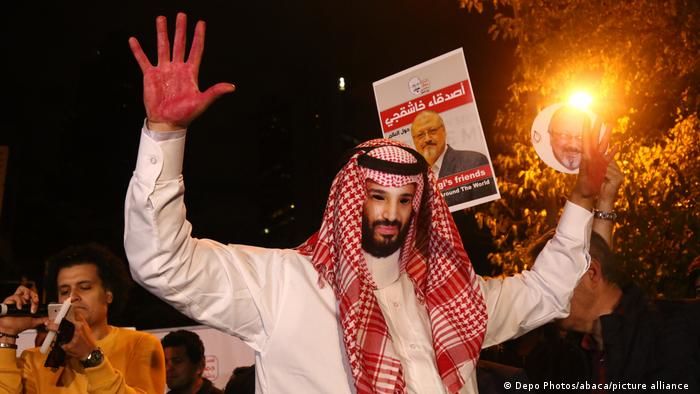 Saudi Arabia faced international condemnation over the brutal murder of Jamal Khashoggi in 2018
What about pressure on Saudi Arabia?
There have been attempts by the US and Europe to shore up Saudi support. American security adviser Brett McGurk traveled to the Gulf state last week, as did UK Prime Minister Boris Johnson.
Up until now, though, US and European officials have tried and failed to get Saudi Arabia to pump more oil , in an effort to alleviate oil prices. Along with the United Arab Emirates, Saudi Arabia is one of the only oil producing countries with spare capacity. If more oil was on the global market, this might help relieve oil prices, which have risen to record-breaking highs thanks to disruptions in oil supply from Russia.
It was not reported as to whether the recent talks with Saudi officials involved oil payments in yuan.
But, "even if Western diplomacy did succeed in bringing these countries on board, their [Saudi officials] worry is that the Middle East is destined to become less — not more — important," Cinzia Bianco, a visiting fellow at the Berlin office of the European Council on Foreign Relations, told DW, referring to the US pivot toward the Asia-Pacific region and away from fossil fuel.
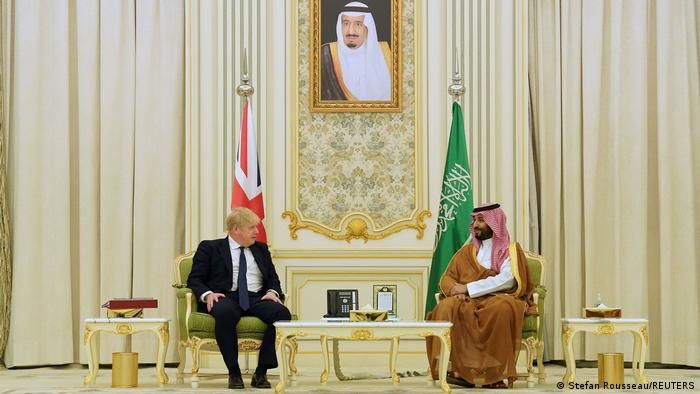 British Prime Minister Boris Johnson (left) paid his respects to the Saudi crown prince last week
"They [the Gulf states] believe Washington has less to offer and less to threaten than it once did," Bianco, an expert on the Gulf region, explained further in a briefing published last week.
"Gulf monarchies' refusal to side with the US and Europe against Russia is not about Russia. It is about navigating the new multipolar world order, taking a transactional approach to protecting national interests," she wrote.
How is China involved?
This is where China comes into it. Ties between Saudi Arabia and China have been deepening for several years already. In 2020, Saudi Arabia was China's largest trading partner in the region, with imports and exports worth over $67 billion (€60.6 billion).
Mostly, these ties have been based on a mutually beneficial economic relationship, one that highlights synergies between China's trillion-dollar, trade-boosting Belt and Road Initiative and Saudi Arabia's own modernization project, Vision 2030.
There are obvious advantages to dealing with a country that will be a long-term buyer of gas and oil, while European customers are increasingly looking into solar and wind power.
Part of Vision 2030 is about preparing Saudi Arabia for a future when oil is less important, and one aspect is to boost Saudi Arabia's potential as a logistics hub in the Middle East. The Belt and Road Initiative fits into this, and China and Saudi Arabia have what is known as a "comprehensive strategic partnership" — although experts like Bianco caution against calling the two nations "allies."
Some analysts have recently suggested that a new era is beginning in Chinese-Middle East relations.
In January, Roie Yellinek, a non-resident scholar at the Washington-based Middle East Institute, observed that a number of foreign ministers from the region had traveled to China that month.
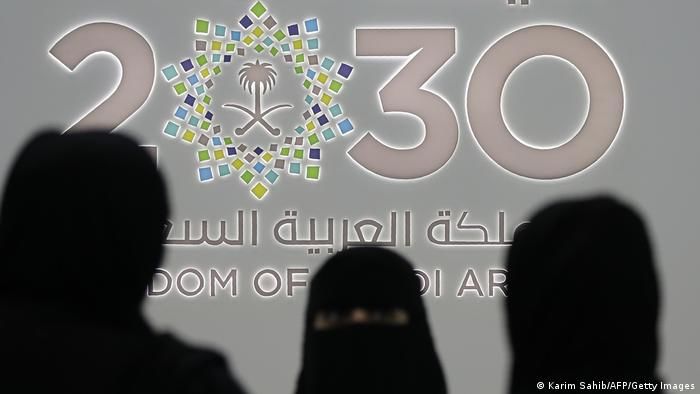 Vision 2030 has liberalized some parts of Saudi life but other aspects, such as in human rights, remain unchanged
"The fact that it was foreign ministers travelling to China, rather than their counterparts with the ministries of trade or economy, suggests a shift in focus," Yellinek argued in an article on the institute's website. "After years of economic-oriented ties … recent events have made it clear that a new era has begun with a greater focus on geopolitics."
This includes a growing military component to the China-Saudi relationship. Between 2016 and 2020, Chinese arms transfers to Saudi Arabia increased 386%, according to the German Institute for International and Security Affairs in a February research paper.
First China sold ballistic missiles to the Saudis, then it began to assist them with their production inside Saudi Arabia.
Also worth noting: The Chinese will deal with leaders the Americans won't. As analysts at the ECFR explained in their 2019 policy briefing, "the Chinese model of authoritarian capitalism already fascinates many Middle Eastern regimes, which see cooperation with China as a means to resist Western pressure to pursue governance reforms and human rights accountability."
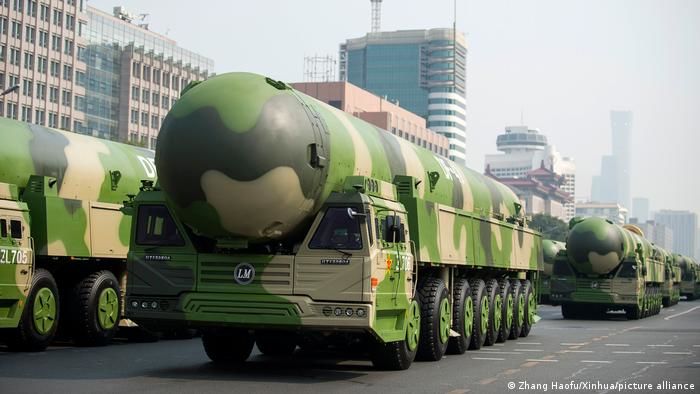 China maintains the largest and most diverse missile arsenal in the world
Is this the end for the US dollar?
The Saudis first suggested the Chinese pay for their oil in yuan about four years ago. But even if this happens, there is unlikely to be any impact on foreign exchange markets in the short, and even medium, term, economic experts have said. Most oil is priced in dollars and it would be a long, complicated process to disengage from that.
Analysts have also pointed out that even if all Saudi and Chinese trade was paid for in yuan, this would only equal around $320 million (€289 million) per working day. Meanwhile all trade in US dollars around the world is equal to roughly $6.6 trillion (€6 trillion) every working day.
In the long term, though, there are fears that a parallel global system of foreign currency exchange could eventually emerge, using China's yuan as an alternative currency. India is reportedly also considering using the yuan for oil purchases from Russia, to avoid international sanctions.
This is seen by some analysts as a way for China to guard against a day when it might potentially become a victim of Western sanctions, the way Russia is being sanctioned now.