
Microsoft CEO to Testify in Musk's Lawsuit Against OpenAI
Satya Nadella expected to explain Microsoft's role in the founding of the AI giant.
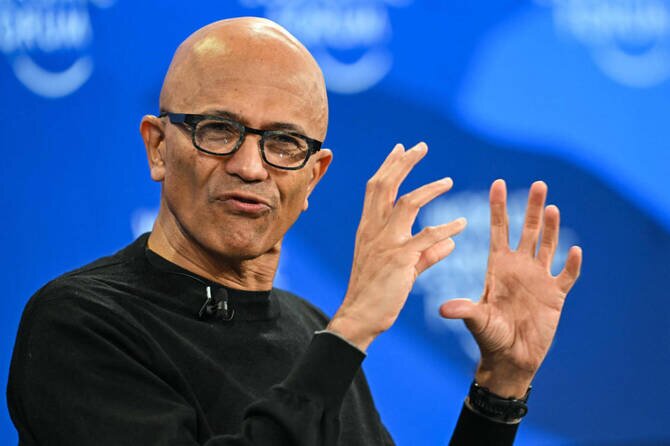
OAKLAND, California: Microsoft CEO Satya Nadella is set to testify on Monday in Elon Musk's lawsuit against OpenAI regarding his company's involvement in funding its shift from a philanthropic organization to a for-profit AI giant.
This testimony precedes that of OpenAI CEO Sam Altman, whose questioning will likely take place on Tuesday or Wednesday, marking one of the final stages in a closely watched trial before a federal jury in Oakland, California.
The ongoing trial has exposed the internal conflicts within an elite circle of Silicon Valley engineers, investors, and executives in the years leading up to the launch of the ChatGPT chatbot in 2022.
Musk accuses OpenAI of abandoning its original nonprofit mission and misappropriating his founding donations totaling $38 million to build a company valued at over $850 billion.
He seeks to have OpenAI revert to its status as a nonprofit, which could impact its position in the global artificial intelligence race against companies such as Anthropic, Google, and China's Deepseek.
OpenAI counters that Musk left voluntarily after failing to secure majority control and has since become the company’s direct competitor through his own AI venture, xAI.
An 'advisory' jury is expected to reach a verdict on any actual wrongdoing by OpenAI by the week of May 18.
Judge Yvonne Gonzalez Rogers will then make the final ruling on liability and remedies after hearing the jury's opinion, indicating that she will likely follow their advice.
If Gonzalez Rogers sides with Musk, it could jeopardize OpenAI’s initial public offering.
Microsoft's involvement is a central point in Musk’s case.
On Monday, Musk’s lawyers are expected to argue that Microsoft knew it was helping divert a nonprofit foundation from its original purpose when it invested in OpenAI in 2019.
They will rely on internal Microsoft emails from January 2018 to demonstrate the tech giant’s interest only emerged once profit became a possibility.
These emails highlight discussions between Nadella and his executives regarding discounts granted to OpenAI for using Azure, Microsoft's cloud-computing platform.
Concerns about OpenAI potentially shifting to Amazon were also raised.
Following this internal debate, cash-strapped OpenAI established a for-profit subsidiary in 2019 to attract investments rather than relying solely on donations.
In 2019, after turning its back on the startup, Microsoft finally invested $1 billion and ultimately injected $13 billion in total, with their stake now valued at $228 billion—17 times the initial investment.
The trial has already featured compelling testimony, including that of OpenAI co-founder Greg Brockman.
His 2017 diary entries suggesting a focus on financial gain have been highlighted by Musk’s legal team to depict Brockman as an opportunist.
Moreover, it was revealed that Brockman told lawyers about a physical threat made by Musk in 2017 after he was denied absolute control of OpenAI.
In response to the ongoing trial, Musk announced a major partnership with Anthropic, OpenAI's top competitor, allowing them to utilize compute capacity at SpaceX’s largest data center.
This testimony precedes that of OpenAI CEO Sam Altman, whose questioning will likely take place on Tuesday or Wednesday, marking one of the final stages in a closely watched trial before a federal jury in Oakland, California.
The ongoing trial has exposed the internal conflicts within an elite circle of Silicon Valley engineers, investors, and executives in the years leading up to the launch of the ChatGPT chatbot in 2022.
Musk accuses OpenAI of abandoning its original nonprofit mission and misappropriating his founding donations totaling $38 million to build a company valued at over $850 billion.
He seeks to have OpenAI revert to its status as a nonprofit, which could impact its position in the global artificial intelligence race against companies such as Anthropic, Google, and China's Deepseek.
OpenAI counters that Musk left voluntarily after failing to secure majority control and has since become the company’s direct competitor through his own AI venture, xAI.
An 'advisory' jury is expected to reach a verdict on any actual wrongdoing by OpenAI by the week of May 18.
Judge Yvonne Gonzalez Rogers will then make the final ruling on liability and remedies after hearing the jury's opinion, indicating that she will likely follow their advice.
If Gonzalez Rogers sides with Musk, it could jeopardize OpenAI’s initial public offering.
Microsoft's involvement is a central point in Musk’s case.
On Monday, Musk’s lawyers are expected to argue that Microsoft knew it was helping divert a nonprofit foundation from its original purpose when it invested in OpenAI in 2019.
They will rely on internal Microsoft emails from January 2018 to demonstrate the tech giant’s interest only emerged once profit became a possibility.
These emails highlight discussions between Nadella and his executives regarding discounts granted to OpenAI for using Azure, Microsoft's cloud-computing platform.
Concerns about OpenAI potentially shifting to Amazon were also raised.
Following this internal debate, cash-strapped OpenAI established a for-profit subsidiary in 2019 to attract investments rather than relying solely on donations.
In 2019, after turning its back on the startup, Microsoft finally invested $1 billion and ultimately injected $13 billion in total, with their stake now valued at $228 billion—17 times the initial investment.
The trial has already featured compelling testimony, including that of OpenAI co-founder Greg Brockman.
His 2017 diary entries suggesting a focus on financial gain have been highlighted by Musk’s legal team to depict Brockman as an opportunist.
Moreover, it was revealed that Brockman told lawyers about a physical threat made by Musk in 2017 after he was denied absolute control of OpenAI.
In response to the ongoing trial, Musk announced a major partnership with Anthropic, OpenAI's top competitor, allowing them to utilize compute capacity at SpaceX’s largest data center.