

Iran, Lebanon reaction to Salman Rushdie attack
Mixed reactions to author Salman Rushdie’s attack came out of the Middle East as he fought for his life on a ventilator in New York.
An official from Iran-backed Lebanese armed group Hezbollah said on Saturday it had no additional information on the stabbing.
“We don’t know anything about this subject, so we will not comment,” the official told the Reuters news agency on condition of anonymity.
Hezbollah is supported by Iran, whose previous supreme leader, Ayatollah Ruhollah Khomeini, pronounced a religious decree in 1988 calling on Muslims to kill Rushdie for blasphemy over his book The Satanic Verses.
He had a bounty on his head offering more than $3m to anyone who killed him.
The suspected attacker was identified by police as Hadi Matar, 24, from New Jersey. He was charged on Saturday with attempted murder and assault.
Matar and his family hails from the south Lebanon town of Yaroun, said its Mayor Ali Tehfe. Tehfe said Matar’s parents emigrated to the United States and Matar was born and raised there.
When asked if Matar or his parents were affiliated with or supported Hezbollah, Tehfe said he had “no information at all” on the political views of the parents or Matar as they lived abroad.
‘Happy to hear’
A bloodied Rushdie, 75, was flown to a hospital and underwent surgery late Friday. His agent, Andrew Wylie, said the writer was on a ventilator with a damaged liver, severed nerves in his arm, and an eye he was likely to lose.
Iran’s government has not officially commented on the attack.
But in Iran’s capital, some willing to speak to The Associated Press offered praise for the assault targeting a writer they believe tarnished the Islamic faith with his 1988 book. In the streets of Tehran, images of the late Ayatollah Ruhollah Khomeini still peer down at passers-by.
“I don’t know Salman Rushdie but I am happy to hear that he was attacked since he insulted Islam,” said Reza Amiri, a 27-year-old deliveryman. “This is the fate for anybody who insults sanctities.”
Mohammad Mahdi Movaghar, a 34-year-old Tehran resident, described having a “good feeling” after seeing Rushdie attacked.
“This is pleasing and shows those who insult the sacred things of we Muslims, in addition to punishment in the hereafter, will get punished in this world too at the hands of people,” he said.
Others, however, worried that Iran could become even more cut off from the world as tensions remain high over its tattered 2015 nuclear deal.
“I feel those who did it are trying to isolate Iran,” said Mahshid Barati, a 39-year-old geography teacher. “This will negatively affect relations with many – even Russia and China.”
Since then-President Donald Trump unilaterally withdrew the US from the nuclear accord in 2018, Tehran has seen its currency plummet and its economy crater. Meanwhile, Iran has enriched uranium closer than ever to weapons-grade levels.
“It [the attack] will make Iran more isolated,” warned former Iranian diplomat Mashallah Sefatzadeh.
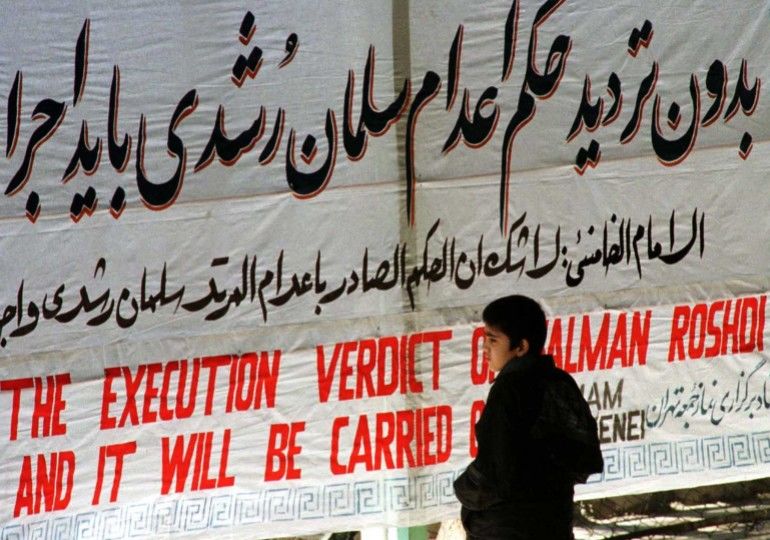 An Iranian boy stands in front of a banner at Tehran University in 1989
that reads ‘the execution verdict of Salman Rushdie will be carried out’
An Iranian boy stands in front of a banner at Tehran University in 1989
that reads ‘the execution verdict of Salman Rushdie will be carried out’
‘A thousand bravos’
Several Iranian newspapers poured praise on Saturday on the person who attacked and seriously wounded Rushdie.
The hardline Kayhan newspaper, whose editor-in-chief is appointed by Iran’s Supreme Leader Ayatollah Ali Khamenei, wrote, “A thousand bravos … to the brave and dutiful person who attacked the apostate and evil Salman Rushdie in New York. The hand of the man who tore the neck of God’s enemy must be kissed.”
Khomeini issued the decree on Rushdie in 1989. It came amid a violent uproar in the Muslim world over his novel, which some viewed as blasphemously making suggestions about the Prophet Muhammad’s life.
While such edicts can be revised or revoked, Iran’s current supreme leader, who took over after Khomeini died, has never done so.
Early on Saturday, Iranian state media made a point to note one man identified as being killed while trying to carry out the decree. Lebanese national Mustafa Mahmoud Mazeh died when a book bomb he had prematurely exploded in a London hotel on August 3, 1989, just more than 33 years ago.
At newsstands on Saturday, front-page headlines offered their own takes on the attack. The hardline Vatan-e Emrouz’s main story covered what it described as, “A knife in the neck of Salman Rushdie.” The reformist newspaper Etemad’s headline asked: “Salman Rushdie in neighbourhood of death?”
‘Incitement to violence’
Some US-based activist groups denounced the decades-old religious decree, blaming it for the attack on Rushdie.
“Whether today’s assassination attempt was ordered directly by Tehran or not, it is almost certainly the result of 30 years of the regime’s incitement to violence against this celebrated author,” said the Washington-based National Union for Democracy in Iran.
The National Council of Resistance of Iran, an opposition group outlawed in Iran, said the attack had taken place at the “instigation” of Khomeini’s decree.
“Ali Khamenei and other leaders of the clerical regime had always vowed to implement this anti-Islamic fatwa [decree] in the past 34 years,” it said in a statement.
In an interview conducted just weeks before he was stabbed and seriously wounded, Rushdie said his life was now “relatively normal” after having lived in hiding for years because of death threats. The magazine interview was to appear on August 18, but the German magazine, Stern, released it on Saturday.
Rushdie, who became a US citizen in 2016 and lives in New York City, said he was worried about threats to democracy in the US.