

Funerals and Islamic Jihad battle songs: Gaza after the ceasefire
In Shujaiya, a neighbourhood of Gaza City already scarred by several rounds of war, men passed around coffee and dates under the shade of a colourful mourning tent while Palestinian Islamic Jihad battle songs blared from a sound system.
Men carrying AK-47s, their faces shielded by black balaclavas, lined the entrance to the tent, and the militant group’s black and yellow flag flew overhead.
The neighbourhood had gathered to mourn five-year-old Alaa Qaddoum, one of the first casualties of Operation Breaking Dawn - a surprise Israeli airstrike campaign targeting Islamic Jihad, the second largest militant organisation in the Gaza Strip after Hamas.
Israel’s military said Alaa’s father, Abdullah, is a senior Islamic Jihad commander, but did not comment on whether he was the target of the strike on Friday that killed her. He was badly injured in the attack, along with Alaa’s seven-year-old brother. The Israeli military said it was aware of the five-year-old’s death and civilian casualties would be investigated.
A 60-year-old civilian sitting on the steps of a mosque and an Islamic Jihad fighter on a motorbike were also killed on Friday afternoon, in the opening salvo of Israel’s three-day offensive.
The motorcyclist was named by Islamic Jihad as Yusuf Qaddoum, Alaa’s distant relative.
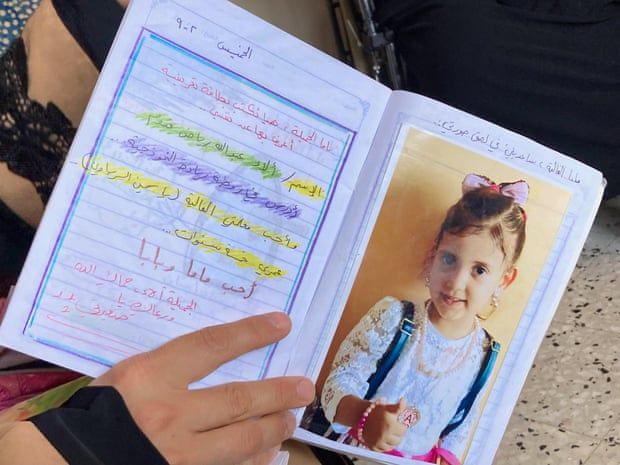 Qaddoum family school books.
“They were aiming at the motorbike, but it was obvious there were children and people at the mosque,” said Alaa’s grandfather, Riad, gesturing at the shrapnel marks and streaks of dried blood at the spot the girl died. “The rest of the street was empty. They could have waited.”
According to the Gaza health ministry, 44 people, including 15 children and several members of Islamic Jihad, were killed and 350 civilians wounded as missiles pummelled the blockaded Palestinian territory before a Egypt-mediated ceasefire came into effect late on Sunday night. Sixty people in southern Israel were treated for minor injuries as hundreds of retaliatory rockets were fired across the Gaza frontier towards the south of the country.
Unlike other Israeli airstrikes in built-up areas of the strip, which since 2014 are often been accompanied by phone calls ordering residents to evacuate beforehand, Breaking Dawn began without warning.
Alaa’s mother, Rasha, said she and her husband were taking their four children to the park when the operation started. The family walked around the corner to borrow a Thermos flask from a relative, and Rasha was inside the house when a missile turned the street into blood and dust.
“She loved school. She was so keen to go back after the summer she already made me call the teacher and register for next year,” the 27-year-old said, surrounded by mourners at the family home as she clutched Alaa’s pink rucksack and leafed through her school books.
“I was standing next to the window when it happened. I saw our relatives holding my daughter, and she was bleeding. She doesn’t know anything about rockets. What was her crime?”
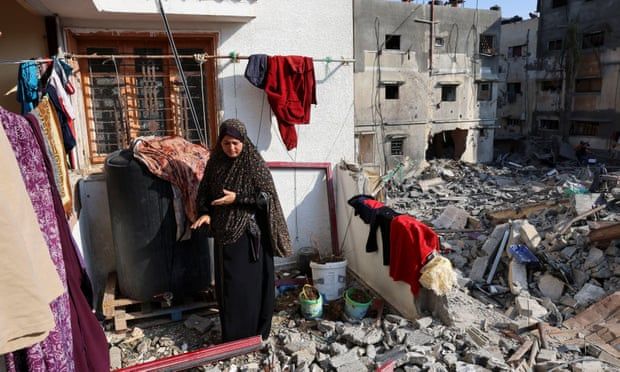 A Palestinian woman hangs laundry at her house damaged during Israel-Gaza fighting.
Founded in 1981 with the aim of establishing an Islamic Palestinian state and destroying Israel, Islamic Jihad is directly funded by Iran and designated as a terrorist organisation by most of the international community. Unlike Hamas, which seized control of the Gaza Strip in 2007, it is not encumbered by the day-to-day governance of the coastal enclave, and as a result is often the driving force behind confrontations with Israel. While the two movements are allied, Islamic Jihad often acts independently, and sometimes undermines Hamas’s authority.
The weekend’s violence – the worst since an 11-day-war in May 2021, which killed 256 people in Gaza and 14 people in Israel – was triggered by the arrest of Bassem al-Saadi, Islamic Jihad’s top commander in the occupied West Bank. While Islamic Jihad did not respond by firing rockets at Israel, the Israeli defence establishment has insisted that Breaking Dawn prevented an imminent major retaliatory attack.
The campaign is viewed by the majority of the Israeli public as an overwhelming success: the IDF managed to kill two senior Islamic Jihad commanders, and says it destroyed rocket-launching sites and training camps, without incurring a single Israeli casualty. A gamble that Hamas would not be drawn into the fray, sparking an all-out war, appears to have paid off, as the group is still replenishing its arsenal and tunnel network after the last round of conflict.
The operation has burnished the security credentials of Israel’s caretaker prime minister, the centrist Yair Lapid, before the politically polarised country holds its fifth elections in less than four years this November. Gaza’s 2.2 million inhabitants, however, are paying a heavy price.
Four wars and several other battles with Israel since the Hamas takeover have devastated the infrastructure and economy of the 17 square miles, while 15 years of a joint Israeli-Egyptian blockade have left the trapped population struggling to access clean water, electricity and adequate medical care.
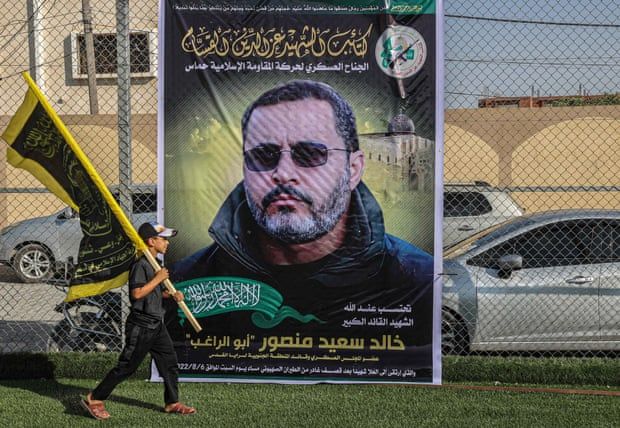 A Palestinian boy holds an Islamic Jihad flag
next to a picture of the group’s leader, Khaled Mansour, who was killed
by an Israeli airstrike on Saturday.
A Palestinian boy holds an Islamic Jihad flag
next to a picture of the group’s leader, Khaled Mansour, who was killed
by an Israeli airstrike on Saturday.
On Monday, after the ceasefire came into effect, most people in the strip were trying to get back to a semblance of normality. Electricity and water were still not working in many areas, and fuel deliveries from Israel have not yet reached petrol stations.
In Sheikh Ijlin, a neighbourhood of southern Gaza City abutting the Mediterranean, residents of two blocks of houses picked over the rubble of their homes, which were destroyed on Saturday; two barefoot little girls played with plastic flowers and blankets pulled from the debris as the adults surveyed the damage.
Safa Shammalakh, a 31-year-old disabled shopkeeper, struggled to get to safety after she heard shouts on Saturday morning that the Israelis had called the owner of the building next door, warning that it would be hit.
“My home is gone, my grocery is gone,” she said. “We hope the ceasefire will hold, but there are never any guarantees. It always happens again.”