CBO Estimates Trump's 'Golden Dome' Missile Defense Plan to Cost $1.2 Trillion
The Congressional Budget Office analysis reveals a significantly higher price tag for President Donald Trump's proposed space-based missile defense system compared to his initial claim.
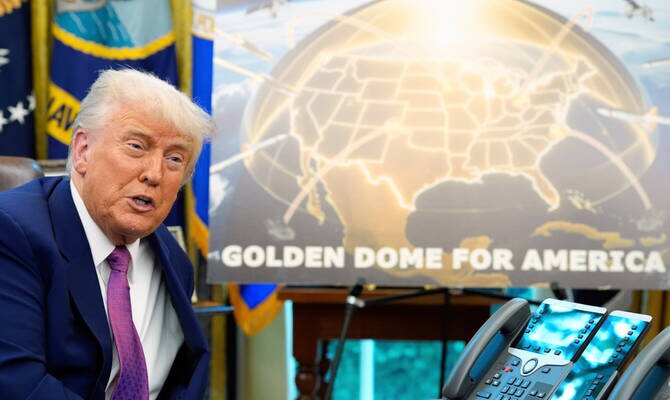
President Donald Trump's vision for an advanced missile defense program, dubbed the 'Golden Dome,' is estimated to cost $1.2 trillion over a span of 20 years, according to recent findings from the Congressional Budget Office (CBO).
This figure starkly contrasts with the initial $175 billion price tag that Trump mentioned last year.The CBO's report, published on Tuesday, emphasizes that its estimates are based on an illustrative approach rather than an exact projection of a specific government proposal.
The analysis highlights the complexity and unpredictability involved in estimating costs due to the lack of detailed information provided by the Department of Defense regarding the systems' deployment and specifics.Trump first introduced the Golden Dome initiative through an executive order during his inaugural week, aiming for its completion before the end of his second term in January 2029.
The president justified this ambitious project as a response to escalating threats from adversarial nations that have been developing sophisticated weapons delivery systems over the past few decades.The concept for this multi-layered defense system is reportedly inspired by Israel's Iron Dome, which has played a crucial role in intercepting missiles and rockets launched by Iran and allied groups.
The US version of Golden Dome is envisioned to integrate ground- and space-based technologies capable of detecting, intercepting, and neutralizing potential missile threats at various stages of an attack.Although Congress approved approximately $24 billion for this initiative through the recent tax and spending bill enacted in summer 2017, questions remain regarding its financial viability.
Gen. Michael A.
Guetlein, director of the Golden Dome project, defended the program by stating that previous cost estimates were based on scaling up outdated systems and do not accurately reflect the affordability measures being taken with this new initiative.Senator Jeff Merkley (D-Oregon), who requested the CBO estimate, criticized the missile defense project, describing it as a large-scale allocation of resources to defense contractors at the expense of working Americans.
The discrepancy between Trump's initial claim and the CBO's revised estimate has sparked ongoing debate over the fiscal prudence and necessity of this ambitious defense program.
This figure starkly contrasts with the initial $175 billion price tag that Trump mentioned last year.The CBO's report, published on Tuesday, emphasizes that its estimates are based on an illustrative approach rather than an exact projection of a specific government proposal.
The analysis highlights the complexity and unpredictability involved in estimating costs due to the lack of detailed information provided by the Department of Defense regarding the systems' deployment and specifics.Trump first introduced the Golden Dome initiative through an executive order during his inaugural week, aiming for its completion before the end of his second term in January 2029.
The president justified this ambitious project as a response to escalating threats from adversarial nations that have been developing sophisticated weapons delivery systems over the past few decades.The concept for this multi-layered defense system is reportedly inspired by Israel's Iron Dome, which has played a crucial role in intercepting missiles and rockets launched by Iran and allied groups.
The US version of Golden Dome is envisioned to integrate ground- and space-based technologies capable of detecting, intercepting, and neutralizing potential missile threats at various stages of an attack.Although Congress approved approximately $24 billion for this initiative through the recent tax and spending bill enacted in summer 2017, questions remain regarding its financial viability.
Gen. Michael A.
Guetlein, director of the Golden Dome project, defended the program by stating that previous cost estimates were based on scaling up outdated systems and do not accurately reflect the affordability measures being taken with this new initiative.Senator Jeff Merkley (D-Oregon), who requested the CBO estimate, criticized the missile defense project, describing it as a large-scale allocation of resources to defense contractors at the expense of working Americans.
The discrepancy between Trump's initial claim and the CBO's revised estimate has sparked ongoing debate over the fiscal prudence and necessity of this ambitious defense program.