

Ex-CIA official Norman Roule on how Biden’s visit could fix Saudi ties, and why it’s important to do so
The visit could not only have a major impact on US-Saudi and regional long-term ties, but also lead to the building of a relationship that will help both countries achieve their long-term goals, Roule told Katie Jensen, the host of “Frankly Speaking,” the Arab News talk show that features interviews with leading policymakers and business leaders.
Despite soaring fuel prices and quickening inflation in the US, the White House has denied that Biden’s visit will focus primarily on oil, a sentiment with which Roule agrees.
“The US and Saudi Arabia have multiple issues on areas ranging from green energy to space that will be important parts of the discussions that take place in Riyadh,” he said.
An Organization of the Petroleum Exporting Countries and non-OPEC ministerial meeting in early June resulted in a pledge to increase oil production by 50 percent in July in order to alleviate the sharp rise in fuel prices.
Various other issues on the table include the waterways which surround Saudi Arabia that are vital to the functioning of the US economy, such as the Red Sea, the Arabian Sea and the Arabian Gulf.
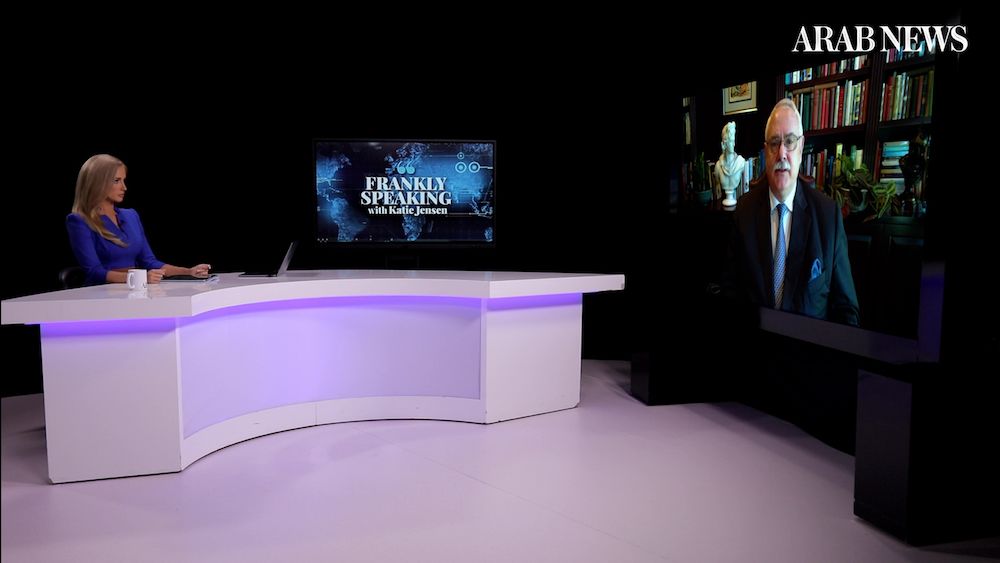 Former senior CIA operations officer and Middle East expert Norman
Roule speaks with Katie Jensen, the host of “Frankly Speaking,” the Arab
News talk show.
Former senior CIA operations officer and Middle East expert Norman
Roule speaks with Katie Jensen, the host of “Frankly Speaking,” the Arab
News talk show.
Agriculture and food security, both regionally and in Africa, where Saudi Arabia’s influence is growing, and the fight against extremism will also be on the agenda.
“These issues just don’t get much press because I think they sound a little more boring than oil and gas prices and some more simplistic challenges,” Roule said.
Still, many argue that oil is the elephant in the room as Biden prepares to make his visit to a country that some Americans view as a giant gas station. Some imply that Saudi Arabia, as the largest and most profitable OPEC member, is somehow to blame for the recent surge in prices. Roule disagrees.
“President Putin deserves a fair amount of the blame,” he said. “Saudi Arabia has a role, but I wouldn’t overstate that.”
He said many other factors, including the cessation of Russian shipments of oil, gas and coal to Europe and rapid economic growth as the world’s economy recovers from the COVID-19 pandemic, are playing their part.
He added: “There has been a failure of capital investment in the US and in other countries. We have an explosive growth of the economy as a result of our economic policies and coming out of COVID-19.”
One of the most interesting aspects of the upcoming Biden visit, according to Roule, is that “the economic goals of the US government and the Saudi government are almost identical.”
Aside from the more trans-global trade issues, both the US and Saudi Arabia are working to improve infrastructure and support the growth of their respective middle classes.
Roule thinks protecting the achievements of both countries is of great importance. “Each party wishes to avoid any conflicts in the region that might produce devastating conventional wars that would set back those economic and social gains,” he said.
“We need Saudi Arabia’s cooperation, partnership, and also to see how we can support Saudi Arabia’s own initiatives to prevent extremism throughout the Islamic world.”
On a more individual level, Roule said, “you’re going to have the president of the US and his vast staff see first-hand what life is like in Saudi Arabia. That will be powerful.”
“You are going to have a personal relationship potential between the president and all of the actors he meets on this trip, to include the crown prince of Saudi Arabia.”
Roule believes such a personal relationship between the two leaders has the potential to “see channels of communications and structures set up so that they can continue these discussions to build on this and actually achieve the goals these meetings were supposed to create in the months that follow this meeting.”
While Roule believes the US leadership respects the Kingdom’s ambitions for reform and challenges it faces in doing so, a wider audience “generally sees the Kingdom in terms of the 9/11 issue, the Jamal Khashoggi murder, and the oil issue.”
Saudi media must do more to counter these stereotypical images of the Kingdom, Roule said, adding that other Middle Eastern countries such as Israel and Qatar have 24-hour broadcasting stations which American television viewers can watch.
He suggests that a Saudi 24-hour television station could “show life in a flat, nonpartisan, non-political way.”
Just as Saudi Arabia is not without its faults, a potential Biden visit to Saudi Arabia is not without its detractors. Those who criticize the trip highlight human-rights issues and the now seven-year war in Yemen.
Roule calls these reservations “excessive,” saying that “I have spoken with many Saudi officials who have assured me, to my satisfaction, frankly, that they are trying to do everything they can to limit civilian casualties.”
He added: “I would stress that the Biden administration itself, in its rhetoric and its political statements, has repeatedly thanked the Kingdom for its strenuous diplomatic efforts that it has undertaken to achieve a political solution to this conflict, and it has been quite a while since you have had the Biden administration criticize the Saudi government, and that is based on what I am certain is the simple view of the facts.”
Roule has no doubt that the Iranian-backed Houthis are the primary opposition to a peaceful resolution to the conflict in Yemen.
US-Saudi relations are critical to countering malicious actions by Iran, according to Roule, who spent 34 years with the CIA covering the Middle East.
For nine of those years, he was the national intelligence manager for Iran at the Office of the Director of National Intelligence, and he currently serves as a senior adviser to the political advocacy group United Against Nuclear Iran.
Tehran may view the Biden visit as a threat, and the country and its proxies may attempt to disrupt the visit, according to Roule.
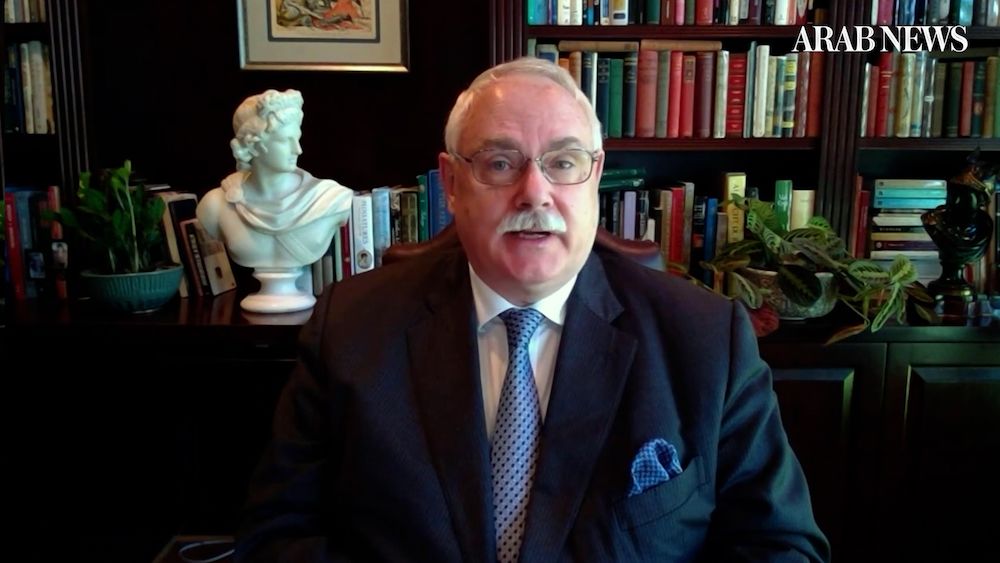 During his frequent travels to the Kingdom over nearly forty years,
Roule said he has been impressed by many aspects of the Kingdom’s
progress.
During his frequent travels to the Kingdom over nearly forty years,
Roule said he has been impressed by many aspects of the Kingdom’s
progress.
“They are not happy with this upcoming visit, particularly with the prospect of improved air defenses in the region, because an integrated air-defense system for the region would complicate Iran’s ability to conduct missile attacks and drone attacks directly or via its proxies,” he said.
Roule called the social and economic success witnessed by the Arabian Peninsula in the past several decades “the greatest threat to the Iranian government,” adding that Tehran views the achievements of the region as “a powerful corrosive that will undermine the stability of the Islamic Republic.”
In his opinion, Iran is attempting to cement its hegemony in the Arab world by force, belying former US President Barack Obama’s claim in an interview with The Atlantic magazine that Saudi Arabia and Iran finding a way to “share the neighborhood” is the best way to institute a “cold peace.”
Despite the obstacles that Iranian proxy force Hamas is creating with the intent of hindering an Israeli-Palestinian peace process, Roule believes Saudi Arabia could have an effective role in a peaceful solution to the conflict.
As a guest in a previous episode of Frankly Speaking, Issawi Frej, Israeli minister for regional cooperation, said the “Saudi leadership would be central to any solution in the future.”
Roule concurred, saying: “The Kingdom has repeatedly said it supports a two-state solution, and once the Palestinian issue is resolved and some legitimate concerns and requirements of the Palestinians are resolved, it would see greater engagement with Israel, which it accepts as a part of the region.”
During his frequent travels to the Kingdom over nearly forty years, Roule has been impressed by many aspects of the Kingdom’s progress, and remains positive that such a visit could have a deeper impact on how the world views the country.
“The history of the Kingdom is more open than it has ever been, to include the pre-Islamic history,” he said.
“I have been struck by the number of contacts I have in the American business community who have told me with delight and astonishment of the trips they have taken to Saudi Arabia, which are increasingly touristic in nature.”
He also praised the opening of the UNESCO World Heritage site in AlUla to increasing numbers of tourists, a move which he called “the greatest development in archaeology, perhaps in the last 20, 30 or 50 years.”
Those who continue to visit the Kingdom from outside, Roule said, “come back with a magnificent appreciation of this unique geography, history, a very warm people, the similarity and values between the American people and the Saudi people and the Arabs in general.”