

23 people die trying to cross from Morocco into Spanish enclave
Human rights groups in Morocco and Spain have called for an investigation into the deaths of 23 people during an attempted mass crossing into the Spanish enclave of Melilla in northern Africa.
Authorities said the individuals died on Friday as a result of a “stampede” after about 2,000 people tried to climb the iron fence that separates Morocco and Melilla, with some falling in the attempt.
The Moroccan Association for Human Rights (AMDH), in a series of tweets on Saturday, called for a “comprehensive, quick and serious” investigation into Friday’s events and published videos of the aftermath of the attempted mass crossing.
The footage showed dozens of people lying by the border fence, some bleeding and many apparently lifeless as Moroccan security forces stood over them. In one of the clips, a Moroccan security officer appeared to use a baton to strike a person lying on the ground.
The AMDH said many of those wounded “were left there without help for hours, which increased the number of deaths”.
It also gave a higher death toll than the figure provided by the Moroccan interior ministry, saying 29 people were killed, but the figure could not be immediately confirmed.
Five rights organisations in Morocco and APDHA, a human rights group based in the southern Spanish region of Andalusia, also backed the call for a probe. They urged authorities not to bury those killed until after formal investigations.
There was no immediate comment from authorities in Morocco on AMDH’s allegations, but an unnamed Moroccan official told the Reuters news agency that security personnel had not used undue force during Friday’s events.
Spanish Prime Minister Pedro Sanchez meanwhile condemned the attempted mass crossing as a “violent assault” and an “attack on the territorial integrity” of Spain.
“If there is anyone responsible for everything that appears to have taken place at that border, it is the mafias that traffic in human beings,” he said.
A Spanish police source told Reuters the people who tried to cross the fence had used sticks, knives and acid against security forces and had changed tactics to try crossing at one perceived weak spot en masse, rather than in separate attempts along the fence.
Some 133 people made it across the border, while 176 Moroccan security officers and 49 Spanish border guards sustained injuries, authorities say.
‘Profound sadness’
Ousmane Ba, a Senegalese asylum seeker on the Moroccan side who runs a community group to help others like him, said the violence followed days of rising tension in the area.
Ba, who neither took part in Friday’s incident nor witnessed it, said asylum seekers living nearby had clashed several times with Moroccan security forces while trying to cross the fence earlier this week.
Many of them are living rough in the countryside nearby and were desperate, he said. “I have never seen migrants attacking this violently. We deplore the deaths near the fence,” he said.
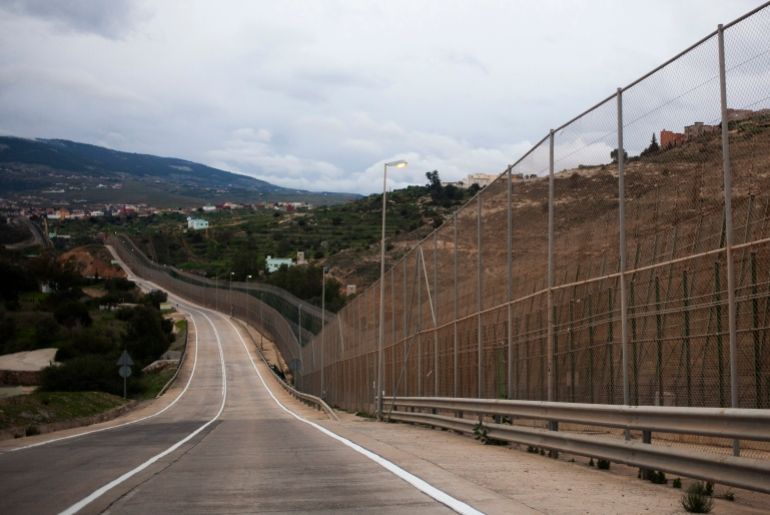 The fence separating Morocco and the Spanish enclave of Melilla
Amnesty International issued a statement saying it was deeply concerned by the events at the border.
“Although the migrants may have acted violently in their attempt to enter Melilla, when it comes to border control, not everything goes,” said Esteban Beltran, the director of Amnesty International Spain. “The human rights of migrants and refugees must be respected and situations like that seen cannot happen again.”
The International Organization for Migration (IOM) and United Nations refugee agency (UNHCR) also weighed in with a statement that expressed “profound sadness and concern” over what happened at the Morocco-Melilla border.
“IOM and UNHCR urge all authorities to prioritize the safety of migrants and refugees, refrain from the excessive use of force and uphold their human rights,” the organisations said.
The Spanish Commission for Refugees, CEAR, also decried what it described as “the indiscriminate use of violence to manage migration and control borders” and expressed concerns that the violence had prevented people who were eligible for international protection from reaching Spanish soil.
The Catholic Church in the southern Spanish city of Malaga meanwhile said “both Morocco and Spain have chosen to eliminate human dignity on our borders, maintaining that the arrival of migrants must be avoided at all costs and forgetting the lives that are torn apart along the way”.
Melilla and Ceuta, Spain’s other North African enclave, have the European Union’s only land borders on the African continent.
The mass crossing attempt on Friday was the first since Spain and Morocco mended relations after a year-long dispute related to Western Sahara, a former Spanish colony annexed by Morocco in 1976. The dispute had begun when Madrid allowed Brahim Ghali, leader of Western Sahara’s pro-independence Polisario Front, to be treated for COVID-19 in a Spanish hospital in April 2021.
Rabat wants Western Sahara to have autonomous status under Moroccan sovereignty, but the Polisario Front insists on a UN-supervised referendum on self-determination as agreed in a 1991 ceasefire deal.
A month after Spain allowed Ghali to be treated in a Spanish hospital, some 10,000 refugees and migrants surged across the Moroccan border into Spain’s Ceuta enclave as border guards purportedly looked the other way, in what was widely seen as a punitive gesture by Rabat.