

Lebanon, Israel reach ‘historic agreement’ on maritime borders
Lebanon and Israel have reached a “historic” deal to end a long-running maritime border dispute in the gas-rich Mediterranean Sea, according to negotiators from the two countries.
Lebanon’s deputy speaker Elias Bou Saab said on Wednesday, after submitting the United States-brokered final draft of the deal to President Michel Aoun, that an agreement had been reached that satisfies both sides.
“Lebanon has obtained its full rights, and all of its remarks have been taken into account,” said Bou Saab.
Lebanon’s presidency voiced hope that “the agreement on the demarcation will be announced as soon as possible”. Aoun had previously said that a deal would not signify a “partnership” with Israel. The two countries are technically at war.
Israeli National Security Adviser Eyal Hulata, who headed the Israeli negotiating team, mirrored Bou Saab’s remarks.
“All our demands were met, the changes that we asked for were corrected. We protected Israel’s security interests and are on our way to an historic agreement,” he said in a statement.
Meanwhile, Israeli Prime Minister Yair Lapid’s office hailed “an historic achievement that will strengthen Israel’s security”.
A signing date for the deal has not been set yet.
While limited in scope, an agreement may ease security and economic concerns between the two countries.
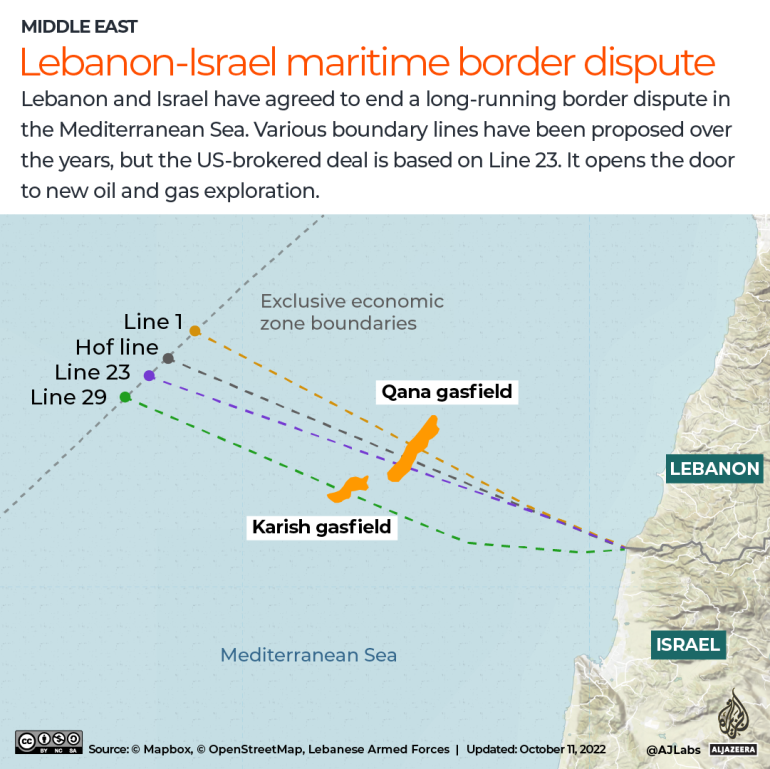
The deal would resolve a territorial dispute in the eastern tip of the Mediterranean Sea in an area where Lebanon aims to explore for natural gas, and near waters where Israel has already found commercially viable quantities of hydrocarbons.
Lebanon’s Energy Minister Walid Fayyad said Lebanese officials have “just passed the last step in making sure that this agreement is satisfactory for the Lebanese government”.
“We look forward to finalising this with the success and the opportunity it will open for Lebanon,” Fayyad told Al Jazeera.
The Lebanese minister added that the quantities of gas under Lebanon’s territorial waters are ones that “invite us to be optimistic”.
“The initial studies … [show that there are] trillions of cubic feet of gas, which would be sufficient for us for a number of years – up to 20 years of electric supply,” Fayyad said.
Lebanese requirements
Lebanon had previously had a number of concerns about the border. The first related to a borderline marked by buoys that was created by Israel as its forces withdrew from Lebanon in 2000. Beirut asked for language in the draft to be changed to avoid this becoming an international maritime border.
Secondly, Lebanon objected to the Qana gas field in a southern Lebanese exploration block extending into Israeli waters. The field is yet to be explored. And while Lebanon refuses to pay any profits from its share of that field to Israel, Israel says it may fall under its exclusive economic zone.
Finally, the Lebanese government wanted French oil giant TotalEnergies to work with it independently of any projects with Israel.
Al Jazeera’s Zeina Khodr, reporting from Lebanon’s capital, Beirut, said intermittent negotiations between the two sides have been taking place for more than a decade.
“But now Lebanon is in crisis and if it is able to start exploring and drilling [for gas reserves], it could have revenues from gas production to help it with its financial meltdown,” she added.
Khodr said that in the past, international companies refused to begin the exploration process over security concerns in the absence of a deal. “In fact today, a delegation from Total is in Beirut; they met the caretaker prime minister who told them to start immediately exploring and drilling the area once the maritime border deal comes into force,” Khodr said.
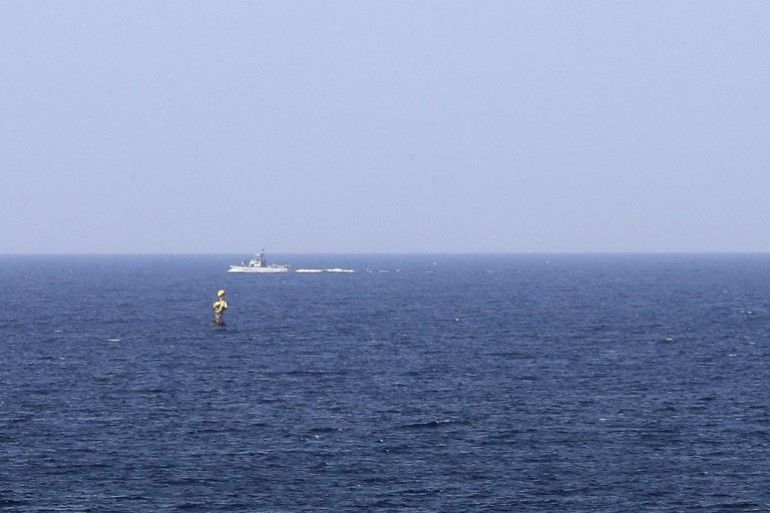 An Israeli military boat patrols Mediterranean waters off Lebanon
Officials from both countries were in close contact via US mediator Amos Hochstein over the past few days to resolve outstanding differences.
US President Joe Biden hailed the deal on Tuesday as a “historic breakthrough” in the Middle East.
“The agreement announced by both governments today will provide for the development of energy fields for the benefit of both countries, setting the stage for a more stable and prosperous region, and harnessing vital new energy resources for the world,” he said in a statement.
A major source of friction was the Karish gas field, which Israel insisted fell entirely within its waters and was not a subject of negotiation.
The US text has not been made public but under terms leaked to the press all of the Karish field would fall under Israeli control, while Qana would be divided but its exploitation would be under Lebanon’s control. Total would be licensed to search for gas in the Qana field, and Israel would receive a share of future revenues.
Bou Saab said Lebanon will “get its full rights from the Qana field”, and Israel might receive compensation through Total. There will be no direct partnership in gas exploration or exploitation between the two enemy states, he said.
On Sunday, London-listed firm Energean began testing the pipeline linking Karish to the Israeli coast, a key step before production can begin. Israel has said production would begin at Karish as soon as possible, regardless of Lebanon’s demands.
Hezbollah, a Lebanese political party backed by Iran, has threatened to use force against Israel should the country explore for gas near the disputed area before Lebanon is allowed to do so.
“This is the first time any sort of agreement between these two countries has been reached,” said Al Jazeera’s Bernard Smith, reporting from West Jerusalem.
Smith added that Israel will hold a security cabinet meeting on Wednesday, and then the proposed deal will go to the high court.
“Then Israel’s Knesset has to give the final rubber stamp to it,” he said. “They want to do all of this before Israel’s elections on November 1, but there’s no guarantee that it will happen before then.”